Tag Archives: Gerd Kanter

Gerd Kanter’s Gold Medal Discus Technique: Part 4

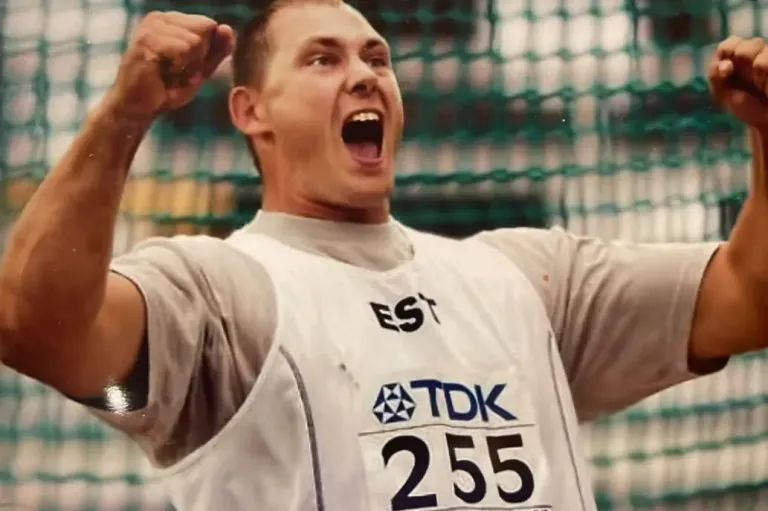
With eleven career medals in international championships, Gerd Kanter had lots of reasons to celebrate

One of history’s great discus throwers, Gerd Kanter was also a successful coach, guiding Kristjan Čeh to World Championship gold in ’22 and silver in ’23. Gerd has agreed to analyze his own technique, step by step, for readers of McThrows.

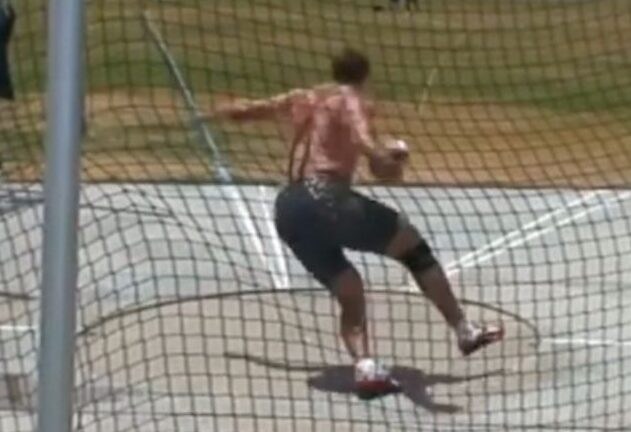
Compared to some other successful throwers, it is not so wide. This might have been due to the angle of my left foot. Early in my career, we  tried to get my left foot pointing in the direction of the throw as I began my sprint, but that never quite worked for me. Turning my left foot more may have allowed me to achieve a greater radius with my right leg, but it made it harder for me to feel torque between my shoulders and hips.

So I would stop my left foot at the angle you see in this picture, and try to sweep my right foot just outside the rim of the ring while keeping a strong left hip. This combination allowed me to create maximum speed and power during my sprint phase. 

This is another cue to help achieve a balanced position through the entry phase. Strong left hip. Discus behind the right hip. Left arm level.


Sign up for the McThrows newsletter to receive emailed notices about future articles by Gerd and other McThrows contributors. In the meantime, check out his book, Gerd Kanter: Five Championship Moments to learn more about Gerd’s fantastic career.

Gerd Kanter’s Gold Medal Discus Technique: Part 3

With eleven career medals in international championships, Gerd Kanter had lots of reasons to celebrate.

One of history’s great discus throwers, Gerd Kanter was also a successful coach, guiding Kristjan Čeh to World Championship gold in ’22 and silver in ’23. Gerd has agreed to analyze his own technique, step by step, for readers of McThrows.

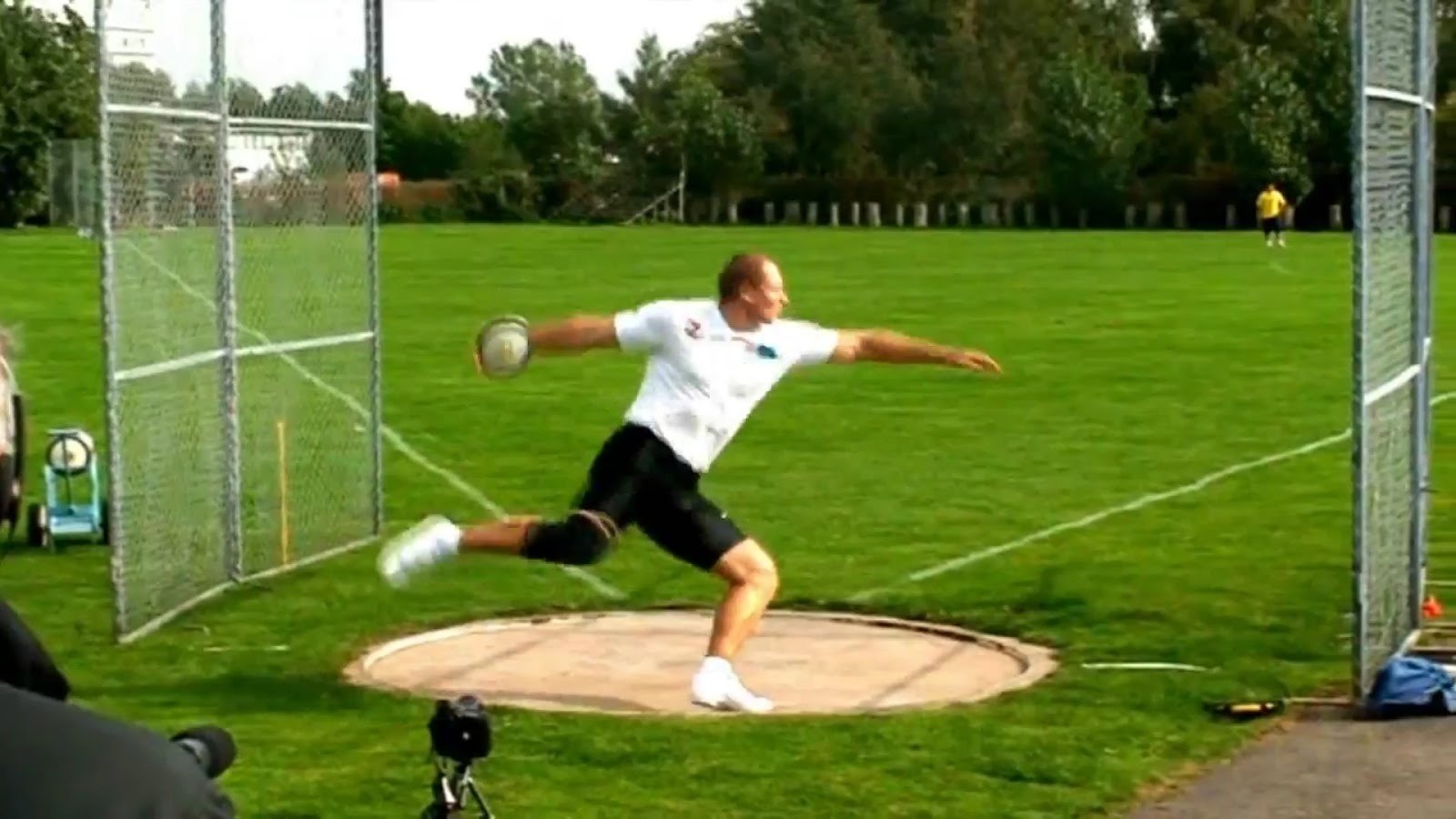
You must feel control of the entire system as the right foot leaves the ground. The upper body must remain slow and passive, and the left hip must remain strong with no breaking!

First, let’s review how we get to this point in the throw.

In Part 1 of this series, I explained the importance of a smooth, balanced windup.

As you see in the photo above, I tried to stay upright while swinging the discus behind me. My weight did not shift during this phase of the throw, and my left foot maintained a solid connection with the ground.

In Part 2 of this series, I emphasized the need to be strong with both hips when beginning the throw.

Of course, the weight must shift to the left in the position you see above, but we do not want the right knee and hip to turn as the left foot and leg open.

A cue that I used was to keep the right heel on the ground as long as possible as the left foot and knee turned so that when it did finally come off, the trajectory of the right leg would be out and around the left side as you see in the photos below…

At this point, I am on balance and in good shape to achieve a wide right leg sweep and to push off my left knee as I start to sprint through the ring.

Next time, I will explain the sprint to the middle!

Sign up for the McThrows newsletter to receive emailed notices about future articles by Gerd and other McThrows contributors. In the meantime, check out his book, Gerd Kanter: Five Championship Moments to learn more about Gerd’s fantastic career.

Gerd Kanter’s Gold Medal Discus Technique: Part 2

With eleven career medals in international championships, Gerd Kanter had lots of reasons to celebrate.

One of history’s great discus throwers, Gerd Kanter was also a hell of a coach, guiding Kristjan Čeh to World Championship gold in ’22 and silver in ’23. Once a month, he will analyze a different phase of his technique for readers of McThrows.

As I explained earlier, it was very important for me to stay balanced and level during my windup, with no shifting of my weight and no leaning forward or backward. Now, in this photo, I am trying to maintain that balance and posture as I begin the throw.

That way, I could keep both of my hips loaded as I began turning to the left to set up for the sprint across the ring. Early in my career, I had a tendency to shift my weight too much to the left during this moment, which caused my left hip to “break” or collapse as I began my right leg sweep. The breaking of the left hip made it impossible to achieve a balanced entry, so we worked hard to correct it. Keeping both hips strong and loaded as long as possible allowed the right side of my body to travel out and around my left side on balance, as you will see in the upcoming frames.

Another important cue for me at this point in the throw was to keep my left arm calm and passive. As you can see, my left foot and leg are ahead of my left arm as I begin to open my left side. When I started out, I often used my left arm aggressively to try to create momentum at this phase of the throw, which aggravated my tendency to “break” my left hip. 

We spent a lot of time working on this part of the throw, because if you give up your balance here, it is game over. You cannot regain it and the throw will be wasted.

Next month, Gerd will examine the next step to setting up a successful entry. In the meantime, check out his book, Gerd Kanter: Five Championship Moments to learn more about his fantastic career.

Discus Days with Gerd Kanter

No male discus thrower has won more international championship medals than the eleven Gerd collected during his long and storied career. Now, for readers of McThrows, Gerd has agreed to share memories, opinions, and observations on the sport in a monthly feature called Discus Days. In this month’s edition, Gerd talks about Daniel Ståhl’s remarkable victory at the World Championships in Tokyo,

If he made that throw at a place like Ramona, it might have been 77 or 78 meters. And Daniel did it under the pressure of trying to win a World Championships.

This performance reminds me of what Al Oerter did in the 1968 Olympic Games when Jay Silvester—who set the World Record of 68.40m earlier in the season—probably should have won. But it rained that night in Mexico City, and Silvester only threw 61.78m, while Al Oerter took the gold with a PB of 64.78m.

Al Oerter was always prepared for any conditions, and he probably knew when it was raining for the final that it gave him his chance to win.

It was the same with Daniel in Tokyo. You saw how he acted during the competition. Daniel looked happy and comfortable, and that was half the battle. 

During his own career, Vésteinn beat Lars Riedel one time, and it was because Vésteinn was ready to throw in the rain and Lars wasn’t. Vésteinn used to have a shoemaker who would take the soles off a pair of throwing shoes and replace them with a material that gave a firmer grip, so he was able to keep his balance while Lars fell on his ass.

I don’t know what shoes Daniel used in Tokyo, but for sure he was prepared, and that is how it is supposed to be when you are a professional. I liked to have a couple of different types of rain shoes, one with the hard plastic plate removed and soles made out of stickier material. In another pair, I would leave the hard plate in but still have the soles changed to the grippier rubber. In a dry ring, you would not be able to spin in those shoes, but in the rain they gave you a lot of traction.

When we were preparing for the 2005 World Championships in Helsinki, we knew the ring there could be slippery if it rained, so I had some fresh shoes prepared. It turned out that the weather was fine, and I got silver by throwing 68.57m in my normal Nikes. But the shoemaker I used spoke to the press and bragged that his special shoes were the reason I took a medal. The people from Nike did not like that. A few days later I received a package from the Nike dealer in Estonia. It was a pair of Nikes in a glass box with a note that said, “Maybe there was some help from us, also?”

While it is the responsibility of the athlete to always be prepared, I do think that World Athletics should do a better job of requiring a standard throwing surface for championship events. It is quite possible to make a surface that is fast in dry weather—the way many throwers prefer it—but that also has some traction in the rain. World Athletics should develop specifications for that kind of surface and inspect the facilities before championships to be sure they meet the requirements. That would help prevent competitions like the shot put at last year’s Paris Olympics and the men’s discus in Tokyo where safety became a big issue.

In the meantime though, congratulations to Daniel, Mykolas Alekna, and Alex Rose for reaching the podium under very difficult conditions.

We’ll publish another piece by Gerd next month. In the meantime, check out his book, Gerd Kanter: Five Championship Moments to learn more about his fantastic career.

Gerd Kanter breaks down his gold medal discus technique: Part 1

With eleven career medals in international championships, Gerd Kanter had lots of reasons to celebrate.

One of history’s great discus throwers, Gerd Kanter was also a hell of a coach, guiding Kristjan Čeh to World Championship gold in ’22 and silver in ’23. Once a month, he will analyze a different phase of his technique for readers of McThrows.

The Windup

I started working with Vésteinn Hafsteinsson not long after the 2000 Olympics where the three medalists—Virgilijus, Lars Riedel, and Franz Kruger—were all taller than me with longer wingspans. In order to compete with guys like that, we experimented with ways to maximize my path of acceleration. A German discus thrower from the 1960’s and 1970’s named Hein-Direck Neu had done this by setting up with his right foot well back from the ring during his windup.

For a while, we tried a similar starting position with my right foot set back maybe 40 centimeters, and biomechanical analysis showed that it helped me to create more power and speed on the implement. But it was hard for me to consistently achieve a balanced entry from this position, so we returned my feet to a normal starting position and settled for using a long windup in the style of Mac Wilkins.

With this windup, I improved my PB by ten meters between 2000 and 2004. Unfortunately, I was rarely able to produce a big throw under the pressure of a major competition such as the World Championships or Olympic Games. After I failed to advance beyond qualification at the 2004 Olympics, we knew that if I was ever going to compete for a medal I had to solidify my technique so that I could throw at least 65 meters under any circumstance.

In order to stay on balance when the right foot leaves the ground, the left hip must remain strong. You’ll see how this works as we progress through the throw over time.

The first and most important step in correcting my tendency to “break” my left hip was adjusting my windup so that I would stay perfectly on balance at the start of the throw. Rather than shifting my weight to my right leg and swinging the discus back as far as possible as Mac Wilkins had done, I would simply sit down into a half squat with my upper body erect and put the discus directly behind me as you see in the picture. We also limited the movement of my left foot during my swing. As you can also see from the illustration, my left foot and right arm are at the same angle at the end of my swing and the left heel is fairly low to the ground. This made it much easier to stay on balance and transition smoothly into the throw.

Another advantage to this shorter windup was that it helped me to feel relaxed and coiled like a loaded spring. When I put the disc back and felt tension in the adductor muscles of both legs, I knew I was ready to begin the throw.

Going for the longest path of acceleration made it difficult for me to consistently enter the throw on balance, and once you lose your balance at the start of a throw it is almost impossible to regain it. There is simply no time. The throw plays out too quickly.

And it turned out I did not need to achieve the maximum path of acceleration in order to throw far. I was fast and explosive enough so that I could generate plenty of power with a short windup–as long as I maintained my balance. 

Next month, Gerd will examine his approach to setting up a successful entry. In the meantime, check out his book, Gerd Kanter: Five Championship Moments to learn more about his fantastic career.