

One of history’s great discus throwers, Gerd Kanter was also a hell of a coach, guiding Kristjan Čeh to World Championship gold in ’22 and silver in ’23. Once a month, he will analyze a different phase of his technique for readers of McThrows.
The Windup
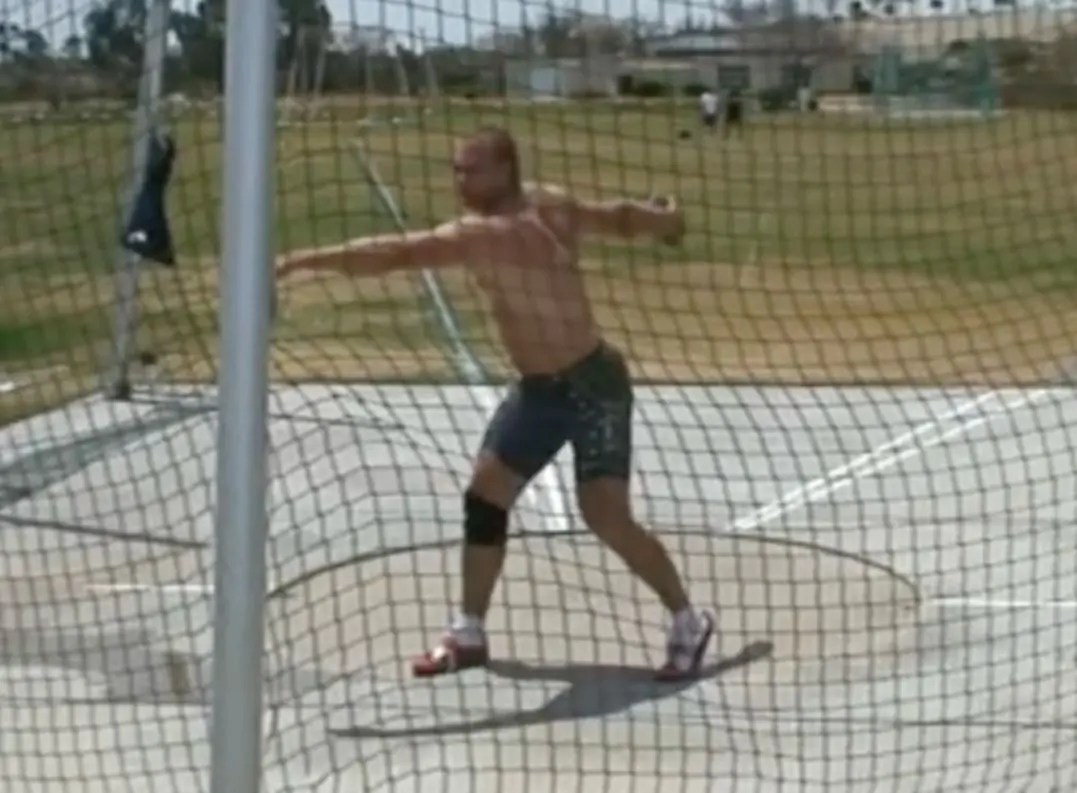
I started working with Vésteinn Hafsteinsson not long after the 2000 Olympics where the three medalists—Virgilijus, Lars Riedel, and Franz Kruger—were all taller than me with longer wingspans. In order to compete with guys like that, we experimented with ways to maximize my path of acceleration. A German discus thrower from the 1960’s and 1970’s named Hein-Direck Neu had done this by setting up with his right foot well back from the ring during his windup.
For a while, we tried a similar starting position with my right foot set back maybe 40 centimeters, and biomechanical analysis showed that it helped me to create more power and speed on the implement. But it was hard for me to consistently achieve a balanced entry from this position, so we returned my feet to a normal starting position and settled for using a long windup in the style of Mac Wilkins.
With this windup, I improved my PB by ten meters between 2000 and 2004. Unfortunately, I was rarely able to produce a big throw under the pressure of a major competition such as the World Championships or Olympic Games. After I failed to advance beyond qualification at the 2004 Olympics, we knew that if I was ever going to compete for a medal I had to solidify my technique so that I could throw at least 65 meters under any circumstance.
The biggest flaw that was holding me back
was my tendency to “break” my left hip as
I began my right leg sweep.
In order to stay on balance when the right foot leaves the ground, the left hip must remain strong. You’ll see how this works as we progress through the throw over time.
The first and most important step in correcting my tendency to “break” my left hip was adjusting my windup so that I would stay perfectly on balance at the start of the throw. Rather than shifting my weight to my right leg and swinging the discus back as far as possible as Mac Wilkins had done, I would simply sit down into a half squat with my upper body erect and put the discus directly behind me as you see in the picture. We also limited the movement of my left foot during my swing. As you can also see from the illustration, my left foot and right arm are at the same angle at the end of my swing and the left heel is fairly low to the ground. This made it much easier to stay on balance and transition smoothly into the throw.
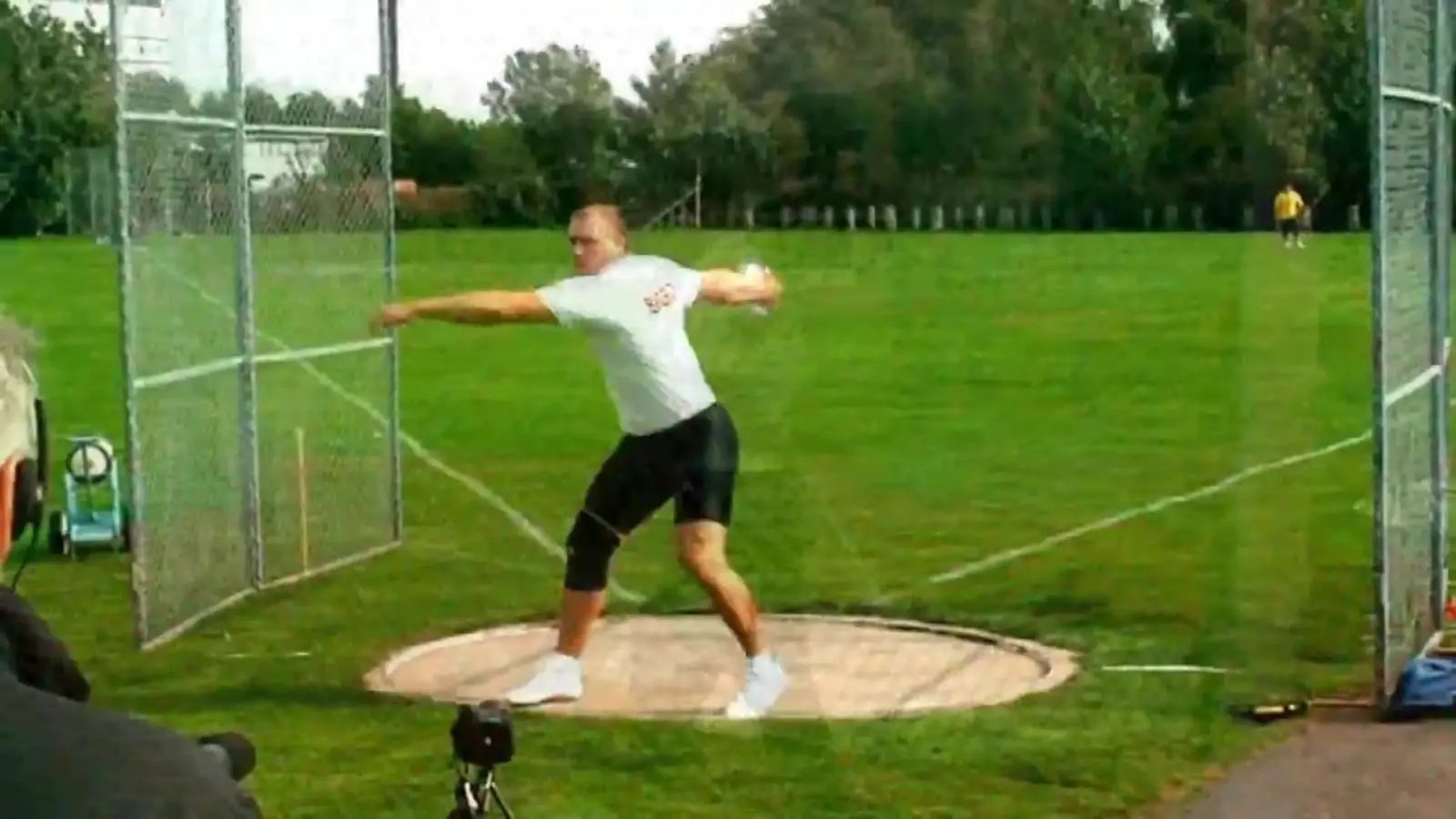
Another advantage to this shorter windup was that it helped me to feel relaxed and coiled like a loaded spring. When I put the disc back and felt tension in the adductor muscles of both legs, I knew I was ready to begin the throw.
Did this windup limit my path of
acceleration a bit? Yes, but for me it was worth the tradeoff.
Going for the longest path of acceleration made it difficult for me to consistently enter the throw on balance, and once you lose your balance at the start of a throw it is almost impossible to regain it. There is simply no time. The throw plays out too quickly.
And it turned out I did not need to achieve the maximum path of acceleration in order to throw far. I was fast and explosive enough so that I could generate plenty of power with a short windup–as long as I maintained my balance.
Next month, Gerd will examine his approach to setting up a successful entry. In the meantime, check out his book, Gerd Kanter: Five Championship Moments to learn more about his fantastic career.

About The Author
