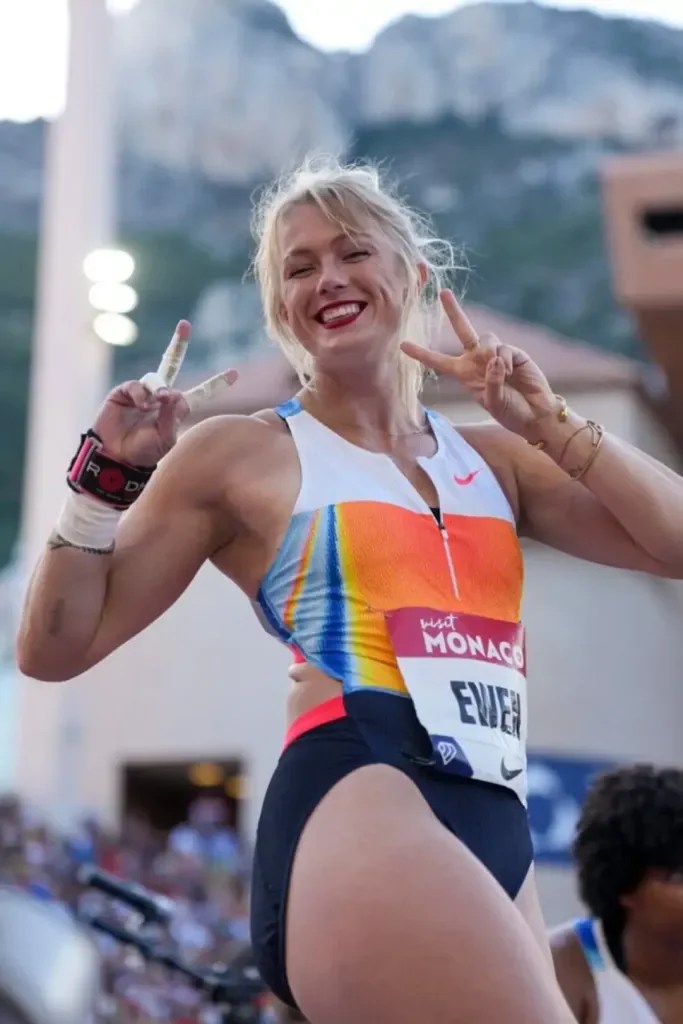
World class putter Maggie Ewen will be filing monthly reports as she travels the world plying her trade. In this piece, Maggie gives McThrows readers insight into life on the road as a professional putter.
If you’re a fan of the professional circuit, I’m betting you’ve noticed throwers always seem to be traveling. Sometimes even multiple countries and competitions within the span of a week. It’s true the life of a professional athlete is filled with travel. That’s because there’s simply more opportunity outside of the United States. Meets are contested more frequently in Europe and there is greater general appreciation for track and field overseas. Even a relatively small throws only meet will have a packed stadium. The pay is better in Europe as well. So, yeah, we want to be over there as much as possible!
I’ve been a professional thrower for eight years and the travel aspect was definitely a learning curve.
But I’m accustomed to the system now. I’d like to give you a snapshot of that system in the hopes you’ll get a better picture of our lives on the road as professional throwers. Most athletes will have a system that looks very similar but as with all things, there are outliers. With that being said, lets get into it!
The first thing you need to know is that most meets will not host a full program. They’ll cherry pick the events they want and the genders they want competing in those events. At that point it’s my job to look through all the meets that will be contested through the year to find the ones that will have women’s shot put. I make a list of the meets I would like to compete in and hand that to my agent. Our agents have many important jobs but I’d argue reaching out to meet directors is the most important. Our agents are our advocates. They approach meet directors and discuss why their athlete should receive an invite to the meet. Most of the time it’s a quick and easy process. Other times, the meet director may wait until just a couple days before the meet to extend the invite. Needless to say, we athletes have learned to stay ready for anything.
Once my agent informs me I have been successfully invited to a meet, I will book travel. Typically, I try to set up a meet schedule that allows me to hit a couple meets while I’m overseas with minimal down time between meets. So, it’s a lot of multi-city flights and (once I’m in Europe) checking if it’s cheaper to book a flight, a train or a rental car to get to my next destination. I’m like my own travel agent. Most athletes have their agents handle this part but I’ve found I prefer to do it myself. When the trip is fully booked, I send the itinerary to my agent who will forward it to the meet organizers.
They send the travel itinerary for three reasons. First, so the meet knows how much to reimburse me for the travel. If I went over the travel stipend they offered, I don’t get reimbursed for the remaining portion. So it’s good to stay on budget. Second, so they know when and at which airport I will be arriving. That allows them to send a driver to pick me up from the airport. Third, so the meet organizers know how many nights I will need to stay at the meet hotel. This is the hotel where they will house and feed all of the athletes for the duration of their stay. It’s fairly standard that they will offer one or two nights before the meet and one or two nights after the meet. If I want or need to stay longer than that, I book my own accommodations out of pocket.
Since all athletes are held to this same standard. We tend to unintentionally show up at the airport at the same time. When I leave baggage claim I scan the airport for someone holding a sign with the name of the meet or a desk set up that has the name of the meet plastered all around it. That is where the arriving athletes, coaches and medical staff congregate. Once everyone is accounted for, they throw us into a car, a sprinter van or a bus depending on how big the group is and shuttle us to the meet hotel.
Once at the hotel, we find the meet desk located in the lobby. This is like the central hub for the rest of my stay. If I ever have a question, need something, have to get my bibs, etcetera…this is where I will go. At this desk will also be a huge board with all the information we need. Shuttle times to and from the track, when and where meals will be held, medical sign up sheets, start lists, really just everything pertinent to our stay. So once I arrive at this desk I will check in and receive my room key for the hotel. It’s important at this stage to ask who my roommate is. Unless athletes request someone specific ahead of time, roommates are assigned at random. They keep the genders separate but they’ll mix up events and nationalities. All in all, this system works fine but it can get tricky if your roommate doesn’t speak the same language. Personally, I like to coordinate with a fellow athlete and request my roommate ahead of time. I’ve found it’s just more comforting to stay with friends rather than strangers while I’m getting ready to compete.
Once settled in my room, I make myself at home for a couple days. Eat complimentary meals at the hotel, use the provided shuttles to get to and from the track, shake out, do workout at the stadium if that’s available and generally just chill until the competition. It’s a lot of down time but that’s important to keep the body ready for the big day. Competition day isn’t much different. Breakfast, small shakeout in the hotel gym, shuttle to the track, call room, compete and shuttle back.
Back at the hotel is when we can finally breathe again after the work is done.
Since, shot put is usually the first event contested, the throwers get back to the hotel hours before dinner is ready to be served. So, we’ve gotten into the habit of treating ourselves to a little meal instead of waiting. One of my favorite post meet dinners is from last year. After the Diamond League meeting in Monaco, Chase Jackson, Sarah Mitton, Jaida Ross (my roommate for this meet) and myself went to dinner. At this point in the season we were all a little homesick and craving something familiar. So, naturally, we got a round of cheese burgers and they were perfect! We ate, laughed, reflected on the meet and just had an overall great time.
Chase Jackson, Jaida Ross, Sarah Mitton, and Maggie chopping it up in Monaco. Pic courtesy of Maggie.
It’s moments like this that make us close not only as competitors but as friends. Being on the road constantly can be lonely. But no one knows the grind better than your competitor who’s going through the same thing. At a certain point, it’s hard not to befriend each other and we find ourselves helping each other through the tough times, the boredom of hotel life and homesickness we all eventually go through.
So now it’s the evening of the competition. It’s not unusual for people to leave for the airport or train station at this time. I usually book my travel for the morning after in case the meet runs long. So bright eyed and bushy tailed at usually around 4am the following morning, I will load back into a shuttle bound for the airport. Am I going home? Am I going straight to my next meet? Am I going to a training camp because there’s too much time before my next meet and they won’t pay for my housing that long? It all depends on the schedule I set up at the top of the season. But the process always stays the same.
The one thing I can guarantee is that I’m not going on vacation.
We travel to compete. It’s a bunch of work trips. It’s not the glamorous travel-and-explore-a-country that you may think it is. We see very little aside from airports, hotels and stadiums. However, it’s an opportunity unlike any other, and I wouldn’t trade it for anything.
This is part one of a monthly series in which Maggie Ewen, one of America’s top putters, will break down her technique step by step.
Hello! This is six-time World Shotput Finalist, Maggie Ewen.
Over the course of the year, I’ll be sharing a frame-by-frame breakdown of my throw. I’ll analyze each phase from the starting position to the reverse. Follow along for a detailed technical analysis designed to help you understand my throw!
The throw I chose to break down is my final attempt at the 2025 Royal City Inferno Track and Field Festival in Guelph, Ontario. I don’t remember the exact distance, but I believe it was around 19.60m. Clearly, not my furthest performance but I felt this was the best technical example of my throw. There are still pieces of it I will inevitably point out as needing improvement, but that’s throwing! It’s near impossible to have a throw where every little piece was perfectly executed.
Position 1
We will start at the setup. At this point, I am focusing on locking my upper body into the position I want to hold through the throw. You may notice that from the hip hinge up, my posture is the same as it would be during a stand throw. I aim to reduce unnecessary movement through the throw (aka introducing more variables that could go wrong) by locking the upper body into this position and trying to hold it steady. This allows me to focus primarily on the lower body as I move through the throw.
The right elbow is up and I am actively pressing the shot into my neck. The left arm is straight ahead, relative to my torso. My weight is balanced 50/50 between the right and left. My legs are not overly bent. This will allow me to go down into the middle during my zero support phase (I will discuss this in greater detail when we reach this phase). My foot placement is just wider than shoulder width keeping it comfortable and athletic. Finally, I am already beginning to engage the left glute in preparation to move into single support.
My rhythmic mindset at this point is slow and steady.
I’m going to let the momentum build throughout the course of the throw, so I don’t need to move quickly into the next phase.
Tune in next time to learn about how I initiate the turn.
Maggie Ewen is one of the greatest putters the United States has produced.
World class putter Maggie Ewen will be filing monthly reports as she travels the world plying her trade. In this piece, Maggie reflects on her journey from beginner to NCAA and US champion under the tutelage of some outstanding coaches.
As is common in the US, Maggie was introduced to putting by her father and her high school coach. Bruce Ewen in on the left. Mark Hanson is on the right.
Since this is the first week of discussing my throw, I wanted to briefly elaborate on my journey into the athlete I am today.
My first coach was my father.
That began in middle school when my sister joined the track team. Like any little sister, I wanted to be just like my older sister. So, when my father offered to help coach her in the discus, I always tagged along. She eventually switched her focus to the track, but I was hooked.
My father and I continued to train every chance we got. That wasn’t because my dad was a strict coach. I simply always wanted to be throwing. He made sure to keep practices fun and to really foster my love for the sport. We primarily focused on big concepts (not detail work) and really dialing in the fundamentals.
In seventh grade, I made the varsity team. My dad was still my primary coach, but my high-school coach, Mark Hanson, also played a big role in my development at the time. He was immensely supportive and understanding of the dynamic between my father and I, which, unfortunately, I’ve since learned can be a rare situation. Too many people let their egos get in the way instead of doing what’s best for the athlete. My father and Hanson never had that problem. They often worked in unison to assure I was given the guidance and support I needed.
Before I left for college, my dad gave me a piece of advice that would shape my entire college career.
He said (and I paraphrase) “Dumble is your coach now. His word is law. If he tells you something that contradicts what I taught you, he is right and I am wrong. You have to fully commit to his style.” With that, I left for Arizona State to work with my new coach, David Dumble.
Dave Dumble introduced Maggie to the world of NCAA throwing.
Dumble regularly redshirted his freshman in order to allow them a full year to adapt to his approach and the college system as a whole. I was no exception. In that time of immense change, Dumble was the best coach I could have asked for. His immense positivity and passion for the throws helped me settle into the next chapter of my development.
Over the next three years, Dumble built up my shot put and discus and taught me how to throw the hammer. This is also the time that I learned about the importance of the weight room and of taking care of my body in the training room. Overall, I think my time with Dumble opened my eyes to how to be an elite athlete inside and outside of the ring.
Brian Blutreich took over after Dave Dumble at ASU. Adapting to his style was a challenging and ultimately successful process for Maggie.
With two competitive years remaining in my college career, Dumble left for Oregon State. I was given the opportunity to transfer but the head Coach of the time, Gregory Kraft, assured me I’d like who they were bringing in. I put my faith in him, and Brian Blutreich became my coach. When this happened I was reminded of my father’s advice. I appreciated everything I’d learned from Dumble, but now Blutreich’s word is law.
It was a huge learning curve, and we had no time to waste. Blutreich’s coaching style was much more straightforward and intense than what I had known with my father or Dumble. He set high standards for himself and his athletes. At the time, this was exactly what I needed. A no-nonsense coach who pushed me to keep raising my own standards and setting higher goals. While he continued to improve my shot, discus and hammer techniques, he also helped me to grow mentally and emotionally within the sport.
Blutreich taught me about mindset at practice vs competition, dealing with nerves, and handling pressure.
It’s undeniable that I learned a lot in the ring. However, I don’t feel like I’d be the same athlete today without the mental strength he helped me develop.
Kyle Long has guided Maggie’s career since 2019.
Once I graduated college, I began working with Kyle Long, who was Blutreich’s assistant coach. This was primarily because as a college coach, the collegiates were Blutreich’s priority. I did not fault him for that. He had a couple of massive talents like Sam Noennig and Turner Washington at the time. So his hands were definitely full. As the assistant coach, Kyle taught the same technique while having the time and flexibility to work with me more consistently.
Our dynamic has changed over the seven years we’ve worked together. Initially, while I still had a lot to learn, we functioned in a standard coach/athlete dynamic. He told me what to do, and I did it. Over time, we have transitioned into a more collaborative coach/athlete dynamic. He respects my opinions and suggestions as much as I respect his knowledge and guidance.
Looking back, I don’t believe I would have changed my journey at all.
Each coach gave me what I needed at the time I needed it. My dad instilled me with a love for the sport and excellent fundamentals. David Dumble enlightened me to all that goes on outside of the ring that is necessary to being an elite athlete. Brian Blutreich improved my technical knowledge while simultaneously improving my mental strength. Kyle Long continues to guide and support me during my professional career. Their combined guidance built me into the athlete I am today, and I am forever grateful.
The 2026 A-Z Clinic, presented by Throw Big Throw Far Chicago will take place at Wheaton North High School in the suburbs of Chicago on Sunday, January 25th from 9am to 1pm. Small group instruction will be offered in discus and shot put technique.
The A-Z is a great opportunity for athletes to receive instruction from top area coaches in a small group, learn-by-doing environment.
Coaches are also encouraged to sign up and attend to observe and film their athletes as they go through drills and take throws with indoor shots and discus training balls.
The cost of the clinic is $75 for those paying in advance, $100 at the door. Follow the QR code on the photo below to register.
Here’s part two of our 2025 NCAA Indoor Championships throws preview. Thanks to Pat Trofimuk for his obsession with statistics and his sage advice.
Women’s Shot Put
Saturday, March 15, 1:45pm EST
Colorado State’s Mya Lesnar took the title in Boston last year with a toss of 18.53m. It will take more than that to win in Virginia Beach, with two ladies in particular likely to push the winning mark over 19 meters.
The first is Nebraska’s Axelina Johansson, who appears to be finding her form at the right time. After a sensational 2023 season during which she surpassed 19 meters on four occasions including a best of 19.54m, the affable Swede topped out at 18.97m in 2024. But, two weeks ago at the Big 10 Championships, she flashed her 2023 stuff while hitting 19.31m for the win. As a former NCAA outdoor champ and Olympic and World Championships finalist, Axelina is at a point in her career where she should thrive under the pressure of a big comp. That will make her hard to beat on Saturday.
If anyone can do it, it’s likely to be Houston’s KeAyla Dove, whose 2025 season has been the kind of roller coaster ride that might make you cough up your funnel cake. She opened with a toss of 16.15m, hit 19.46m on Valentine’s Day, and has gone 18.20m and 18.28m in her two meets since.
But at this point in her career, KeAyla has plenty of experience navigating the ups and downs of her sport. Recruited out of high school to Sam Houston State by Coach Jon Tipton, KeAyla has since competed for three different schools in five different conferences.
She followed Coach Tipton when he took a job at North Texas State after the 2022 season and pushed her PB to 18.95m her first spring in Denton. Unfortunately, Coach Tipton quickly found that North Texas was not a good fit for him, and once again moved on.
KeAyla stayed, but did not thrive in Tipton’s absence, and after a rocky indoor season, the Mean Green staff encouraged her to enter the transfer portal. She did not have to be asked twice, and left North Texas without a firm destination in mind.
Luckily, Tipton was hired last summer by the University of Houston, and KeAyla was able to join him there.
The slow start to this indoor season was part of a careful plan to revive KeAyla’s career. “The first couple meets,” says Tipton, “were all about modeling our process. Our pre-meet routine, how we would go through warmups, how we’d handle prelims. That kind of thing. So, we didn’t care about distance. And the big thing was, we wanted KeAyla to enjoy throwing again. She’d lost that for a while.”
Tipton knew KeAyla had a big throw in her after seeing her push the 6k ball to 50 feet in training. Everything clicked at the Howie Ryan Invitational, and the result was a 51-centimeter PB.
The dropoff to 18.20m and 18.28m in the ensuing weeks can be attributed to a lack of stability in KeAyla’s technique, which is still in the developmental phase. In competition, she sometimes switches between a traditional and static start, and a reverse and non-reverse finish.
But, according to Tipton, “KeAyla is a Ferrari. Everyday, it’s about balancing the needle. A biomechanist here in Houston told her not long ago that she is physically capable of throwing 20 meters.”
If she can get anywhere close to that in Virginia Beach, she may walk away with her first NCAA title, which would be a nice step towards what she and Coach Tipton hope will be a long and successful pro career once her eligibility runs out this spring.
Another intriguing candidate for the top of the podium is defending outdoor champ Jaida Ross of Oregon. In 2024, Jaida was under 19 meters in every indoor comp, including NCAA’s where she finished second to Lesnar with a best of 18.47m. Then in April, she threw 19.71m at two different meets. In May, she broke 20 meters, then hit 19.60m at the Trials to make the team for Paris where she missed a medal by 4 centimeters.
With a World Championships coming this September, Jaida and her coach, Brian Blutreich, seem to be following the same plan that worked so well in 2024. Thus far in 2025, Jaida has a best of 18.47m. Is she capable of reaching the mid-19’s and grabbing the title in Virginia Beach? Absolutely. But with her eyes firmly focused on repeating outdoors, making the team for Tokyo, and fighting for her first international medal, don’t expect her to be in peak form this early in what promises to be a very long season.
And I do not mean to count out the defending champ. Mya Lesnar hit a season’s best 19.02m at the Mountain West Championships, and can certainly go farther on Saturday. Axelina, KeAyla, and Jaida all have PB’s significantly better than Mya’s 19.10m from 2024, but that did not stop Mya from winning in Boston. If it takes something closer to 19.00m than 19.50m to win, she could be in the mix.
My thrower to keep an eye on for the future is Koko Odeluga of Ol’ Miss, last year’s World U20 champ. Her best so far this season is 18.37m, but her coach is the Yoda of peaking, and she tossed a PB at last year’s Olympic Trials, so she won’t be wilting under the spotlight in Virginia Beach. She also has a super aggressive technique that is very fun to watch.
Men’s Shot Put
Saturday, March 15, 5:00pm EST
Trof and I like drama as much as the next guy. He even gets up at an ungodly hour many Sundays to get his Formula 1 fix, a habit that I find strange considering that you can stream Talladega Nights any time you want.
But we both agree that it is well within Tarik Robinson-O’Hagan’s power to end this thing on his first attempt Saturday. He’s the defending indoor and outdoor NCAA champ. He’s thrown over 21 meters twice in 2025. He’s been killing it in the weight room and in training with the off-weight shots. His coach is a dead ringer for Andy Reid. What else does a guy need?
Cincinnati’s Fred Moudani-Likbi is the only other putter over 20.50m so far this season. He’s also the only member of the field who can cuss in French, which can be an overlooked advantage. He lost his 2024 season to a lifting injury, but according to Coach Susan Seaton (who guided Annette Echikunwoke to hammer silver in Paris) kept “an amazingly positive mindset” while rehabbing.
Fred was able to come back and hit some lifting maxes this January, and according to Seaton his main focus lately is reviving his feel for the implement. In February, he found a nice groove at the Music City Invite where he put 20.62m to finish second in a duel with Tarik.
He dropped off to 19.12m at the Big 12 Championships, where Seaton says he probably put too much pressure on himself. The 20.62m would have been a French indoor record, but his federation wouldn’t certify it because of various technical details, so he was gunning for a big one at Big 12’s and got a little tight.
“Once you get into the mindset of focusing on the result,” she explained, “it is hard to get back to focusing on what is happening inside the circle. But one good thing with successful athletes is they are good communicators. They find ways to remain coachable. Fred is one of those people, and we’ve had some good conversations about this experience. He felt bad to let the team down at the Big 12’s, but I told him maybe it will turn out to be a good thing if it helps us have a better mental strategy at NCAA’s and you can focus on what you can control and not distances, marks, and placing, which you can’t really control. Hopefully, he can just focus on what happens in the ring and making a nice throw.”
Seaton also shared her experience with Annette at the 2024 Olympic Trials, which she says was more stressful than the Olympics. They were staying at an Airbnb in Eugene, and the morning of the final Annette was astonished to find her coach calmly watching the European Soccer Championships on her phone. “She was like, ‘Coach, I’m really nervous!’, and I said, ‘I know,’ but I just kept watching soccer and she finally said, ‘Coach, how can you keep watching soccer!?’”
Seaton reminded her that it would be another six hours before they headed to the track, and there was no point in driving themselves crazy with worry in the meantime.
“I said, ‘What are we doing today?’ She said, ‘Throwing hammer.’ I said, ‘What do we do every day? Throw hammer, right? So how hard can it be? You know the people in your life who love you and are proud of you. They will love you no matter what. And who cares what anyone else thinks? So, let’s not worry and just watch some soccer.’”
Assuming Fred takes his coach’s advice, he’ll be the guy pushing Tarik.
Next on the season’s best list is Thomas Kitchell from North Carolina, who hit an SB of 20.47m in February. Thomas transferred from Wake Forest last fall, and his coach Amin Nikfar was happy to get him.
“He’s been great,” Nikfar says. “I’ll only have him for one year, and with a one-year guy it’s important to be careful about making technical changes, so we haven’t tried many new things. You get handed a sports car, you don’t take it apart right away, just maybe try to supercharge it a little bit.”
Thomas was coached in high school by Glenn Thompson, who also mentored Ryan Whiting and Joe Kovacs back in the day. He then worked with Collin Post at Wake Forest. “Those guys,” according to Coach Nikfar, “did a phenomenal job with him, so this is just a continuation of what they started.”
Wisconsin’s Jason Swarens has been hanging around the top echelon of the sport for a while now, finishing fourth at the 2024 NCAA indoors, and second outdoors. His 20.24m toss at the Big 10’s broke the school record of 20.00m set by Danny Block in 2013. Always a class act (Danny grew up in the area where I coach) Danny immediately texted his congratulations. “I hope,” he wrote, “that you hold the record as long as I did.” If Swarens can find his form on Saturday, more congratulations might be in order.
When my daughter was little, I used to take her to the zoo all the time, and on many of those occasions we’d see Amish families walking around in their simple, homemade clothes looking like they’d just stepped out of a time machine. I have to admit, it was a little disorienting.
Shot put fans may experience the same weird feeling when South Carolina’s CJ Licata enters the ring in Virginia Beach and sets up to throw from a glide. But, go easy on him, people. He’s endured a lot just to make it this far.
CJ came down with appendicitis last year just a few days before the outdoor NCAA Championships and, after being hospitalized and losing ten pounds, could manage a best of only 18.79m in spite of having gone over 20 meters at three meets earlier in the season. He competed a few weeks later at the Trials, then finally had surgery to remove the appendix. A back injury messed up his recovery process this fall, and a groin strain this winter complicated matters further. CJ finally opened the 2025 season two weeks ago when he went 20.06m at the SECs. His coach, Mike Sergent, says he’s fit as a fiddle now, and very, very fired up. Trof pointed out that CJ might actually have benefited from throwing off a rough ring, as rotational putters prefer it a bit slick, but of course this is the one time in history when an organizing body actually listened to advice from coaches. Some guys just can’t catch a break.
Licata’s teammate and roommate Dylan Targgart finished third in Boston last year, but has struggled with back issues since the summer. Sergent believes he and CJ can both go over 20 meters on Saturday, which would be a great way for two “tough, positive” guys to finish their collegiate indoor careers.
I’m not sure how tough Trof and I are, but we are absolutely positive that the throwing events in Virginia Beach will be smokin’! I hope you can all tune in and cheer on these great athletes.
Ok, I missed it. My daughter flew in this morning, and I wasn’t going to ask her to figure out how to get from the airport to the hotel her first time in Rome. So the ladies threw the shot while I was on the train.
Sweden’s Fanny Roos was the leading qualifier, though, with a toss of 18.70m. Which was awesome to see. Fanny had a breakout year in 2021 when she took European Indoor silver and finished seventh at the Olympics. She made the Worlds final in 2022 and took another European Indoor medal in 2023, but has struggled since the retirement of her longtime coach, Vésteinn Hafsteinsson, seemed to set her adrift, though she landed with Staffan Jönsson, who had done a remarkable job rejuvenating the career of Daniel Ståhl.
It can be a funny thing switching coaches. Of Vésteinn’s old group, Fanny and Simon Pettersson have struggled—Simon did not advance in the men’s disc today—while Daniel has thrived and shot putter Marcus Thomsen is once again thriving after a difficult 2023 campaign.
Anyway, it would be awesome to see Fanny announce her return to form by snagging her first outdoor European Champs medal.
Look to Jessica Schilder and Yemisi Ogunleye, who both went one-and-done in qualification—a wise move since the final is tonight—to challenge for podium spots.
Men’s Disc Qualification
I missed the A group, but is anyone surprised that Mykolas Alekna went 67.50m on his first throw? It was 9:30 in the morning, hotter than hell in a mostly empty stadium, but…who cares? Look for him to go 70m tonight.
Kristjan did not reach the auto mark but felt comfortable enough with his 65.64m opener that he passed his second and third attempts.
At his size, Daniel is probably the last guy who wanted to be out there throwing in the heat with the final just a few hours away—that’s right, the men’s disc final is also tonight—and it showed, He went 69.01m, 63.79m, foul, then rolled through the mixed zone looking like an extremely grouchy bulldozer.
Vikings are tough you-know-whaters, though, so don’t be surprised to see him on the medal stand tonight.
The highlight for me this morning was seeing Mika Sosna make the final in his first ever senior Championships. I had to haul some ass to get there on my time—a sight which some innocent pedestrians I rumbled past might never be able to unsee. But it was worth it, as he sneaked in at twelfth. And Mika is no shrinking violet. He came up big at Throw Town in April when surrounded by some of the world’s best, so look for him to make the top 8 tonight.
Women’s Disc Qualification
Sandra is going for her 7th European title, and God help anyone who gets in her way. Full disclosure, she looked off balance during warmups and on her first attempt, and I was actually wondering if her reign might end not with a bang but with a really crappy performance in qualification. What a foolish man I am. She was still off balance in round two but hit 65.62m to lead all qualifiers.
When Marike Steinacker stepped in for her third throw, she was the only German discus thrower of either gender who had not secured a place in the final. No pressure there. She came through with a toss of 63.30m, and look for her to contend with Sandra, Shanice Craft—winner of three previous Euro bronzes—and Jorinde Van Klinken—the hardest working woman in show business (Instead of going home and resting between this morning’s shot qualification and tonight’s final, made time in her busy schedule to toss an SB of 65.12m in Group A) to join Sandra on the podium.
Gopher throws coach Peter Miller says the hammer is Shelby’s “least favorite” event in spite of the potential she displayed while producing a PB of 65.83m during a redshirt 2023 season. This winter, Frank used a wind and four turns in the weight to try to get more carryover into the hammer, and a 62.78m toss at the Clyde indicates she might be on the right track.
But though she hopes to contend for big Big Ten points in the ball and chain, the discus is, in Coach Miller’s words, “Shelby’s baby.” And the little bundle of joy seems to be developing quite well! Shelby switched from a fixed feet to full-reverse thrower in 2023 and pushed her PB to 59.07m in the process. She also notched her second consecutive fifth-place finish at the USATF Championships and earned a silver medal at the U23 NACACs in Costa Rica, a pleasant surprise as it was the first time Shelby had visited a foreign country other than Canada (which doesn’t even seem like a foreign country except that everyone is polite there and a “loonie” is a dollar and not a parent raising their hand at a school board meeting).
After a solid off-season of training, Shelby launched a 59.10m bomb at an indoor discus comp on campus in February, then surpassed it last weekend in Waco as part of a very solid series: 56.16m, Foul, 59.69m, 58.17m, 58.98m, 58.13m.
Her goals for 2024? According to Coach Miller, Shelby would like to win her first Big Ten discus title and improve upon her best NCAA finish, which was 6th in 2022. As this is an Olympic year, she’d also like to improve on those fifth-place USATF finishes. Is a spot on the podium and the plane to Paris a possibility? “Shelby,” says Miller, “is physically stronger and faster than she was a year ago. As long as she shows up with a good attitude, she will be tough to beat.”
The same might be said of Gopher freshman Angleos Mantzouranis, whom Coach Miller describes as “an immensely powerful young man” who “looks like an NFL fullback in his lower body.”
Miller says that Mantzouranis’s strength sometimes interferes with his ability to make technical adjustments. “Luckily,” he explained, “I teach the hammer in a similar way to Angelos’s coach back in Greece, Alex Papadimitriou, so that helps.”
Angelos Mantzouranis and Coach Miller at the Clyde. Photo courtesy of Coach Miller.
It might be best that Miller and Papadimitriou share mentorship of Angelos, as his recent ups and downs might be too much for a single nervous system to withstand. Last summer, for example, he dropped a 77.16m one-and-done bomb with the 6-kilo implement during qualification at the European U20 Championships, then No-Marked in the final after pulling an 80-meter effort wide left, banging one off the cage on the right, and barely toe-fouling a 78-meter toss which would have put him on the podium..
In his collegiate debut on March 15th at the Hurricane Invitational, Angelos opened at 70.27m but followed up with five consecutive fouls. He fouled again in rounds one and two at the Clyde, which had Miller wondering if he might be “the worst hammer coach in the NCAA.”
But one thing Angelos does not do is back off when the chips are down, and he ended up putting together a nice series on Friday that included PB’s of 73.50m and 73.85m. Miller says they, “had a good conversation after the meet about the problem of him thinking one thing during a competition and me cueing him on another. We know we have to be on the same page going forward.”
Also sharing space on that page is 2023 NCAA hammer runner-up Kostas Zaltos, who like Angelos, hails from Greece.
The Peloponnesian pipeline first opened for Miller shortly after he took over the men’s program at Minnesota. In the spring of 2019, he was going through some Facebook messages when he noticed one from Kostas saying he’d be throwing at the upcoming European U20 Championships in Sweden.
It just so happened that Miller was planning to attend that comp, and while there he got to meet Kostas and see him throw. “Personality-wise,” Miller recalls, “we connected right away. He fouled out of the competition, but that was probably for the best because it might have kept other schools from noticing him.”
Kostas arrived on campus in January of 2020 and showed off his pop by launching the weight 20.92m before the season was shut down by Covid. As a foreign student, Kostas was required to return to Greece, and while he was gone, the University of Minnesota terminated the men’s track program.
He was set to transfer when the Board of Regents agreed to restore outdoor track only. “Kostas was actually happy about that,” says Miller. “He hated throwing the weight.”
With a European and Olympic Championships this summer, Kostas is taking a redshirt year to focus on making the Greek national squad. The PB 76.33m he hit at the 2023 NCAAs has him just under the 76.50m qualifying mark for Europeans, and within shouting distance of the 78.20m Olympic standard as well.
He is currently training with Miller in Minneapolis, and will compete two or three times in the US before heading home to Greece for the summer. Miller will continue to write Kostas’s training programs and to coach him as best he can over Zoom. Next year, Kostas will be back competing for U of M where he will join Shelby, Angelos, and others on what promises to be a powerful Gophers throws squad.
Book update
Make that “books.”
Training for Gold: The Plan that made Daniel Ståhl Olympic Champion is available on Amazon in paperback and as an eBook.
Cover photo courtesy of Arwid Koskinen
Training for Gold details the 2020-2021 training plan used by Daniel and his coach Vésteinn Hafsteinsson. Anyone interested in the art of training, of balancing lifting with technique work, balancing hard work with rest, avoiding injury, and peaking when it counts, will find valuable information here from one of the great throwing coaches of all time.
In addition, we are a week or two away from releasing our second book about Vésteinn and Daniel…
Gold: The Olympic Journey of Daniel Ståhl and Vésteinn Hafsteinsson is an inside look at their ten-year partnership which resulted in World Championship and Olympic gold.
As I said, this baby will be out soon. Stay tuned!
Throwdown at Throw Town
In a preview of big throws to come at the upcoming 2024 Oklahoma Throws Series World Invitational (April 12-14), the discs were flying this past weekend at Throw Town Ramona.
On Saturday, the 23rd, UCLA commit Julia Tunks bashed a PB 59.84m to extend her Canadian U20 and U23 records.
In the men’s comp, 2022 US champion Andrew Evans broke 67 meters for the first time to finish ahead of 2022 World Championships finalist Alex Rose.
Alex Rose opened his 2024 season at Throw Town. Photo courtesy of Caleb Seal.
The following day, Tunks went 58.92m, while 2023 Pan Am U20 bronze medalist and future Kansas Jayhawk Maddie Fey hit 53.52m. Fey’s future teammate at Kansas, Kat Meacham, went 49.89m, while outstanding high school junior Taylor Wiseman notched a 50.23m PB and future Clemson Tiger, Christina Barnett pushed her all time best to 47.35m.
Photo Courtesy of Caleb Seal.
Meanwhile, Evans once again took advantage of the propitious Oklahoma winds in extending his PB to 67.50m. He was again followed by Rose, who notched an early season’s best of 66.57m.
The lineup for the World Invitational promises to be veeeery interesting. More on that soon!
Jalani Davis won the NCAA weight toss and finished 3rd in the shot. Photo courtesy of Ole Miss.
36 the hard way
The Ole’ Miss throws squad, led by the venerable John Smith and his protege Dempsey McGuigan, finished the indoor season with a flourish, sweeping the weight and shot at the SEC Championships, then adding two more individual NCAA titles to Smith’s voluminous resume.
The fun began in Fayetteville, Arkansas, on February 23rd when Jalani Davis launched the weight a PB 25.09m to break the meeting record she set in 2023. Teammate Jasmine Mitchell came in second with a toss of 23.73m.
In the men’s weight, sophomore Tarik Robinson-O’Hagan took the title by dropping three of his six attempts past the 23-meter line, including a best of 23.55m. Four of Tarik’s throws would have been good enough to put him ahead of second-placer Ruben Banks of Alabama, who finished with a top toss of 22.54m.
With Davis and Robinson-O’Hagan delivering early knockouts, the weight comps lacked drama. It was a different story in the shot.
At the 2023 SECs Florida’s Alida Van Daalen snatched the title from Davis with a sixth-round PB of 18.66m. Davis also PB’d in that comp, with a toss of 18.43m, which foreshadowed her stunning performance at the USATF Outdoor Champions where she would hit 18.62m to win a spot on the US team for Budapest.
This year, Van Daalen had the lead going into round five with a best of 18.25m. Davis, meanwhile, sat in eighth place with a scorecard that read: 15.56m, 16.08m, Foul, Foul.
That kind of series at a championship meet can make a coach regret his choice of career, but Smith never lost faith that Davis would hit the big one.
“Jalani,” he explained, “generates a lot of power. But sometimes she has trouble getting left at the back and sometimes she forgets to get up out of the middle, so she plows everything forward and can’t keep it in. But if she gets out of the back early and gets up at the finish, it’s gone. I’ve seen her struggle then put it together and go ten feet farther.”
That’s essentially what happened on her fifth throw in Fayetteville, when Davis launched a new indoor PB of 18.61m to take the lead.
To her credit, Van Daalen produced her best throw of the day in round six, but still finished two centimeters shy of Davis.
John Smith, Tarik Robinson-O’Hagan, Ole Miss head coach Connie Price-Smith, Jalani Davis, and Dempsey McGuigan. Photo courtesy of Ole Miss.
Going into the SECs, Smith thought Robinson-O’Hagan was in shape to throw 20 meters. It turned out he needed to do just that to hold off a strong field which included Roje Stona of Arkansas, John Meyer of LSU, and Dylan Targgart of South Carolina.
Stona (19.80m) and Meyer (19.78m) held the top two spots after three rounds, with Robinson-O’Hagan (19.59m) and Targgart (19.33m) at their heels.
The bombs dropped in round five. First, Florida’s Kai Chang busted a 19.36m PB which, back in the day, might have put him in contention. Just for fun, I looked up the 2014 SEC Indoor results, and the winner that year, Kentucky’s Brad Szypka, finished with a best of 19.47m. Alas, those days are long gone, and Chang’s chuck would lift him no higher than fifth.
Robinson-O’Hagan stepped in two throws later and smashed 20.38m, an all time PB and his second career toss over the 20-meter line.
“He got himself turned in the middle better on that one,” explained Smith. “And he really attacked through his right side at the front.”
Meyer answered with 19.84m to briefly jump Stona, but the big Jamaican–a remarkable athlete who holds a discus PB of 68.64m– replied with a 19.94m SB. (Note: A few days after SECs, Stona wowed the football world by ripping off a 4.69 40-yard dash at Arkansas’ pro day.)
Targgart found his form a round later and launched a PB of 19.99m to vault into second. But, in the end, Robinson-O’Hagan’s 20.38m held up for the win, giving Ole Miss the second throws sweep in SEC Indoor history.
The NCAA Championships were held in Boston two weeks later, at a facility called “The Track at New Balance,” whatever that means. Unfortunately for the throwers competing there, the ring at the Track at New Balance–try saying it slowly, in your best announcer’s voice–was notoriously slick.
Smith credits Dempsey–who is Irish and therefore extremely reliable–with gathering intel on the facility weeks in advance. Based on Dempsey’s findings, they decided to order Velaasa shoes for their crew as Velaasas tend to be grippier than the standard Nikes. That would turn out to be a wise decision if not quite a cure-all.
Shortly before the SECs, Robinson-O’Hagan had begun throwing the weight with a full windup and four turns, but they considered switching him back to three turns at NCAAs due to the treacherous ring.
Tarik Robinson-O’Hagan took fifth in the NCAA weight. Photo courtesy of Ole Miss.
Tarik, though, adheres to the “Go big, or go home!” philosophy of throwing, and with Banks, Northern Arizona’s Garret Bernt, and Harvard’s Kenneth Ikeji heading a strong field in Boston, it would clearly take 24 meters to nab the win.
Tarik felt like he was in 24-meter shape, but he’d need to employ four turns to reach that distance. “He’s so competitive,” Dempsey explained. “To Tarik, there’s no difference between second and eighth place. He was gunning for the win, so we stayed with four turns.”
Unfortunately, Tarik fouled his first attempt, and could not quite find his rhythm the rest of the comp. Dempsey says the ring was not to blame, an assertion that would be supported by Tarik’s performance in the shot the next day.
“It was,” according to Dempsey, “just one of those days. Really, it was the only bad meet he’s had in the weight. It just happened to occur at NCAAs.”
Meanwhile, both Ikeji (24.32m) and CSUN’s Trey Knight (24.14m) went big. So did Bernt (23.09m) and Banks (23.05m) to round out the top four.
Tarik ended up fifth with a best of 22.97m. The good news though, according to Smith, was that Tarik’s performance in the weight got him angry going into the shot. More on that in a bit.
Next up was the women’s weight where Jalani Davis, like Tarik, was determined to go for the win. The difference was that Davis would not need a PB to contend. She’d won in 2023 with a toss of 24.51m, and her 25.09m from the 2024 SECs denoted her as the clear favorite.
Teammate Mitchell and 2023 NCAA second-placer Shelby Frank of Minnesota had both reached 24 meters this season, but neither were likely to threaten Davis–if she could control her considerable firepower on that slick surface. To make this more likely, Team Smith made the decision that in addition to wearing Velaasas, Jalani would begin the comp using two turns rather than her normal three.
After a tentative opener of 21.34m, Davis climbed to 23.14m then 24.80m. With Mitchell and Frank both struggling to find their footing, it appeared 24.80m would likely be enough for the win, so Jalani switched back to using three turns on her final three attempts.
The meet and collegiate record of 25.56m had been held by Smith pupil Brittany Riley since 2007, and according to Smith, Jalani was in shape to take it down, but “her speed and power didn’t work on that ring.” She sandwiched a 22.88m toss between two fouls, but in the end had to be satisfied with her second consecutive title. As in 2023, Frank (22.69m) finished second and Mitchell (22.15m) third. Remarkably, it was Mitchell’s fourth consecutive NCAA Championships medal in the event.
Jasmine Mitchell medaled in her fourth consecutive NCAA Indoor Championships. Photo courtesy of Ole Miss.
The next day, Robinson-O’Hagan lined up against a men’s shot field loaded with heavy hitters including the aforementioned SEC studs, Georgia’s Alex Kolesnikoff, Ohio State’s Hayden Tobias, Notre Dame’s Michael Shoaf, Wisconsin’s Jason Swarens and Andrew Stone, and Nebraska’s Kevin Shubert. All those guys have 20-meter pop, so Smith decided to have Tarik swing for the fences in round one.
“We knew Tarik was in good shape,” he explained. “In the last two weeks, he’d had training PRs with several different balls, and we figured if he could hit a big throw early he could shake up the competition.”
That he did, with a PB blast of 20.57m, which put him ahead of Swarens (19.87m) and Wake Forest’s Thomas Kitchell (19.73m).
The SEC crew got going in round two as Stona (19.96m) and Targgart (19.99m) jumped Swarens and Kitchell. Then Stona made matters veeeery interesting by blasting a 20.48m PB on his fourth attempt.
Meanwhile, Smith strongly encouraged Tarik not to rest on his laurels. After that sensational opener, he’d gone 19.58m, Foul, 20.20m, and 20.15m–an outstanding series, but one that left the door open for Stona and perhaps others. Targgart, for example, climbed to 19.95m in round five.
“After his opener,” Smith explained, “Tarik was sliding off to the left on his finish, so I told him to stop being a wuss and stand up at the front and nail it.”
Tarik Robinson-O’Hagan found firm footing in the NCAA shot. Photo courtesy of Ole Miss.
Round six turned out to be anticlimactic as Kitchell, Swarens, and Stona all fouled, and Targgart settled for 19.89m. So when Tarik stepped in for his final attempt, he had the competition sewn up. That did not, however, prevent Smith from giving him a quick “ass-chewing.”
According to Smith, Tarik is an old-school type putter who thrives on emotion and prefers to compete angry. “He actually loves to get chewed out during competitions. He gets pissed at me if I don’t do it.”
Whether it was the quality of the ass-chewing or residual disappointment from his performance in the weight, Robinson-O’Hagan found the fire he needed to close the comp with a new PB and facility record of 21.05m.
The final throwing event was the women’s shot, with Colorado State’s Mya Lesnar coming in as the favorite. She was the only collegiate woman to crack the 19-meter barrier during the indoor campaign, but figured to be pushed by Oregon’s Jaida Ross who hit a PB of 18.84m at the Razorback Invitational in January, and by Jalani, who according to Smith was in 19-meter-plus shape.
Unfortunately, the slick ring caused trouble from the get go. Mya opened with 15.36m, Alida Van Daalen with 15.14m. Jalani hit 18.15m in round one, which would have been fine had she been able to build from there, but her living-on-the-edge approach to shot putting was not a good match for the facility and she fouled her five remaining throws.
She even earned a rare “yellow card” after one failed attempt when she expressed her frustration with a certain four-letter word. This, according to Dempsey, was quite a surprise. “Tarik cusses all the time,” he marveled, “and gets nothing.”
Jalani Davis finished third in the NCAA shot. Photo courtesy of Ole Miss.
Sitting in eighth place after three rounds, Lesnar finally found her balance in the fourth and banged out an 18.53m winner. Ross responded with 18.47m to lock up second place, while Jalani’s 18.15m held up for third.
What with the competition and the unpredictable nature of a ring that seemed manageable at times and impossible at others, the points did not come easy in Boston. But in the end, the Ole Miss throws squad hauled in 36, a mark they’ll be looking to beat at the outdoor championships in June.
The memory keeper
It would be hard to contest the discus or javelin in most indoor venues without sending paying customers sprinting for the exits, so meets like the recent Indoor World Championships trend to skip the decathlon in favor of a heptathlon featuring the 60-meter dash, long jump, shot put, high jump, 60-meter hurdles, pole vault, and 1000-meter run. In Glasgow, Switzerland’s Simon Ehammer took gold in the event, finishing with 6418 points, 11 more than Norway’s Sander Skotheim.
The bronze medal went to an Estonian named Johannes Erm who, since last November, has been trained by a team of coaches and support personnel put together by Raul Rebane, a journalist and communications consultant. A quarter century ago, Raul assembled a similar team around Gerd Kanter.
Raul first became aware of Gerd in May of 2000 when he stopped by a local competition in Tallinn to watch the decathlete Erki Nool try to sharpen his discus technique.
“I had never heard the name ‘Gerd Kanter,’” Raul recalled later. “I had never seen him. He was very fast in the ring, but he had terrible technique. In this competition, he threw a personal record of around 53.50m, which was nothing special for a guy who was already twenty-one years old.”
But there was something about young Gerd that set him apart from most of the other competitors.
“His eyes,” Raul says, “were burning.”
Thirty years spent covering sports had taught Raul an important lesson about identifying talent. Great athletes, he observed, are not like you and me.
“They cannot be normal,” he explained. “They must be people for whom achievement is more important than life. Every training to them is a possibility to get better, to take a short step towards their dream. They are always hungry to do more. There is no question about going to training. They just go.”
Raul invented a name for this type of ferocious determination. He calls it “achievement brains,” and his formula for evaluating athletic potential is simple: “First brains, then muscles. When they are together, jackpot!”
Something Raul saw in Gerd’s eyes at that meet in Tallinn suggested to him that this tall kid with lousy technique might have what it takes to be a champion. A couple of weeks later, he spotted Gerd walking along the street and decided to check his “brains.”
“Your name is Gerd Kanter?”
“Yes.”
“You are a sportsman?”
“Yes.”
“Who are you?”
“I am a discus thrower.”
“Are you kidding? Fifty-three meters, what kind of discus thrower are you?”
“I am a discus thrower!”
“Okay, let’s go have some coffee.”
“I don’t drink coffee!”
“Then we’ll have water.”
It was the start of a beautiful relationship.
Long story short, Raul set about helping Gerd pursue his discus dreams. First, he convinced Vésteinn Hafsteinsson to take Gerd into his training group. Over time, he rounded up sponsors, and put together a support team that included a physiotherapist, massage therapist, and sports psychologist. One day, Raul noticed that a teenager named Hans Üürike had created a Gerd Kanter fan page online, and Hans was drafted into the cause as well. (After contributing his talents to Team Kanter, Hans went on to manage the careers of Daniel Ståhl, Sarah Mitton, Fanny Roos, Simon Pettersson, and Fedrick Dacres.)
Eight years after Raul and Gerd sat down for that first glass of water, Gerd stood atop the medal stand at the Beijing Olympics. It was the second most impactful day of Raul’s life.
“The most important event in my life,” he says, “was 20th August 1991, when Estonia got independence. The funny thing is that I was in Japan covering the World Championships and all the journalists there wanted to interview me about what was happening in Estonia. Russian tanks were 80 kilometers from Tallinn. Fortunately, they finally agreed to withdraw, so I went to Tokyo as a citizen of one state–the Soviet Union–and came back citizen of another state, a free Estonia.”
Estonians had suffered terribly under Soviet occupation. Russian troops first arrived in 1940 after Stalin and Hitler signed a pact dividing up eastern Europe. The arrests and deportations began immediately. Police officers. Public officials. Intellectuals. Military personnel. Anyone around whom resistance might coalesce. In just twelve months, an estimated 60,000 Estonians were murdered outright or deported to Soviet gulags. That number included Raul’s grandfather and his grandfather’s three brothers.
When Estonia finally regained its independence, Raul helped establish the Institute of Historical Memory to remind future generations not to take freedom for granted. The wisdom of that sentiment became evident when Russia invaded Ukraine in February of 2022.
Estonians like Raul harbor no illusions about what Vladimir Putin intends for the rest of the former Soviet Bloc if he succeeds in Ukraine. Over the last two years, they have committed to providing aid to the Ukrainians valued at more than two percent of the Estonian gross domestic product.
My wife, Alice Wood, with Raul Rebane at the Memorial to the Victims of Communism in Tallinn, Estonia.
Recently, Putin expressed his displeasure by placing Estonian prime minister Kaja Kallas on a “wanted list” for “desecrating historical memory” after her government ordered the removal of old Soviet monuments left behind from the fifty-year occupation. This was alarmingly similar to accusations Putin directed towards the Ukrainian government on the eve of the Russian invasion two years ago.
As the Paris Olympics approach, Raul hopes to provide Estonians with a welcome bit of distraction by helping Johannes Erm contend for a medal. But the war in Ukraine and the tragic past of his own country will never be far from his mind. “This is our history” he once explained. ”Invasions and a flattened country. It’s in our collective memory. We won’t forget, and never will.”
The wind keeper
In The Odyssey, a gent named Aeolus is in charge of the four winds. In the world of American discus throwing, that would be Caleb Seal, who runs Throw Town Ramona, a facility near Tulsa, Oklahoma, which Caleb describes as ‘the windiest part of the United States in April.”
The Throw Town facility was constructed with those winds in mind. It features three cages facing different directions so throwers can best take advantage of whatever Mother Nature has to offer on a particular day. Coach Seal believes the spring weather at Throw Town can provide a high-level thrower with a five-meter bump–which can come in handy in an Olympic year when the qualifying marks are 64.50m for women and 67.20m for men.
Josh Syrotchen, Alex Rose, and Coach Seal celebrating big throws last April at Throw Town. Photo courtesy of Coach Seal.
On April 12-14, Throw Town will host a World Athletics bronze-level comp where athletes can take a crack at those qualifiers while picking up ranking points and possibly a chunk of the $30,000 in prize money available that weekend.
One thrower sure to appear is two-time Olympian Alex Rose, who broke the 70-meter barrier at Throw Town last April.
Alex works full time as a sales engineer, and he’d been especially busy in the days leading up to the 2023 Throw Town comp. A training seminar allowed him time for exactly one hour of lifting and zero hours of throwing the week of the meet. But one aspect of his throwing style might have made Alex the perfect guy to take advantage of the Oklahoma winds.
“I throw very low compared to most guys,” he explained recently. “And my disc travels very fast. At the Worlds in Doha, I was clocked at one of the fastest speeds ever on a 61-meter throw that stayed twelve feet off the ground. But at Ramona, the winds lifted my throws up to what for most people is the normal height. I took a warmup on the first day that weekend, and said, ‘Oh my god, that looks like how I’ve always wanted to throw!’”
In the first of two competitions that weekend, Alex raised his PB from 67.48m to 69.41m.
The next day was sunny and maybe ten degrees warmer, which allowed Alex to wear his spandex kit. Properly attired, he hit 70.39m.
That throw, he said later, meant “everything.”
“It was a huge goal of mine to break 70 meters. It’s one of those bucket list throws that you never think you’re going to get. But it was the best wind I’ve ever seen, and I hit it well and it just kept going and going. It was a career moment for me, especially with everything I’d been through the past year.”
That would include the birth of his son and managing the stress of driving approximately 750 miles per week for work. Alex says his efforts to find throwing and lifting facilities while on the road have made him a “master at Google Maps,” but he considers himself lucky when he’s able to squeeze two lifting and three throwing sessions into a week. That’s a clear disadvantage when competing against athletes who train full time, but he’s never regretted his decision to start a family and career during his prime athletic years.
“There was a moment when I had to make the choice,” he recalled. “Do I focus on throwing and risk a late start to my family, and maybe struggle to help support my family, or do I try to do my best given the circumstances?”
He chose the latter option, and has somehow managed to balance family, work, and throwing well enough to make the final at the last two World Championships.
This summer, he hopes to make his first Olympic final, and will begin his season back at Throw Town where he is likely to be joined by other world class throwers looking to smash PBs while picking up valuable world-ranking points.
Will Mother Nature cooperate?
“Heck yes,” says Coach Seal. “They don’t call it ‘tornado alley’ for nothing.”
Book Update
Training for Gold, the Plan that made Daniel Ståhl Olympic Champion is available in both print and eBook editions!
Recently, Coach Garry Power of Ireland kindly posted the following review:
This maybe a niche book in terms of being about a discus thrower and the plan to achieve the ultimate in sport – an Olympic Gold – but it is so much more. The book provides a philosophical insight into meeting the needs of an individual athlete. It is open and honest. Both authors have excelled in achieving a balance of theory and philosophy or art and science. I loved it.
With fifteen-hundred years of literary tradition behind them, the Irish know what they’re talking about when it comes to books, so I’m not going to argue with the man. Nor should you!
In Local News
My dear friend Jim Aikens built a hugely successful throwing program at Fremd High School in the suburbs of Chicago before retiring to Dallas, Texas, to hug his grandchildren and dodge fire ants. He left behind a legacy of excellence and kindness, which I am happy to report has been continued by one of his finest throwers from back in the day, Ken Kemeny, who is currently coaching at St. Charles North High.
In fact, we like Joe so much, we have decided to steal his idea and form a summer throwing club, this one to be called the Throw Big Throw Far Chicago Club.
Expert instruction will be available in the shot, disc and hammer beginning in June, along with ample opportunities to compete. It’s a great chance to spend the summer months sharpening your throwing technique while hanging out with fellow throws nerds.
Leonardo Fabbri, Ryan Crouser and Joe Kovacs on the medal stand in Budapest. Photo courtesy of Mitch Crouser.
It’s always something
If Ryan Crouser has been looking unusually trim on his Instagram vids, it’s not because of camera angles or a sudden embrace of the Mediterranean diet. According to Mitch Crouser, Ryan’s father and coach, Ryan “picked up a bug” just after Thanksgiving while in California filming some publicity pieces for NBC, and then came down with a nasty case of the flu while back home in Oregon for Christmas.
That made for an unpleasant and frustrating few weeks, but Mitch says Ryan is feeling well again, and either way, a bout with the flu is small potatoes compared to what they’ve dealt with in the past.
In 2022, Ryan contracted Covid just after taking gold at the Worlds in Eugene. One of the symptoms he suffered was a hellacious bout of insomnia that sidetracked Ryan’s preparation for his remaining comps, including the Diamond League Final in Zurich. He recovered in time to make the trip to Europe, then picked up a sinus infection which left him feeling like utter doodoo. But you’d never know it from the results: 22.74m in Zurich, 22.19m in Zagreb, and 22.00m in Bellinzona.
Then, last year, he developed blood clots in his lower left leg three weeks before the Worlds in Budapest, an experience that Mitch, in his understated way, calls “sobering” as it carried implications beyond Ryan’s ability to defend his title. If you follow the sport, you know how things turned out. A one-and-done 21.48m in the morning qualification round followed by a Series for the Ages in that evening’s final: 22.63m, 22.98m, 22.28m, F, F, 23.51m.
Mitch considers the 2023 Worlds to be Ryan’s finest performance, and it’s hard to disagree.. After literally limping into Budapest, he won by more than a meter against an historically tough field.
Have you seen the film Godzilla Minus One? The part where the Japanese ships drag Godzilla deep down into the ocean then quickly haul him up again so he gets the bends? When he finally pops to the surface, the Big G is looking woozy, and the Japanese commander is all like “He’s weakened! Now, we have a chance!” Then Godzilla opens his mouth and bites a battleship in half.
That’s the Budapest men’s shot comp in a nutshell.
This winter, Ryan would like to stomp over to Glasgow and snap up the only major medal–an Indoor Worlds gold–missing from his trophy case. First, he’d need to finish in the top two at the Indoor USATF Champs on February 16-17, but Mitch is not one hundred percent sure he’ll be ready by then. “We’ll see how things roll,” he said. “If his training is going well, we’ll try to go for World Indoors. Right now, we’re taking it week by week. Of course, the big goal is the Olympics later this summer, so if it doesn’t seem like Ryan is ready in February and March, there’s no reason to rush it.”
While I had him on the phone, I wanted to ask Mitch about a topic that came up at the European Discus Conference this past November. The timetable for the 2024 European Championships in Rome had just come out, and vexation ensued over the fact that the qualification and final rounds of the men’s discus were scheduled on the same day. That’s a situation shot putters like Ryan have faced regularly at Worlds–as they did this summer in Budapest–and sometimes at the Olympic Games.
One of those was the Olympics in Rio where Ryan won his first gold. “We got up at 4:00 a.m.” Mitch recalled. “It took an hour to get to the stadium. Then you warm up and compete, ride the bus for an hour back to the village, eat, turn around and do it all over again. Later on, we looked back at the outline we prepared for everything we had to do that day, and when you break it down line by line it’s insanity.”
“The people in power have no clue what they’re asking the athletes to do,” he continued. “If they want to see the biggest throws possible, having the qualification and final on the same day is not the way to do it.”
Ryan showed in Rio and in Budapest that he could handle a qualification/finals double header, and I asked Mitch if there was any secret to that success.
“We prepare for it,” he explained. “And the biggest part is the mental part. You have to be mentally in tune with what you’re going to face, and it helps to have been through it more than once. In this case, experience is worth a lot.”
Mitch actually began preparing Ryan for the mental rigors of throwing not long after Ryan first started competing as a youngster.
“We’d play little games at practice,” he says. “I’d tell Ryan, ‘This is your last throw in the Olympics’ or something like that just to up the pressure a little bit. I learned during my own career that performing well when it counts is a learned ability, that everyone at the highest level is so good physically, the big competitions come down to who can hold up best mentally.”
Ryan and his fellow Americans will get plenty of practice at holding up under pressure in 2024. At last year’s Outdoor Championships, the US got to fill four slots in the men’s shot for Budapest with Ryan receiving a bye as defending World Champ. There are no byes for the Olympics, so a country which last year had five of the world’s top eleven men’s putters will have to whittle it down to three for Paris. The Olympic Trials will take place June 21-30 at Hayward. Mark your calendar!
Iceland’s most recent volcanic event lights up the night sky. Photo courtesy of Vésteinn Hafsteinsson
Thar she blows
The recent volcanic eruption in Iceland has gotten a lot of attention, as volcanic eruptions often do, but fortunately it does not appear this one will be nearly as disruptive to the rest of the planet as past outbursts. In 2010, for example, the volcano known as Eyjafjallajökull (If you say that out loud three times, I’m pretty sure a gnome or fairy will appear) blew massive amounts of ash into the atmosphere and bollixed up international air traffic for weeks.
John Dagata has vivid memories of that incident, which he shared with me during a recent conversation. John, who currently trains World Champion Laulauga Tausaga, was at the time coaching for Great Britain, a pressure-packed assignment as the Brits were determined to make a strong showing at the 2012 London Olympics.
The day the 2010 eruption began, John was in Faro, Portugal, for a training camp with twenty-two British athletes. They were meant to head home the next day, but when Eyjafjallajökull caused the grounding of all flights in the region, John tried to extend their stay until he could figure out an alternative method of travel.
Unfortunately, the person in charge told him the facility was fully booked and the Brits would have to leave at their appointed time.
“I was walking back to my room,” he recalled, “thinking ‘How are we going to get back?’ when I noticed there was a bus depot right across the street.”
John stopped in to inquire about possibilities and ended up leasing a bus to transport him and his squad to the town of Roscoff on the coast of France. From there, they would take a ferry across the Channel to Plymouth.
There was one problem.
He needed to come up with 28,000 Euros to cover the costs.
After briefly mulling over his situation, John devised a plan. His training group consisted of approximately twenty-five athletes and coaches. That left plenty of empty seats on the bus he’d leased. Might there be other people stranded in Portugal desperate enough to pay a premium for a chance to get home? John was determined to find out.
The team manager at the time was a man named Mike Delaney. After securing the deal for the bus, John went to him and said, “We need some cardboard.”
They made signs advertising seats on the bus to Roscoff for 1,000 Euros each and took them to the airport. “There were thousands of people stranded there,” John recalls. “The place was packed. People were sleeping on the floor. Nobody had any idea when planes would be allowed to fly again.”
They quickly sold twenty-eight spots, and later that night John and Mike stood at the front of a packed bus. Mike spoke first. “Welcome to Icelandic adventures!” he announced.
Then John explained the ground rules. They would travel the entire length of Portugal, northern Spain and France, with no breaks other than a quick fifteen-minute stop every three hours.
“Anyone who causes problems,” he warned, “will be shown the door.”
A couple began bickering shortly after departure, sending John into “Don’t make me come back there!” mode. Other than that, the fifty-hour trip passed smoothly.
By the time they reached Roscoff, John says the bus “looked like a bomb had gone off. People were laying everywhere.”
He boarded the ferry to Plymouth with 28,000 Euros in a bag, which he later handed to his astonished boss. “I’m pretty sure,” he says looking back, “I’d have been fired if we hadn’t scraped together that cash.”
The Federation sent a bus to fetch the squad from Plymouth. John could finally relax as they settled into the last, easiest leg of their long journey, a four-hour drive to London. Ten minutes later, the bus ran out of gas.
This is the first of two books about Daniel Ståhl’s time with Vésteinn Hafsteinsson
Finally!
In December of 2020, Roger Einbecker, Vésteinn Hafsteinsson, and I agreed to collaborate on writing a book. Three years later, we’ve got one! During that time, we faced and overcame many obstacles, and more than once I thought to myself, “Geez, this is what it must be like to give birth!”
I was too smart to say those words around my wife, an actual woman who has given birth, but to my amazement, she said them to me not long ago. Her name is Alice Wood, and she has produced two books and three children, so you can take that analogy as fact when she utters it.
Here’s the deal on our current book about Daniel. Vésteinn trained him for ten years, during which time Daniel won World and Olympic gold along with a Worlds silver. The book is a deep dive in to the plan Vésteinn used for Daniel during the 2020/2021 season to prepare him for the Tokyo Games.
The plan that prepared Daniel to take Tokyo gold.
Vésteinn analyzes at least one sample week from each phase, with anecdotes and lessons he learned during his thirty years as a coach.
This book is currently available on Amazon, and our next book–the story of Vésteinn and Daniel’s collaboration–will be ready soon.
On December 15-17, Portage High School in Portage, Indiana, will host the 2023 National Throws Coaches Conference, featuring some of the best throwing coaches in the entire US of A.
The sessions begin on Friday with Gary Aldrich of Carnegie Mellon University speaking on glide shot put technique. Gary has been a big part of the American throws community for many years, and was in charge of the USA throws squad at the 2021 Olympic Games. He’s a great guy with tons of practical experience to share.
Gary will be followed by Jerry Clayton, one of the most accomplished coaches in the history of the sport. During stints at the University of Illinois, Southwest Texas State, Florida, Auburn, Michigan and LSU, Jerry coached 16 NCAA champions, including Edis Elkasević, Gábor Máté, and Cory Martin. During his Friday session, Jerry will present on rotational shot technique.
The final speaker on Friday will cover discus technique. That will be current University of Wisconsin coach Dave Astrauskas, who has produced a bevy of top throwers including Danny Block, Riley Budde, Kelsey Card, Alicia DeShasier, and most recently 9-time All-American Josie Schaefer.
Saturday will feature additional sessions led by Gary, Jerry, and Dave, after top high school coach James Bell of North Central High in Indianapolis opens the proceedings with a presentation on practice planning. Gary, Jerry, and Dave (It’s fun to say. Try it.) will be hosting practical sessions, during which they will coach an athlete or two through their favorite throwing drills.
As if that were not enough, the legendary John Smith, coach of Connie Price Smith, Jeneva Stevens, Gwen Berry, Raven Saunders, Jessica Ramsey and many other world-class throwers, will present two sessions on Saturday, one on weight training and another on how to convert a glider to the spin technique, something he has done successfully over the years, most recently with Jalani Davis who finished third at the 2023 USATF Outdoor Championships and made the US team for Budapest.
As if that were not enough, lunch is included.
The conference will conclude on Sunday the 17th with hammer sessions led by Coach Smith and his former pupil JC Lambert, the throws coach at University of Illinois and husband and coach of 2019 World champion DeAnna Price.
You may have noticed that the United States has become a women’s hammer powerhouse recently, and John Smith and JC Lambert are two of the architects of that transformation, so you won’t want to miss this rare opportunity to learn their approach to coaching this event.
Also on Sunday, Coach Clayton will present on the javelin.
That’s a lot of knowledge for not a lot of money ($100 for coaches, $50 for athletes). Go to nationalthrows.com to register!