Each month, I’ll touch on some interesting stories in the world of throwing. In this edition, you’ll read about Jordan Geist’s great start to 2026, Ryan Crouser’s thoughts on repeating as Olympic champ and World Record holder, and the schedule of events for the 2026 World Throws Invitational at Ramona.
Geist!
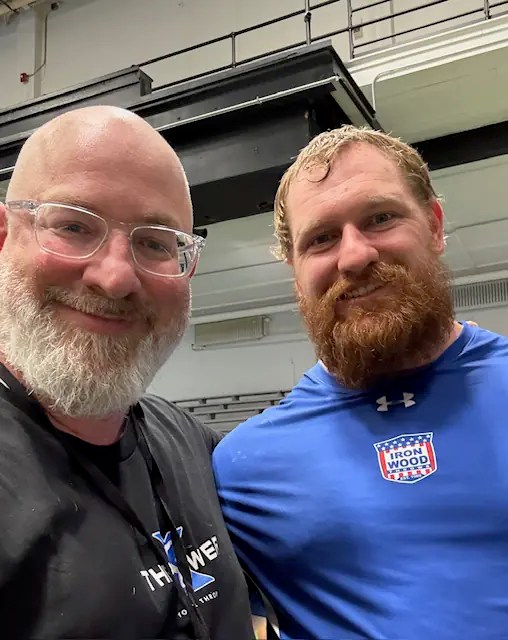
Joe Frontier and Jordan Geist at the 2025 World Shot Put Series event at Drake. Pic courtesy of Joe.
After a disappointing 2025 campaign during which he failed to make the US team for Indoor or Outdoor Worlds (and as a result is not currently funded by USATF), Jordan Geist has come out smokin’ in 2026.
How hot is he? Twenty-two meters in each of his first two meets (which is half a meter farther than he managed in all of 2025) hot.
In search of insight into Jordan’s resurgence, I reached out to my good friend Joe Frontier of Throw Big Throw Far Podcast fame, the man who officiated when Jordan married former Arizona teammate and NCAA champion Sam Noennig.
According to Frontier, Jordan has been working on technical matters with two-time Indoor World shot champ Ryan Whiting,
One thing they’ve cleaned up is Jordan’s tendency to foul on the top of the toeboard on his reverse.
Frontier says, “they decided Jordan needed to land flat-footed inside the toeboard, which meant adjusting what his left foot was doing before it left the ground.”
The change has given Geist the confidence to go hard early and often in competition rather than holding back to avoid fouling. So far, that has made a world of difference.
Jordan’s life is currently a bit fragmented, with Sam finishing her Physician’s Assistant program in Phoenix, Whiting coaching in northern California, and Jordan himself coaching at Slippery Rock University in western Pennsylvania.
He has simplified in other ways, though. There will, for example, be no more hammer throwing for the foreseeable future. And Whiting is now in charge of Jordan’s lifting program, which will free him up from a longtime habit of overthinking his training.
“The goal,” says Frontier, “is to stop him from overanalyzing and second-guessing and turn him into a robot.”
So far, so good.
(If you’d like to get help from Ryan Whiting as you pursue your own throwing adventure, check out Thrower X.)
Good Question!
In my experience, there is no such thing as a boring interview with Ryan Crouser, who is as thoughtful as he is imposing. Knowing this, I asked Marlene Sack , daughter of my friend René, if she had any questions she’d like me to ask the GOAT as I prepared to speak with Ryan for a piece in Track and Field News. Here’s what Marlene came up with:
Marlene: Does it feel different to win a gold medal or break a World Record the second time you do it?
Crouser: It definitely does, and the Olympic Games is different than the World Record. For my first Olympics in 2016, I was straight out of college, the new kid on the block with not many expectations on my shoulders. For my next Olympics in Tokyo, I had been a full time thrower for five years so I felt a lot of pressure and then a big sense of relief when I won. In Rio, I was happy to have made the team and just hoping to maybe make the final and compete for a medal, but Tokyo was mine to lose. I was throwing really well that season and had just broken the World Record for the first time, so winning was less enjoyable and more a sense of release.
With the World Record, it has been almost the opposite. I had six competitions before I first broke the World Record where I thought I was going to do it. Everything in training indicated I was going to do it then, but in the meet I’d get a little tight. It was extremely frustrating. I would have made a huge wager that I was going to break the World Record in each of those 6 comps and it never happened. When I let the shot go on the World Record throw in ‘21, I thought, “Finally!” I had expected it on 30-plus competition attempts leading up to that moment, and I felt like I had 30 whiffs and finally made contact. Then in LA in ‘23, I was coming off a big training block with sets of five. I had been throwing well, considering I was doing 5×5 and felt beat up and tired. I did a recovery week before the meet in LA, but there were no indicators in training that I was ready to break the World Record again. But the recovery week had me feeling rested, and the ball felt light during warmups. My first static warmup went 22.00m, and I thought it would be 21.00m, so the whole day was a surprise. It was a much diff feeling than when I broke the record in ‘21. In ‘23, it was more enjoyable. It was like, “Where did this come from?”
The classic equation for happiness is expectations minus reality.
When expectations are high and the results are low you’re living in the unhappy zone. Then, when you aren’t expecting much and the ball goes far, you’re on the happy side of the equation. When you are trudging through the unhappy side of the equation and then it connects, it means more. It’s like a sigh of relief, like ok, I’m not crazy.
Joe Kovacs and Jamie Myers back in the day at Chula Vista. Pic courtesy of Jamie.
During many years as a Senior Strength and Conditioning Coach for the USOPC, Jamie Myers has worked with Olympic and World medalists from a variety of events, but in his meathead heart the throws are number one. This is the first in what will be a monthly series of chats with Jamie on matters of strength.
McThrows:Is there an issue that you’ve dealt with more often than others when it comes to training throwers?
JM: The idea of the weight room becoming no longer a means to an end, but an end in itself. That might sound weird, because if you want to throw 22 meters in the shot, you are going to be hard pressed to do it if you can’t bench 500lbs and squat 700lbs.
So strength is important, but there are times when you have to make a decision on what is going to help you throw farther.
If you are short on time, for example, and can’t do both throwing and lifting on a particular day I’d say nine times out of ten you ought to go throw.
McThrows:That’s a hard sell for a lot of throwers, especially high school boys!
JM: Definitely. Looking back on how I used to be at that age, I spent a lot more time in the weight room than was necessary. I got everything I needed in there to help me throw far, but then I still had to do flys and curls and everything else I saw guys in Flex Magazine doing. This was before Instagram.
And some guys can throw far in high school just by getting cock strong, but if a kid wants to throw in college and beyond, they should take a longer view and work more on technique.
If you can throw far in high school without benching 400lbs, that’s great because you can always put strength on later.
McThrows:Do elite throwers struggle with the throwing v. lifting balance as well?
JM: Yes, but maybe in a different way. Athletes in Chula Vista sometimes convinced themselves that they had to hit specific lifting numbers so they could throw a certain distance. That in order to throw 65 meters in the discus, for example, they first had to be able to clean 180 kilos. But I question whether or not it’s a one-to-one ratio. Maybe if they are in shape to throw 65 meters, then they are also in shape to clean 180k.
Also, it’s important to keep in mind that once you reach a certain level of strength, you don’t have to keep proving it year after year.
If you can cruise through triples at 450lbs on bench press, the odds are that you can bench 500lbs, so do we need to actually put 500lbs on the bar and bench it? I would argue no.
Sometimes training is such that you might not get to the point of doing singles in a given year for whatever reason. Does that mean the season is a bust? I don’t think so, and if that’s how you judge your season, you’ve got problems.
McThrows:What would you say to folks like me who love to watch Instagram vids of Joe Kovacs squatting huge weights?
JM: I’d say that Joe is one of one, and there are things he can do because he is Joe. People should not see that and think they need to do what Joe does because that ain’t happening.
It makes me happy to see him squat huge weight, but people should not see Joe squatting 700 for ten in his basement and think ‘Oh, I need to do that same number.’ If you take something from it, just look at the idea of what he is doing. Try to understand what the percentage is rather than what the number is. How does this squat workout fit into his overall plan?
Because everything you do in training has a cost, and we can’t just continue to add things even if they look really cool on Instagram. If you add one thing, you must subtract another. And that’s true of any athlete in any event.
With eleven career medals in international championships, Gerd Kanter had lots of reasons to celebrate.
One of history’s great discus throwers, Gerd Kanter was also a hell of a coach, guiding Kristjan Čeh to World Championship gold in ’22 and silver in ’23. Once a month, he will analyze a different phase of his technique for readers of McThrows.
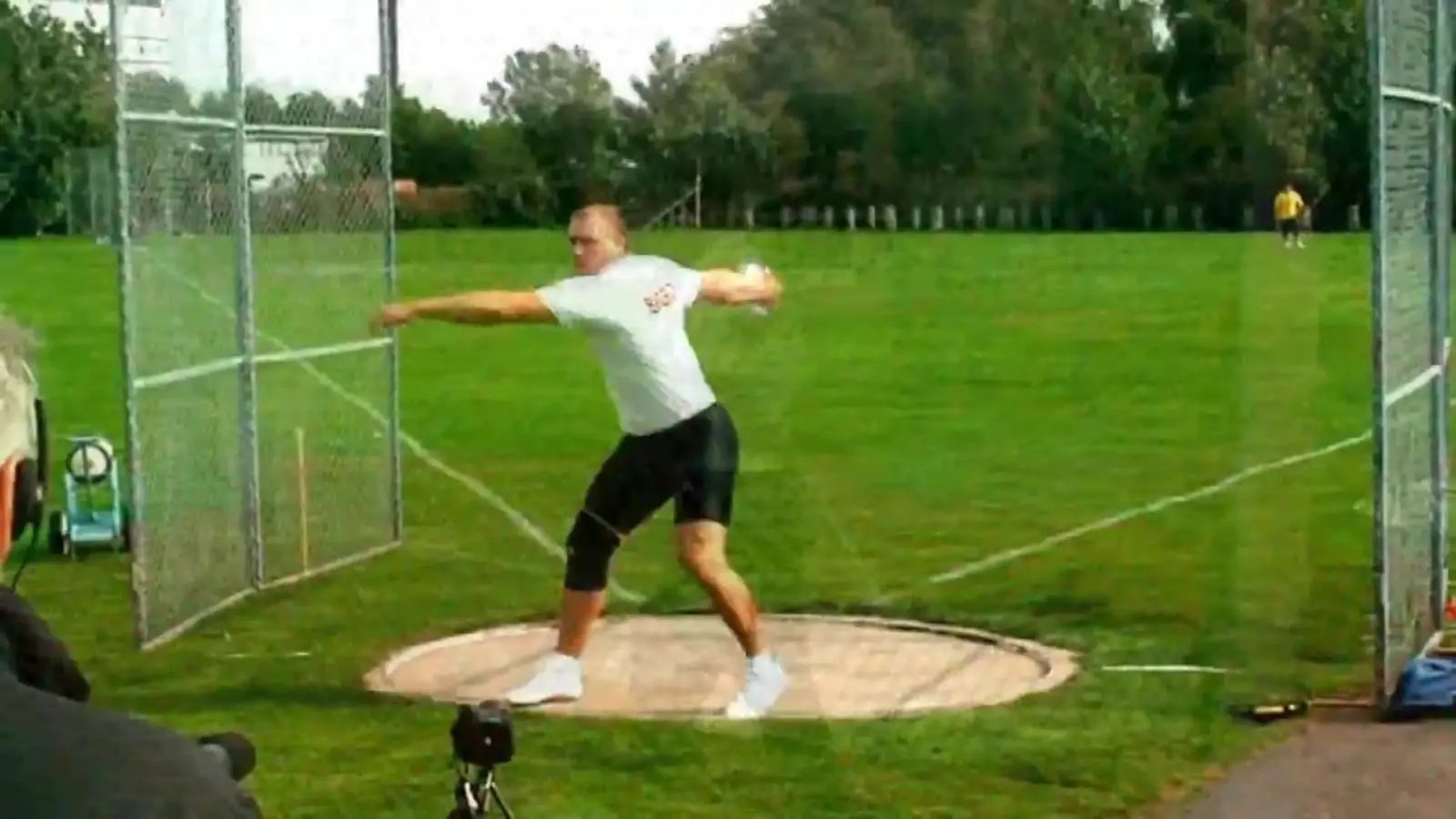
As I explained earlier, it was very important for me to stay balanced and level during my windup, with no shifting of my weight and no leaning forward or backward. Now, in this photo, I am trying to maintain that balance and posture as I begin the throw.
One cue I used was to keep my right heel on the ground as long as possible.
That way, I could keep both of my hips loaded as I began turning to the left to set up for the sprint across the ring. Early in my career, I had a tendency to shift my weight too much to the left during this moment, which caused my left hip to “break” or collapse as I began my right leg sweep. The breaking of the left hip made it impossible to achieve a balanced entry, so we worked hard to correct it. Keeping both hips strong and loaded as long as possible allowed the right side of my body to travel out and around my left side on balance, as you will see in the upcoming frames.
Another important cue for me at this point in the throw was to keep my left arm calm and passive. As you can see, my left foot and leg are ahead of my left arm as I begin to open my left side. When I started out, I often used my left arm aggressively to try to create momentum at this phase of the throw, which aggravated my tendency to “break” my left hip.
We spent a lot of time working on this part of the throw, because if you give up your balance here, it is game over. You cannot regain it and the throw will be wasted.
Next month, Gerd will examine the next step to setting up a successful entry. In the meantime, check out his book, Gerd Kanter: Five Championship Moments to learn more about his fantastic career.
This is part two of a monthly series in which Maggie Ewen, one of America’s top putters, will break down her technique step by step.
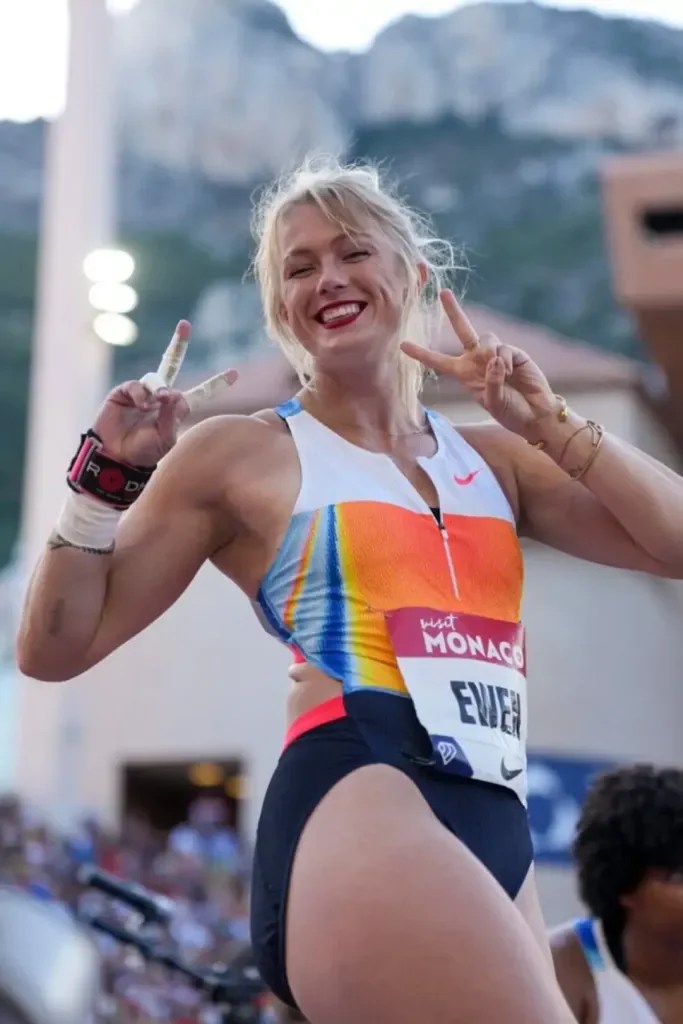
Hello! This is six-time World Shotput Finalist, Maggie Ewen.
Let’s dive into position two! In my opinion, this is one of the most important phases of the throw. This position sets up how I will drive into the middle. Do I over-rotate into the middle? Am I on balance in the stand throw? Do I move down the middle or find myself in “the bucket”? So many vital technical questions can be answered by how I set up this position.
Continuing from position one. My upper body is still locked into the position I started in. I want to avoid initiating the rotation with my left arm as that will almost certainly lead to opening up or over rotating out of the back. Therefore, I initiate the turn with the left leg and the belly button. I realize how silly “the belly button” seems. It’s a reminder that I want my torso moving with my left leg. At this point in the throw I am not looking to create separation between the hips and the shoulders. If my hips are turning, I want my upper body to turn in unison with them. As the upper body turns, the left hand should arc towards the back of the ring and then out and around the left leg. I don’t want to shift laterally over the top of the left foot. I want the system to turn around the left.
As I rotate the left leg I am trying to achieve two things. First is to keep my weight about 50/50 between my right and left foot. Second is to turn the left leg/ knee/ heel/ toes as far as possible without lifting the right foot. By turning the left without lifting the right, I am creating a stretch reflex across my hips. It’s the same concept as the stretch reflex across the chest on the strike. With the stretch reflex I build across my hips in this position, once I lift my right leg it will want to snap around to catch up to the rest of the system naturally.
Through all of this, the left glute is still engaged.
It is preparing to lock the left leg into the pillar that the right leg will sweep around in the next phase.
My rhythm is still slow and steady. I compare the entry to doing a power clean. Through the deadlift portion of the clean, as you’re bringing the bar off the ground to the thighs, it doesn’t really matter how fast you move the bar. You’re more concerned with setting up the right position to properly hit the bar and be athletic in the second half of the clean. It’s the same on the entry. Yes, I’m building a little momentum when I start turning, but primarily I’m focused on smoothly setting up a position that I can later explode out of.
Tune in next month to learn about the right leg sweep!
World class putter Maggie Ewen will be filing monthly reports as she travels the world plying her trade. In this piece, Maggie gives McThrows readers insight into life on the road as a professional putter.
If you’re a fan of the professional circuit, I’m betting you’ve noticed throwers always seem to be traveling. Sometimes even multiple countries and competitions within the span of a week. It’s true the life of a professional athlete is filled with travel. That’s because there’s simply more opportunity outside of the United States. Meets are contested more frequently in Europe and there is greater general appreciation for track and field overseas. Even a relatively small throws only meet will have a packed stadium. The pay is better in Europe as well. So, yeah, we want to be over there as much as possible!
I’ve been a professional thrower for eight years and the travel aspect was definitely a learning curve.
But I’m accustomed to the system now. I’d like to give you a snapshot of that system in the hopes you’ll get a better picture of our lives on the road as professional throwers. Most athletes will have a system that looks very similar but as with all things, there are outliers. With that being said, lets get into it!
The first thing you need to know is that most meets will not host a full program. They’ll cherry pick the events they want and the genders they want competing in those events. At that point it’s my job to look through all the meets that will be contested through the year to find the ones that will have women’s shot put. I make a list of the meets I would like to compete in and hand that to my agent. Our agents have many important jobs but I’d argue reaching out to meet directors is the most important. Our agents are our advocates. They approach meet directors and discuss why their athlete should receive an invite to the meet. Most of the time it’s a quick and easy process. Other times, the meet director may wait until just a couple days before the meet to extend the invite. Needless to say, we athletes have learned to stay ready for anything.
Once my agent informs me I have been successfully invited to a meet, I will book travel. Typically, I try to set up a meet schedule that allows me to hit a couple meets while I’m overseas with minimal down time between meets. So, it’s a lot of multi-city flights and (once I’m in Europe) checking if it’s cheaper to book a flight, a train or a rental car to get to my next destination. I’m like my own travel agent. Most athletes have their agents handle this part but I’ve found I prefer to do it myself. When the trip is fully booked, I send the itinerary to my agent who will forward it to the meet organizers.
They send the travel itinerary for three reasons. First, so the meet knows how much to reimburse me for the travel. If I went over the travel stipend they offered, I don’t get reimbursed for the remaining portion. So it’s good to stay on budget. Second, so they know when and at which airport I will be arriving. That allows them to send a driver to pick me up from the airport. Third, so the meet organizers know how many nights I will need to stay at the meet hotel. This is the hotel where they will house and feed all of the athletes for the duration of their stay. It’s fairly standard that they will offer one or two nights before the meet and one or two nights after the meet. If I want or need to stay longer than that, I book my own accommodations out of pocket.
Since all athletes are held to this same standard. We tend to unintentionally show up at the airport at the same time. When I leave baggage claim I scan the airport for someone holding a sign with the name of the meet or a desk set up that has the name of the meet plastered all around it. That is where the arriving athletes, coaches and medical staff congregate. Once everyone is accounted for, they throw us into a car, a sprinter van or a bus depending on how big the group is and shuttle us to the meet hotel.
Once at the hotel, we find the meet desk located in the lobby. This is like the central hub for the rest of my stay. If I ever have a question, need something, have to get my bibs, etcetera…this is where I will go. At this desk will also be a huge board with all the information we need. Shuttle times to and from the track, when and where meals will be held, medical sign up sheets, start lists, really just everything pertinent to our stay. So once I arrive at this desk I will check in and receive my room key for the hotel. It’s important at this stage to ask who my roommate is. Unless athletes request someone specific ahead of time, roommates are assigned at random. They keep the genders separate but they’ll mix up events and nationalities. All in all, this system works fine but it can get tricky if your roommate doesn’t speak the same language. Personally, I like to coordinate with a fellow athlete and request my roommate ahead of time. I’ve found it’s just more comforting to stay with friends rather than strangers while I’m getting ready to compete.
Once settled in my room, I make myself at home for a couple days. Eat complimentary meals at the hotel, use the provided shuttles to get to and from the track, shake out, do workout at the stadium if that’s available and generally just chill until the competition. It’s a lot of down time but that’s important to keep the body ready for the big day. Competition day isn’t much different. Breakfast, small shakeout in the hotel gym, shuttle to the track, call room, compete and shuttle back.
Back at the hotel is when we can finally breathe again after the work is done.
Since, shot put is usually the first event contested, the throwers get back to the hotel hours before dinner is ready to be served. So, we’ve gotten into the habit of treating ourselves to a little meal instead of waiting. One of my favorite post meet dinners is from last year. After the Diamond League meeting in Monaco, Chase Jackson, Sarah Mitton, Jaida Ross (my roommate for this meet) and myself went to dinner. At this point in the season we were all a little homesick and craving something familiar. So, naturally, we got a round of cheese burgers and they were perfect! We ate, laughed, reflected on the meet and just had an overall great time.
Chase Jackson, Jaida Ross, Sarah Mitton, and Maggie chopping it up in Monaco. Pic courtesy of Maggie.
It’s moments like this that make us close not only as competitors but as friends. Being on the road constantly can be lonely. But no one knows the grind better than your competitor who’s going through the same thing. At a certain point, it’s hard not to befriend each other and we find ourselves helping each other through the tough times, the boredom of hotel life and homesickness we all eventually go through.
So now it’s the evening of the competition. It’s not unusual for people to leave for the airport or train station at this time. I usually book my travel for the morning after in case the meet runs long. So bright eyed and bushy tailed at usually around 4am the following morning, I will load back into a shuttle bound for the airport. Am I going home? Am I going straight to my next meet? Am I going to a training camp because there’s too much time before my next meet and they won’t pay for my housing that long? It all depends on the schedule I set up at the top of the season. But the process always stays the same.
The one thing I can guarantee is that I’m not going on vacation.
We travel to compete. It’s a bunch of work trips. It’s not the glamorous travel-and-explore-a-country that you may think it is. We see very little aside from airports, hotels and stadiums. However, it’s an opportunity unlike any other, and I wouldn’t trade it for anything.
No male discus thrower has won more international championship medals than the eleven Gerd collected during his long and storied career. Now, for readers of McThrows, Gerd has agreed to share memories, opinions, and observations on the sport in a monthly feature called Discus Days. In this month’s edition, Gerd talks about Daniel Ståhl’s remarkable victory at the World Championships in Tokyo,
Daniel Ståhl’s winning throw of 70.47m in Tokyo was, if you take the circumstances, the all time best throw in discus history.
If he made that throw at a place like Ramona, it might have been 77 or 78 meters. And Daniel did it under the pressure of trying to win a World Championships.
This performance reminds me of what Al Oerter did in the 1968 Olympic Games when Jay Silvester—who set the World Record of 68.40m earlier in the season—probably should have won. But it rained that night in Mexico City, and Silvester only threw 61.78m, while Al Oerter took the gold with a PB of 64.78m.
Al Oerter was always prepared for any conditions, and he probably knew when it was raining for the final that it gave him his chance to win.
It was the same with Daniel in Tokyo. You saw how he acted during the competition. Daniel looked happy and comfortable, and that was half the battle.
Daniel and I both learned the discus from Vésteinn Hafsteinsson, who was always telling us we had to be ready no matter what.
During his own career, Vésteinn beat Lars Riedel one time, and it was because Vésteinn was ready to throw in the rain and Lars wasn’t. Vésteinn used to have a shoemaker who would take the soles off a pair of throwing shoes and replace them with a material that gave a firmer grip, so he was able to keep his balance while Lars fell on his ass.
I don’t know what shoes Daniel used in Tokyo, but for sure he was prepared, and that is how it is supposed to be when you are a professional. I liked to have a couple of different types of rain shoes, one with the hard plastic plate removed and soles made out of stickier material. In another pair, I would leave the hard plate in but still have the soles changed to the grippier rubber. In a dry ring, you would not be able to spin in those shoes, but in the rain they gave you a lot of traction.
When we were preparing for the 2005 World Championships in Helsinki, we knew the ring there could be slippery if it rained, so I had some fresh shoes prepared. It turned out that the weather was fine, and I got silver by throwing 68.57m in my normal Nikes. But the shoemaker I used spoke to the press and bragged that his special shoes were the reason I took a medal. The people from Nike did not like that. A few days later I received a package from the Nike dealer in Estonia. It was a pair of Nikes in a glass box with a note that said, “Maybe there was some help from us, also?”
While it is the responsibility of the athlete to always be prepared, I do think that World Athletics should do a better job of requiring a standard throwing surface for championship events. It is quite possible to make a surface that is fast in dry weather—the way many throwers prefer it—but that also has some traction in the rain. World Athletics should develop specifications for that kind of surface and inspect the facilities before championships to be sure they meet the requirements. That would help prevent competitions like the shot put at last year’s Paris Olympics and the men’s discus in Tokyo where safety became a big issue.
In the meantime though, congratulations to Daniel, Mykolas Alekna, and Alex Rose for reaching the podium under very difficult conditions.
We’ll publish another piece by Gerd next month. In the meantime, check out his book, Gerd Kanter: Five Championship Moments to learn more about his fantastic career.
With eleven career medals in international championships, Gerd Kanter had lots of reasons to celebrate.
One of history’s great discus throwers, Gerd Kanter was also a hell of a coach, guiding Kristjan Čeh to World Championship gold in ’22 and silver in ’23. Once a month, he will analyze a different phase of his technique for readers of McThrows.
The Windup
I started working with Vésteinn Hafsteinsson not long after the 2000 Olympics where the three medalists—Virgilijus, Lars Riedel, and Franz Kruger—were all taller than me with longer wingspans. In order to compete with guys like that, we experimented with ways to maximize my path of acceleration. A German discus thrower from the 1960’s and 1970’s named Hein-Direck Neu had done this by setting up with his right foot well back from the ring during his windup.
For a while, we tried a similar starting position with my right foot set back maybe 40 centimeters, and biomechanical analysis showed that it helped me to create more power and speed on the implement. But it was hard for me to consistently achieve a balanced entry from this position, so we returned my feet to a normal starting position and settled for using a long windup in the style of Mac Wilkins.
With this windup, I improved my PB by ten meters between 2000 and 2004. Unfortunately, I was rarely able to produce a big throw under the pressure of a major competition such as the World Championships or Olympic Games. After I failed to advance beyond qualification at the 2004 Olympics, we knew that if I was ever going to compete for a medal I had to solidify my technique so that I could throw at least 65 meters under any circumstance.
The biggest flaw that was holding me back was my tendency to “break” my left hip as I began my right leg sweep.
In order to stay on balance when the right foot leaves the ground, the left hip must remain strong. You’ll see how this works as we progress through the throw over time.
The first and most important step in correcting my tendency to “break” my left hip was adjusting my windup so that I would stay perfectly on balance at the start of the throw. Rather than shifting my weight to my right leg and swinging the discus back as far as possible as Mac Wilkins had done, I would simply sit down into a half squat with my upper body erect and put the discus directly behind me as you see in the picture. We also limited the movement of my left foot during my swing. As you can also see from the illustration, my left foot and right arm are at the same angle at the end of my swing and the left heel is fairly low to the ground. This made it much easier to stay on balance and transition smoothly into the throw.
Another advantage to this shorter windup was that it helped me to feel relaxed and coiled like a loaded spring. When I put the disc back and felt tension in the adductor muscles of both legs, I knew I was ready to begin the throw.
Did this windup limit my path of acceleration a bit? Yes, but for me it was worth the tradeoff.
Going for the longest path of acceleration made it difficult for me to consistently enter the throw on balance, and once you lose your balance at the start of a throw it is almost impossible to regain it. There is simply no time. The throw plays out too quickly.
And it turned out I did not need to achieve the maximum path of acceleration in order to throw far. I was fast and explosive enough so that I could generate plenty of power with a short windup–as long as I maintained my balance.
Next month, Gerd will examine his approach to setting up a successful entry. In the meantime, check out his book, Gerd Kanter: Five Championship Moments to learn more about his fantastic career.
Each month, I’ll touch on some interesting stories in the world of throwing. In this edition, you’ll read about the slick ring debacle at the Tokyo Worlds, the coaching retirement of Andrew Ninow, and the javelin adventures of Sarah Blake. At the end of the piece, I’ve included some of my favorite photos from the past year or two.
Slippery people
A recent article in The Athletic regarding the playing surface at MetLife Stadium quotes 49ers tight end George Kittle thusly:
“No NFL field should be the butt of a joke…Ever. I feel like all fields should have a level of safety to it. I just don’t get why there’s not a standard for, ‘Hey, you gotta pick between one or two turfs.’ There shouldn’t be 12 different turfs and 12 different grass fields. I just think that’s weird because most other sports, it’s not like basketball players play on different hardwood, soccer players in Europe all play on really nice grass. So it’s just weird to me.”
Throwers everywhere feel your pain, George! Someone randomly tuning into the men’s discus comp at the recent World Championships might be forgiven for wondering why the event was being contested on an ice rink. Full respect to Daniel Ståhl, Mykolas Alekna and Alex Rose for keeping their poop together under horrendous conditions in Tokyo, but shouldn’t World Athletics be able to provide a throwing surface that maintains some grippiness in the rain?
Mo Saatara, who has coached Camryn Rogers to Olympic and World hammer gold and co-coached Mykolas Alekana to a European title and six total medals at international championships, told me that while World Athletics does require a certain type of finish on the concrete throwing pads used in the shot, disc, and hammer, they do not take the threat of rain into account. “In dry conditions,” he explained, “the standard World Athletics surface is excellent. But, there’s not a lot of texture to it, so when it rains, it gets slippery.”
Daniel Ståhl came up huuuuuge in the Tokyo rain.
John Smith, coach of several Olympic and World Championship finalists and approximately one jillion NCAA medalists, says it is not difficult to construct a pad that works in all conditions if you follow these steps:
Trowel the freshly poured concrete until it is shiny like a garage floor.
Let it cure for 2-3 weeks.
Mix 1 gallon of muriatic acid with 4 gallons of water.
Pour the acid/water mixture onto the concrete.
Let it sit for 45 seconds.
Wash it off.
That process, he says, will result in a slightly pitted surface that “is fast but still works in wet weather.”
It would be nice if World Athletics were to take that kind of care in the construction of throwing rings, but in the meantime, Saatara and Smith agree that athletes must prepare for lousy conditions by training in the rain.
The facility at the pre-Worlds camp for Canadian athletes featured a ring exactly like those in Japan National Stadium, and Mo had Rogers take some throws during a storm so they’d be ready for any eventuality in the actual comp.
Smith recalled nightmare conditions during women’s discus qualification at the 1988 Olympic Trials.
“It was pouring so bad, they took the men’s long jump inside, but they let the women’s discus go on. Luckily, it had been raining a lot where we practiced in Indiana, so we were ready.”
Smith’s future wife, Connie Price, was able to get off one decent attempt out of three, but that was enough to put her in the final, which she ended up winning.
Saatara and Smith insist their athletes show up to comps prepared with shoes that will give them the best chance of maintaining their footing in a slick ring.
Rogers is a Nike athlete who, according to Mo, prefers to throw in SDs “rain or shine,” and always travels with a newer pair that provide optimum grip.
Smith calls the Puma model from the 1970s the best throwing shoe he’s ever seen, but as they went the way of the leisure suit, he has his athletes try different models of currently available brands so they are ready for anything. The Velaasa Stones, for example, are considered a good bet on a slippery surface.
There is another factor here that, according to Smith, can determine an athlete’s ability to stay upright on a rainy day—bodyweight.
“Keep in mind,” he says, “that semi-trucks handle ice better than regular cars. So the heavier the guy, the more grip they have.”
As if throwers needed another reason to shovel it in at mealtime.
A whole new world
One of the top throws performances of 2025 came from Ralford Mullings, who launched an NCAA Championships record 69.31m while denying the heavily-favored Mykolas Alekna his first collegiate title. Those two will go head-to-head once again at next year’s NCAAs, each under the care of a new coach.
After a sensational career under Mo Saatara at Cal, Mykolas has transferred to Oregon where he will be mentored in 2026 by Brian Blutreich. Ralford will remain at Oklahoma, but his coach there for the past two years, Andrew Ninow, has left the business with Pat Ebel coming over from Auburn to replace him.
For better or worse, both of these situations reflect the current state of NCAA sports.
The “better” part involves Mykolas, who was able to take advantage of modern transfer and athlete compensation rules to negotiate an undisclosed sum from Oregon’s NIL collective. It’s not easy making a living as a professional discus thrower, even when you’re the World Record holder, and it might make a big difference in his life if he can begin his post-collegiate career this summer with an advanced degree and money in the bank.
The “worse” part involves coach Ninow, one of the bright lights among American throws coaches, who felt he could not stay in a profession that offers little or no security to him and his family.
Ralford Mullings and Coach Ninow teamed up to set the NCAA Championships discus record in 2025.
Certainly, coaching in the NCAA has never been a stable way to make a buck. Head coaches in all sports have been subject to dismissal based on their won/lost records, and when a head coach is axed their assistants generally get the boot as well.
But the situation has been made markedly worse now that a new and incredibly expensive arms race has broken out among top football and basketball schools. In order to lure the best coaches in those sports, schools have been offering massive salaries. In order to lure the best athletes, schools have been pouring millions of dollars into upgraded facilities.
This has encouraged athletic departments to claw back some of the money they’d previously devoted to non-revenue sports. And it’s not only roster sizes and travel budgets that have shrunk. So has the amount of patience afforded to coaches of those sports who, in the past, might have been valued for their contribution to the educational mission of their school.
Take, for example, Gary Wienecke, who served as head coach of the men’s track and cross country programs at the University of Illinois for thirty-six years without winning an NCAA title. According to the U of I web page, Wieneke’s best seasons were from “1985-95 when the Illini placed in the top three 20 times in 22 Big Ten meets.”
Because he ran a clean, competitive program that reflected well on the university, Wienecke was a revered figure at U of I. But today, when money invested in sports is meant to produce conference and national championships, it’s hard to imagine a coach with Wienecke’s record keeping his job for the long haul.
Coach Ninow read the writing on the wall, and did not like the message.
“These days,” he said when we spoke last fall, “there’s no security in your position no matter how well the athletes in your events do. If the head coach gets fired, you’re gone as well, and then you’re at the mercy of what’s available, which can mean uprooting your family and moving across the country for a job that’s no more secure than the one you left.”
He described working for Oklahoma head coach James Thomas as “amazing” but says he’s “not getting a sense that Olympic sports are a priority” these days.
Ninow and his wife love living in Norman with their two children, and couldn’t face the idea of having to uproot them because of a coaching shakeup that could come at any time.
So, in spite of the fact that he’d have another year coaching the NCAA champion, Ninow decided to resign his position and take a job at a non-profit that works with the University to raise money for the College of Engineering.
Breaking the news to his throwing squad wasn’t easy, but Ninow says that “one common thread with all my recruits is that they are good character people, family people, and I explained to them it had nothing to do with them or with OU or the head coach. Making the change was the right thing to do as a dad. They know my wife and kids, and even though it was not an easy thing to swallow, they were able to understand it was the right move.”
As for Mullings, Coach Ninow believes he’ll do just fine under Ebel. “Ralford and I have done some unique things technically,” he said, “but Ralford is a smart guy and Ebel is a great coach. And I’ll be around to give guidance if they ever need it.”
As to the future of track and field in the NCAA, Ninow fears that the “business mindset” has carried over from football and basketball. “The difference,” he says, “is that those guys make a lot of money. If universities want to retain coaches in the non-revenue sports, coaches who are wired for family and mentorship, who support the ideals of the university, they need to make it doable.”
Breakthrough
When Sarah Blake was in high school, someone spotted her playing baseball against boys and told the track coach she had “a hell of an arm.” The track coach then convinced her to give javelining a try. It was the beginning of a long and often tortured romance with the event.
World Athletics profiles include a “progression” page which traces the athlete’s PBs chronologically. A javelin thrower’s “progression” often includes peaks, valleys, and mysteriously missing years. Sarah’s is no exception.
She graduated high school in 2015 with a PB of 41.72. During her second season at the University of Kentucky, she reached 53.12m. Her SB in 2018 dropped to 44.08m, then jumped up to 52.73m in 2019 after she’d transferred to Mississippi State. Covid knocked out her 2020 season, injury her 2022 season, and she finished 2023 with an SB of 48.22m. Finally, in 2024 she produced her first PB in seven years, a 57.63m effort at the American JavFest.
Such is the life of the javelin thrower, one that Sarah admits you have to be “a little crazy” to embrace.
“Sometimes,” she said when we spoke last fall, “we go years without having a personal best. Then, out of nowhere something connects.“
“I guess it’s because the jav is so technical. You can do one thing right, then the next throw you do something else right but lose whatever you’d just done well.”
And then there are the injuries.
“The javelin is so violent,” she says, “that you can literally injure anything in your body.” Sarah herself has had surgery once on her shoulder and twice on her elbow. A training partner recently tore his Achilles.
One reason she has been able to compete post-collegiately is that her job as a physical therapy tech provides Sarah with access to free treatment.
Curtis was competing for Mississippi State when Sarah arrived, and they’ve trained together ever since. As fellow Bulldogs, they were mentored by April Thomas. Later, both worked under Tom Pukstys. Now, they coach, support, and cheer vociferously for each other.
Sarah Blake and Curtis Thompson at the 2025 US Championships.
“Curtis,” she says, “is one of the most supportive people to me. For the past two years, he kept me throwing even when I doubted myself.”
In 2025, Thomson sat ringside while Sarah took third at the US Championships. It was a perfect javelin moment, featuring triumph and mayhem.
Blake was sitting in fifth place after four attempts when Thompson told her she needed to carry more speed into her next throw and suggested she do a practice runup off to the side. When Sarah picked up her tempo on that practice run, she caught a spike in the track surface and bit the dust. Hard.
The announcer had shushed the crowd at that end of the field prior to the start of an 800 heat, and Blake says that “everyone could hear it when I smacked the ground.”
It was, she recalls, “one of the most embarrassing things that could happen.”
Also one of the most painful, as she broke her left wrist.
Such an injury might have ended the comp for a normal athlete, but javelin throwers are made of stern stuff.
Instead of withdrawing, Sarah got up and threw a season’s best 55.80m.
Afterwards, she informed Curtis that the broken wrist was all his fault.
“Well,” he replied. “At least you ran faster.”
Earlier that day, Thompson had snagged his fifth US title. Six weeks later, he took the bronze medal in Tokyo, a development which shocked just about everyone except Blake, who for several months had witnessed a new level of consistency from her training partner.
“Curt,” she recalls, “was hammering out 80-meter training throws even from a short approach, so we realized early on that something really good was going to come out of this year. When he PB’d in his first meet, it matched up with how he’d been doing in practice.”
Blake says the consistency in training gave Thompson the confidence he needed to finally reach the podium at an international championships and to, in her words, “write history for US jav throwing.”
Thompson’s story will have a new chapter in 2026, as will Blake’s. Both will continue training and competing while working to support themselves. Eventually, Sarah says she’ll hang up the spikes and work as a strength coach, ideally for an NFL team. “I, look forward,” she says, “to being the person having a ball yelling at the men telling them to lift.”
Some favorite photos
Simon Pettersson shares a hug with Vésteinn Hafsteinsson, the man who coached him to Olympic silver in ’21. This photo was taken at the Finnkampen meeting in Stockholm, the final competition of Simon’s career.
Also from Finnkampen, here are Simon and Wictor Petersson celebrating their contributions as Sweden defeated Finland in the 100th edition of this competition.
More celebrating as Fanny Roos, Sara Lennman, and Axelina Johansson swept the Finnkampen shot put.
A huge shoutout to Coach Bill Richards for bringing Vésteinn Hafsteinsson to the Wisconsin Coaches Association Clinic. The first time Vésteinn has presented in the United States.
Here are Daniel Ståhl and Mykolas Alekna getting ready to battle at the Zurich Weltklasse. It rained a bit here, and Mykolas won. It rained a lot more in Tokyo, and we know how that one ended.
It’s hard to read the sign, but the expression of Emanuel Sousa says it all after he hit the 67.50m qualifying mark for Worlds while competing in Ramona.
The competition in Ramona was so hot that it literally blew up an electrical generator.
That’s the control room set up by Jason Coon and the Throws University/Garage Strength crew of Dane Miller who ran the broadcast from Ramona and somehow made it work in spite of the blown generator and monumental winds which discus throwers love but cameras and mics not so much. It was a huge honor to serve as a commentator alongside my dear friend Joe Frontier of Throw Big Throw Far and Thrower X fame. In the middle of the picture you see Matty Denny testing out my special kneeler chair for old guys with bad backs. The chair somehow survived.
The best moment of an incredible 2025! Celebrating with Marcus Gustaveson after he made the US team for Tokyo.
This is part one of a monthly series in which Maggie Ewen, one of America’s top putters, will break down her technique step by step.
Hello! This is six-time World Shotput Finalist, Maggie Ewen.
Over the course of the year, I’ll be sharing a frame-by-frame breakdown of my throw. I’ll analyze each phase from the starting position to the reverse. Follow along for a detailed technical analysis designed to help you understand my throw!
The throw I chose to break down is my final attempt at the 2025 Royal City Inferno Track and Field Festival in Guelph, Ontario. I don’t remember the exact distance, but I believe it was around 19.60m. Clearly, not my furthest performance but I felt this was the best technical example of my throw. There are still pieces of it I will inevitably point out as needing improvement, but that’s throwing! It’s near impossible to have a throw where every little piece was perfectly executed.
Position 1
We will start at the setup. At this point, I am focusing on locking my upper body into the position I want to hold through the throw. You may notice that from the hip hinge up, my posture is the same as it would be during a stand throw. I aim to reduce unnecessary movement through the throw (aka introducing more variables that could go wrong) by locking the upper body into this position and trying to hold it steady. This allows me to focus primarily on the lower body as I move through the throw.
The right elbow is up and I am actively pressing the shot into my neck. The left arm is straight ahead, relative to my torso. My weight is balanced 50/50 between the right and left. My legs are not overly bent. This will allow me to go down into the middle during my zero support phase (I will discuss this in greater detail when we reach this phase). My foot placement is just wider than shoulder width keeping it comfortable and athletic. Finally, I am already beginning to engage the left glute in preparation to move into single support.
My rhythmic mindset at this point is slow and steady.
I’m going to let the momentum build throughout the course of the throw, so I don’t need to move quickly into the next phase.
Tune in next time to learn about how I initiate the turn.
Recently, my friend Priit Tänava, king of stats, asked me to rank a list of ten men’s discus throwers in worst-to-best order.
I happily agreed, but it turns out that comparing great athletes from different eras is complicated! Consider the sport of baseball. Ted Williams, the fantastic Boston Red Sox player from the 1940’s and 1950’s finished his career with 521 home runs, which today has him tied for 20th on the all time list—great, but not that great. Based on his home run total, it’s hard to imagine Williams making a list of baseball’s top ten power hitters of all time, right?
But a case can be made that Williams was a much better slugger than guys who hit 100 or even 200 more home runs than him. Consider:
• Williams missed nearly five full seasons of his prime while serving in WWII and the Korean War.
• He played in an era when hitting was much more difficult because pitchers had advantages that they no longer enjoy—a higher mound, for example. Pitchers also possessed the unacknowledged but often exercised right to zing a fastball at a batter’s unprotected head to keep him from getting too comfortable at the plate, a tactic which would get them ejected and possibly suspended today.
• Steroids were not available during Williams’ career, so we can assume he notched his dingers without help from performance-enhancing drugs.
Based on these factors, some would rank Ted Williams as one of the greatest power hitters ever, maybe even in the top five all time.
Another argument could be made, though, that Williams does not belong on anyone’s top ten list because hitting was actually easier in his day. Consider:
• When Williams began his career in 1939, baseball was exclusively a white man’s sport. The color barrier was not broken until 1947, and it wasn’t until 1959 that every team finally integrated. Surely there were great black and Latino pitchers that he never had to face because of this racist policy.
• It used to be quite common for a starting pitcher to stay in the game for an entire nine innings. This meant they had to pace themselves and could not throw the ball nearly as hard as pitchers routinely do in the modern era where teams typically use four or five different pitchers each game.
All these factors make it difficult to pinpoint exactly where athletes from different eras rank in relation to each other.
That said, here’s how I’d order the list of discus studs Priit sent me:
• PB 67.18m in 1974 • Olympic champ in 1972 after taking silver in ’64 and bronze in ’68 • World Record holder • Two-time European Championships medalist (’71 gold and ’74 silver)
• PB 55.33m in 1948 • Olympic champ in 1948, silver in ’52 • World Record holder • Three-time European Championships gold medalist (’46, ’50, ’54)
To me, Danek’s Olympic gold is more impressive because it came at the beginning of the modern professional era, but I have to give Adolfo his due for winning three European golds, which is as many as Gerd Kanter, Lars Riedel, Jurgen Schult, and Virgilijus Alekna won combined!
• PB 69.46m in 1980 • Olympic champ in 1956, ’60, ’64, ’68 • World Record holder
Oerter was legendary for his ability to bring the heat when it counted. He famously won Olympic gold with torn rib cartilage in ’64 and tossed an Olympic Record in a rain storm to take his final gold in ’68. His four Olympic titles will never be matched.
So, why not rank him number one?
For most of Al’s career, the sport was not nearly as professional as it is today, and he did not have to put his body through what modern throwers must to remain competitive. That’s why throwers so rarely repeat as Olympic champions. Robert Harting was as tough a competitor as Oerter, but two years after taking gold at the London Olympics, he blew out his ACL during an active recovery session as he began training for 2015. Harting recovered in time to make a run at repeating in Rio, but was foiled when he wrenched his back the night before qualification while bending over to turn off a light. That’s the kind of stuff that happens when you push your body to the limit, which is what it takes to win in the modern era.
• PB 74.08m in 1986 • Olympic champ in 1988, silver in ’92 • World champ in 1987, silver in ’99, bronze in ’93 and ’97 • European champ in 1990, silver in ’98, bronze in ’94 • World Record holder from 1986 to 2024 • Nine total medals at international championships
Jurgen is famous for holding the World Record for nearly 40 years, but the true measure of his greatness was the success he attained at international championships after switching to non-reverse throwing so he could be more consistent under pressure. He also made an impact on the sport by serving as a German national coach.
Jurgen Schult at the 2022 World Championships flanked by Kristjan Čeh and Gerd Kanter.
• PB 70.66m in 2012 • Olympic gold in 2012 • World champ in ’09, ’11, ’13, silver in ’07 • European champ in ’12 and ’14, silver in ’10 • Eight total medals in international championships
Like Al Oerter, Robert was tough in the big competitions, winning on his final throw in Berlin 2009 and winning in spite of an injury in Moscow 2013. Handsome and charismatic, he made discus throwing look sexy and a little bit dangerous. If you’ve seen the video of the ’09 final and have never tried to rip your shirt off after a big throw or making a three-pointer in a pickup basketball game…I simply do not understand you.
Trash me if you must for putting him ahead of Jurgen and Al Oerter, but… watch the video!
• PB 70.98m in 1980 • Olympic champ in ’76, silver in ’84
Even though Danek won three Olympic medals to Mac’s two, I’m putting Mac ahead of him due to his huge influence on the sport of discus throwing. Mac has inspired and mentored countless coaches and athletes over the years including Vésteinn Hafsteinsson, who ended up developing two of the guys ahead of Mac on my list. That’s why I put him above Robert, Jurgen, and Al Oerter. Also, he totally got the shaft with the 1980 Olympic boycott when he would have been a clear favorite to repeat as gold-medalist.
• PB 73.38m in 2006 • Olympic champ in 2008, bronze in ’12 • World champ in 2007, silver in ’05 and ’11, bronze in ’09 and ’13 • Eleven total medals in international championships
Gerd competed during an immensely competitive era during which he had to contend with one Alekna, two Hartings, and a Malachowski. In spite of this, he took eleven international championships medals, the most for any male discus thrower.
That’s reason enough to rank him this high, but I also give him huge props for what he meant to his home country of Estonia. Winning international medals is never easy, but try doing it while carrying the hopes of an entire nation on your back.
• PB 71.50m in 1997 • Olympic champ in 1996, silver in ’00 • World champ in 1991, ’93, ’95, ’97, ’01, bronze in ’99 • European champ in 1998 • Nine medals at international championships
I’ll admit that my emphasis on total number of international medals is not fair to guys like Mac and Oerter whose only chance to accumulate hardware came at the Olympics, but can we ignore those five World titles won by Lars?
No, we cannot.
Also, like Robert and Mac, Lars was a charismatic presence in the sport. Unfortunately for the ladies, he usually kept his shirt on, but watching him celebrate big throws and agonize over lousy ones was great theater.
• PB 73.88m in 2000 • Olympic champ in 2000 and ’04, bronze in ’08 • World champ in 2003 and ’05, silver in ’97 and ’01 • European champ in 2006, silver in ’02, bronze in ’98 • Ten medals at international championships
Virgilijus gets big points for unseating Lars as discus Übermensch and dominating the sport between 2000 and 2007 when Gerd finally took over. A model of consistency (he won 38 of his 39 comps between 2005 and 2006) and class, Virgilijus—like Gerd—gave his countrymen something to cheer for as they recovered from a grim half century of Soviet occupation.
As a side note, Virgilijus was the first thrower I know of to travel with his own physiotherapist, a very small dude who the other throwers referred to as “the mechanic.” With the help of that physio, Virgilijus not only dominated the sport but also had enough energy left over to sire the future World Record holder.
• PB 71.86m in 2019 • Olympic champion in 2021 • World Champion in 2019, ’23, and ’25, silver in ’17 • Six total medals at international championships
Go ahead and accuse me of recency bias, but my choice of Daniel as numero uno is more nuanced.
As you’ll see below, I’ve worked with Vésteinn Hafsteinsson on two books about Daniel, so I have a pretty good understanding of what it took for him to reach the top of the sport, and that knowledge has informed my decision.
Clearly, Daniel was born with immense physical talent.
This list is full of large, athletic dudes, but none of them can match Daniel’s combination of size, strength, and smoothness in the ring.
Based on that, you might wonder why Daniel hasn’t been even more dominant in his career. Six medals in international championships is a great accomplishment, but at Daniel’s age—he turned 33 last summer—it doesn’t seem likely he’ll reach Gerd’s record of eleven. Daniel has also never won a European Championship. At the past two Europeans, in ’22 and ’24, he did not even medal. Nor did he reach the podium at the ’22 Worlds or ’24 Olympics, making him and Robert Harting the only guys on this list without multiple Olympic medals.
What’s so great about him, then?
For much of his career, Daniel was conflicted, tormented even, about living the life of a sports hero.
Daniel did not grow up wanting to be a famous athlete. Aside from his exceptional size, he was a regular kid who loved hanging out with his family and playing ice hockey with his friends. His parents had been throwers, and he picked up the shot and disc as a kid, but he did not train seriously until he was nineteen and Vésteinn Hafsteinsson took him into his group, which at the time included Gerd Kanter.
Training under Vésteinn and around Gerd gave Daniel his first glimpse of the sacrifices and level of commitment it would take to be an Olympic champion.
During the decade it took for Gerd to rise to the top of the sport, pretty much every choice he made was based on the calculus of whether or not it would help him achieve his goal of some day winning a gold medal. As a result, he led a boring life. Get up in the morning, eat and go to training. Come home, eat and rest, then back to training. Come home, eat and sleep, then tomorrow back to training.
Vésteinn remembers one time in ten years that Gerd asked to miss a session, and that was late in his career when they were at a training camp in California and someone offered Gerd—a huge basketball fan—tickets to see his first NBA game.
In a way, it was a dream scenario to have Daniel learn the habits of a champion by training alongside Gerd. The problem was that Daniel was not suited to the life of a discus monk. He hated being bored and felt terribly homesick for his family and friends while training with Vésteinn’s group in the small town of Växjö where he knew nobody and had nothing to do but lift and throw.
The situation became infinitely worse when Daniel got good.
Sweden had not suffered under the Soviet boot as had Estonia and Lithuania, but folks there were still hungry for native-grown sports champions, and when Daniel threw a world-leading 66.89m in May of 2014, he became an instant celebrity. He was recognized wherever he went and people made it quite clear that they expected him to win medals. Gold medals. Lots of them.
This put Daniel in a difficult situation. After a few years of training with Vésteinn, he understood what kind of life he’d have to lead if he was going to live up to people’s expectations. But he’d tried that life and it made him miserable. At times, he considered quitting the sport and going back to live quietly among family and friends, but how could he do that now that he’d been “outed” as a potential champion? What would people say about him then?
The four years after his breakthrough throw in 2014 were extremely tough on Daniel, on Vésteinn, and on the many people around Daniel who cared about him as more than just a discus thrower.
Then, when he finally found some equilibrium and became World Champion in 2019, the pandemic hit and threatened to deny him the chance to win Olympic gold in 2020.
Daniel overcame that, winning at Tokyo in ’21, but the following summer brought two potentially cataclysmic changes. First, Vésteinn retired from coaching. Life on the road, and the effort required to guide his group to their historic performance at the 2021 Games had finally exhausted him, and suddenly Daniel faced the prospect of continuing his career without his most important ally.
I’m not privy to Daniel’s private thoughts at that time, but he had to have been dismayed by the possibility that no matter how hard he worked going forward he’d spend the rest of his career fighting for bronze medals while regularly getting his ass kicked by two young whippersnappers.
That had to be an unpleasant prospect for a guy who’d always been haunted by the fear of disappointing his fans.
But instead of folding, Daniel came out swinging in ’23.
He and his new coach, Staffan Jönsson, clicked right away and Daniel rolled into the 2023 Worlds having put together a magnificent season. His fourth-round toss of 69.37m had him in the lead until Čeh popped a 70.02m on his final attempt. As the frontrunner going into round six, Daniel had last ups, and he responded to Čeh by launching a monster 71.46m toss that was arguably the greatest clutch throw in any international championships.
Until this past summer.
If you’re reading this piece, you’ve probably seen the video of the final in Tokyo. And you’ve probably participated in a debate regarding the conditions, the facilities, etc…
But the fact that grizzled veterans like Matty Denny and Andrius Gudžius, tough, skilled dudes, couldn’t manage to stay upright in the ring is evidence enough that this was an historically bad situation.
That’s why I’d call Daniel’s sixth-round SB 70.47m the absolute greatest clutch throw in discus history.
In no previous era of the sport has it been harder to win medals at international championships than it is right now. Daniel has overcome tremendous obstacles both internal and external to show that he’s the best thrower of the best era, and that’s enough for me to rank him first all time.
For a detailed look at how Daniel trained under his first coach, Vésteinn Hafsteinsson, check out Training for Goldon Amazon.