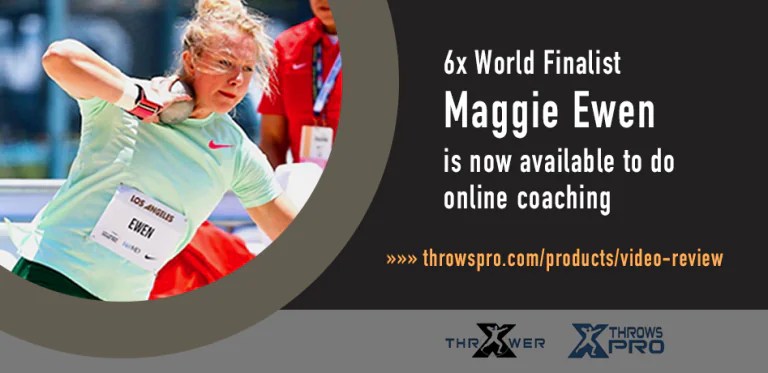
Life on the circuit with Maggie Ewen: Managing physical and mental fatigue.

World class putter Maggie Ewen has been filing regular reports as she travels the world plying her trade. In this piece, Maggie gives McThrows readers insight into the challenges of staying fresh over a long season.


Physical and Mental Fatigue

It’s been a couple months since the season ended and the off-season began. Like most athletes, I took a couple weeks off after the last meet. The physical and mental strain from competing all summer is draining. Even when everything is going well, it’s hard to combat the strain of constant travel mixed with intense training and high pressure competitions. Add in some injury issues like I had last year, and all that mental and physical stress doubles.

I was so completely burnt out. That is why these end of season breaks are so massively important. The body needs time to refresh and the brain needs time to reset. 

However, the off season isn’t the only time for breaks. They should be a scheduled part of our in-season and off-season programs.

When that happens, there’s a good chance that the unscheduled break won’t be at a convenient time. I’ve had my own moments like that. In preparation for a big meet, I’ll use an off day (or two) to go out and take extra reps so that I feel like I have done everything possible to have a great meet. Instead of resting, I irritate a nagging injury or develop a new one. For me personally, the most frequent issue I get from this exact scenario is a dramatic case of mental fatigue. I start overthinking a good throw and turn it into something unrecognizable. Then I have to take a day off to reset my brain and it usually takes an additional day to find that good throw again. Now I am three days closer to the meet and right back where I started three days earlier. I should have just taken the break…

Taking frequent small breaks allows for more opportunities to get ahead of the fatigue. When we reduce it little by little over time, we prevent it from becoming a problem. It’s the same concept as rehabbing a muscle. Ideally, we want to proactively do things to prevent injury instead of reacting to it once it has become a problem that needs to be addressed. 

I think most athletes and coaches are good at catching physical fatigue. We’ve got that down. We understand the importance of not overexerting the body over an extended amount of time. That’s how we avoid injury.

So programs are written with scheduled deload weeks, athletes are told to take a rest day when they seem extra tired, we lighten the intensity of our throws at some practices, etc… It’s such an ingrained part of training that athletes don’t even question why we’re being sent home early or given a light week in the weightroom. We simply accept it is another tool in our toolbox of strategies to combat physical fatigue. 

On the other hand, we have our strategies to combat mental fatigue. You’re not alone if nothing comes to mind. If I’m being completely honest, I kind of draw a blank as well. I think that is because the strategies to combat mental fatigue are more personal to the individual athlete. We’re talking psychology now. Everyone’s body physiology works the same. So, the strategies for our physical fatigue can be universally handed out and we’ll see results. However, every athlete’s psychology is unique to them. What inspires them, demoralizes them, stresses them out, etc… I believe that is why mental exhaustion is so hard to combat. It’s so personal.

A lot of coaches will suggest taking a break to let the athlete reset by putting the implement down for a bit. Does it work? Most of the time it does. But who knows how long it will take to actually show results. As I mentioned earlier, I employed this exact strategy at the end of last season. It took over a month for me to even want to look at a shot again. So, I’d say this strategy works but the timeline it takes to work can be quite variable. 

There is often a lot more going on in an athlete’s mind than they are expressing to their coach. Stress about an upcoming meet, anxiety over a performance, frustration over execution of a technical cue, etc… These are things we battle with on a daily basis but we may never vocalize. They have the potential to build up and become all consuming, distracting and unproductive thoughts. There have been plenty of times when I have found myself in this head space and practice devolves into more of a therapy session. It’s cathartic for me and beneficial for my coach to understand my headspace. Now he can better redirect my focus towards constructive thoughts and we can have more beneficial practices.

It’s important to remember that the coach/athlete relationship is a partnership. Coaches do not only work with us to make us strong and throw far. A good coach wants their athlete to be the whole package: physically capable of out throwing their competition and mentally strong enough to compete in high pressure situations.  

Maggie Ewen Technique Breakdown: Part 5

This is the fifth part of a regular series in which Maggie Ewen, one of America’s top putters, will break down her technique step by step.

Up until this point in the throw, I have been very lower body dominant. The upper body was simply along for the ride while my hips, legs and feet moved me through the ring. Now it is time for the upper body to get involved. As we move into this section, remember that I am detailing my ideal goal of these positions. As is clear from the photos provided, we don’t always hit our ideal positions. I am my biggest critic, so I constantly see all the discrepancies between the goal and the execution. I like to think about that as all the ways I can improve and eventually throw further! Anyways, let’s get to it.  

As I continue to squeeze the adductors together, I am looking to land in the middle with my right toe, knee, hips, shoulders (literally everything) facing 9 o’clock or, as I call it, 270º. While my shoulders are facing 270º, I want my left arm reaching straight ahead of me also towards 270º (in an ideal world). This is where the separation begins.

While this happens, I am actively trying to keep the left arm reaching back. Initially it reaches toward 270º, but as the hips continue to turn the left arm will reach more towards 0º or the back of the ring. It is tricky to explain; however, the overall goal of the left arm reach is to land in the stand throw position with the left arm reaching back towards 0º and the shoulders square to 0º. So the left arm is still straight ahead of the body and not wrapping across the chest. 

Once the left arm is reaching towards 0º, the left foot should be coming down at the front of the ring (in an ideal world). I want it down as early as possible so I can get the legs and hips involved in my finish for as long as possible. If the left foot comes down late, the right foot/hip has nothing to work into. This means the hips are simply turning and not actually generating more speed and power.

Once it touches the ground in the middle, the right foot will never stop turning until the hips are square to the throw and the ball is coming out of my hand.

This is a phase of the throw where patience is the key. Since I am in single support I cannot add speed or power. I simply have to be patient and give the legs/system time to turn through this phase. While I am being patient with the lower body, I am focused on holding back the shoulders and creating separation. It is a very important phase of the throw since this is the last step before I actually deliver the ball. In my opinion, outside of the strike itself, this is the most important phase of the throw.  

Tune in next month to learn about the finish!

Gerd Kanter’s Gold Medal Discus Technique: Part 4

With eleven career medals in international championships, Gerd Kanter had lots of reasons to celebrate

One of history’s great discus throwers, Gerd Kanter was also a successful coach, guiding Kristjan Čeh to World Championship gold in ’22 and silver in ’23. Gerd has agreed to analyze his own technique, step by step, for readers of McThrows.

Compared to some other successful throwers, it is not so wide. This might have been due to the angle of my left foot. Early in my career, we  tried to get my left foot pointing in the direction of the throw as I began my sprint, but that never quite worked for me. Turning my left foot more may have allowed me to achieve a greater radius with my right leg, but it made it harder for me to feel torque between my shoulders and hips.

So I would stop my left foot at the angle you see in this picture, and try to sweep my right foot just outside the rim of the ring while keeping a strong left hip. This combination allowed me to create maximum speed and power during my sprint phase. 

This is another cue to help achieve a balanced position through the entry phase. Strong left hip. Discus behind the right hip. Left arm level.


Sign up for the McThrows newsletter to receive emailed notices about future articles by Gerd and other McThrows contributors. In the meantime, check out his book, Gerd Kanter: Five Championship Moments to learn more about Gerd’s fantastic career.

Maggie Ewen Technique Breakdown: Part 4

This is the fourth part of a regular series in which Maggie Ewen, one of America’s top putters, will break down her technique step by step.

Let’s talk about zero support! 

I’ll be the first to admit that not a lot happens through this phase. When we are not in contact with ground, there is little we can do to actually add to the throw. So the main focus of this phase tends to be controlling the left arm (keeping it from over-rotating) and being patient until the right foot comes down in the middle. But as you’ll see in the upcoming paragraphs, there is more going on than meets the eye. Let’s get into it!

As I sweep out of the entry, I am still hinged at the waist. The right leg is now in front of my body and driving into the direction of the sector. As it continues to sweep forward, I want my torso to move forward with the right leg.

This allows my weight to move off my left foot sooner which in turn allows me to pick up the left foot earlier.

With my left up early, I can keep my knees tight as I move into the middle. Initially, the knees are not tight to each other, but they are tight to my midline axis (the axis that splits the right and left sides of the body). My left leg is clearly behind me but since the left knee is still tight to my midline, I am not dragging. Dragging is when the knees start drifting apart, causing the left leg to float wide and lag behind the rest of the system.

Once it begins dragging, it spends the rest of the throw trying to catch up to the midline/right leg, causing a slower rotation through the middle and often leads to the left foot coming down late in the front of the ring. It’s like the example of a spinning figure skater. Wide arms (dragging left leg) causes slower rotation. Arms tight to the body (knees tight to the midline axis) causes faster rotation.

I do not push or flick off my left foot (at least not consciously). I am pulled off of my left by the center of mass and right leg moving across the ring. Once the left is off the ground, I am squeezing the adductors together to reduce the distance between the knees even more.

I will start to be active with the upper body and begin to create the separation between the hips and the shoulders. 

Tune in next month to learn about the landing position and initiating separation between the hips and shoulders!

Strength Matters with Jamie Myers: October, 2026 edition.

During many years as a strength and conditioning coach, primarily working for the USOPC, Jamie Myers has worked with Olympic and World medalists from a variety of events. In his meat head heart, however, the throws are number one. This is the latest in our series of chats with Jamie on matters of strength.

McThrows: So 2026 was the first year since the pandemic with no Olympic Games or World Championships. Does the lack of a major international championships affect the way athletes prepare for a season?

JM: It can in different ways. For example, if you have an injury that you’d try to work through during a normal year, the “off year” gives you the chance to get it taken care of so you won’t have to keep pushing through it next season when there is a Worlds or Olympics. 

In that and other ways, it can be a less stressful year. American athletes, for instance, can go to USAs knowing that if you’re not at your best it’s not going to cost you a spot on a team.

And the break is probably even more impactful for perpetual medalists like Ryan Crouser.

That’s a lot of pressure both mentally and physically when you can’t afford to have a down year or at least do a little mental reset. 

The last time guys like Ryan had an “off year” was 2018. I had been working at the Olympic Training Center for nine years at that point, and I knew then that the break was beneficial, but now after seeing him and Joe Kovacs fight for medals year after year, I appreciate it even more. 

McThrows: How would a training plan look differently in an off year?

JM: It would give you a chance to focus on improving a certain quality that might raise an athlete’s performance down the line. Let’s say everybody agreed that a particular athlete could benefit from an improvement in their maximal strength. An “off year” would be a good time to push that because you wouldn’t have to work as much on dynamic strength. You could use the “off year” to build a better base of strength that the athlete could draw on in subsequent years.

The chance to shore up different weaknesses and get a mental reset could turn out to be the difference between an athlete making or not making a team in the future, which is big because if you aren’t making World or Olympic teams, you’re not going to last long in this sport.

McThrows: What are your thoughts on the “Ultimate World Championships”? 

JM: It’s for sure not the same as a Worlds or Olympics because all the events are included. To athletes who are left out, it’s irrelevant or maybe even offensive. The athletes I work with who will be competing have not approached it like a Worlds or Olympics. It feels more like a Diamond League meet from my perspective, but that may change if it continues. 

And for sure there is value in competing against the best in an environment that is anywhere close to what you are exposed to at an international championships.

For a long time, all you’ve had to do to face the best was to show up at an average meet at Long Beach State.

McThrows: A quick digression. Mykolas Alekna had an amazing year in spite of not being able to bench press since February. Is bench press an overrated lift?

JM: It might be for the discus. From a physics standpoint, if you just use your upper body to throw the disc it is not going to go far. I have to point out, though, that his injury was to his left pec and not his right.

This also might be another illustration of the importance of learning how to do the movements before you get strong. Mykolas clearly developed a great feel for the throw early on. He’s never been a guy who got by mainly on maximal strength.

Like Ryan Crouser, Mykolas knew how to throw far and right before he was considered strong in throwing circles.

But the first priority in a technical event should be mastering positions and rhythm. It’s easy to add strength later.

McThrows: When an athlete suffers an injury that prevents them from lifting in a “normal” way, how do they keep their nervous system sharp?

JM: There’s lots of ways to do it. Jumps. Medball throws. It also helps to have special genetics.

McThrows: I’d like to say I could relate to that, but…

The Mental Game with Benn Harradine: Embrace your bum!

Benn Harradine is the five-time Australian discus champion and co-founder of Harradine Performance, through which he helps athletes and folks from all walks of life realize their potential by strengthening their mental and physical game. Benn holds degrees in exercise physiology, physical education, and health and personal development, and currently serves as CEO of Killmonday Games. He has agreed to do regular interviews with McThrows focusing on the mental side of coaching and competing.

McThrows: Benn, the recent World Athletics Ultimate Championships offered athletes a chance to compete for a lot more money than is normally at stake in track and field competitions. That’s exciting, but I wonder, could it also be unnerving? How can going for the big bucks affect an athlete’s motivation and/or mental preparation?

BH: To answer that question, it helps to consider the nature of motivation. The things which motivate us generally fall into two categories. There are what I would call “suboptimal” motivating factors, which are like the fast food of motivation. They fill up your cup but don’t last long. I’d put competing to earn money or Diamond League points—transactional motivators—in that category.

“Optimal” motivating factors are things that are more inline with and inherent to your overall mission, values, and purpose as a person. That type of motivation only comes when an athlete grapples with questions like “Why do I do this?” and “What do I truly value?” 

It’s like the difference between eating a nice red steak with a salad, rather than McDonalds. It fortifies you and helps you get through the shit.

Given the nature of the sport of throwing, you might have out of twenty comps fifteen that are dreadful, and if you haven’t taken the time to get clear about how tossing a discus aligns with your purpose in life, if you are just competing because it feels good to throw far and make money, it can be hard to sustain through all the ups and downs. A larger sense of purpose, on the other hand, keeps you at the table like a bad gambler.

McThrows: It sounds like you’ve had personal experience with this.

BH: I have. The biggest turning point in my whole career came in 2009. I had moved to Germany to train with Jurgen Schult, and we made steady progress, so that summer I got selected to represent Australia at the World Championships in Berlin. 

I’d had some consistent marks in California that season, and threw 64.03m in Halle and 64.97m in Lugano in June, but Jurgen—with all his experience—was aware that throwing well at a fairly minor competition in Switzerland was not the same as throwing well in a World Championships, especially for a young thrower making a lot of technical changes. So he suggested I give myself some space and look at Berlin as part of the journey.

I ended up throwing 61.74m there, which was not enough to advance out of qualification. The head of Australian performance did not share Jurgen’s outlook, and after the competition he came up to me and said, “This is the biggest failure of the whole team.” That sent me into…I don’t want to say an “existential crisis” but it certainly got me asking “What’s the point?” Was I competing in the discus to get this guy’s approval? Or did it fit into a larger purpose? 

That’s when I started competing in the colorful suits. I decided I wanted to do things on my terms, which meant combining entertainment and performance. And family was a big value in my life, so I asked myself, “How can I either create a family around this, or bring my real family into it so I can honor them by what I do?”

After that, throwing the discus became more than “Let’s see how far we can get,” and I discovered that to be very freeing. It made it much easier to manage the usual anxiety of “I have to throw far” in order to make money, be popular or whatever.

McThrows: And how did that influence your attitude towards major competitions?

BH: It helped me realize that the World Championships and Olympic Games are valuable stepping stones that help you along the way in your mission, but those comps aren’t necessarily more valuable than others. 

Something like the Ultimate Games strikes me as very transactional.

And if you are operating with a true sense of purpose, money is probably not high on the list of what motivates you. 

McThrows: So would you say the short answer to my original question of how might the prize money at the Ultimate Championships influence an athlete’s motivation and/or mental preparation is, “Hopefully, not much”?

BH: Yes. And especially when you are talking about throwers, because the money situation can drive you crazy if you put too much emphasis on it. There is a huge disparity in our sport in the ways athletes from different events are paid, maybe not in terms of prize money, but behind the scenes with appearance fees. I remember doing a comp in Holland with Robert Harting where he got 13,000 Euros as an appearance fee when a sprinter who had never made an Olympic final got 70,000.

It all comes down to identity, to doing the work on who you are outside of whatever sport you compete in. My dad used to say, “With or without a medal, you’re still just another bare bum in the shower.” Throwing became a lot more fun once I embraced that idea.

Subscribe to the McThrows newsletter to receive emailed notification about upcoming articles featuring Benn and other McThrows contributors.