Throws News for February, 2026


Each month, I’ll touch on some interesting stories in the world of throwing. In this edition, you’ll read about Jordan Geist’s great start to 2026, Ryan Crouser’s thoughts on repeating as Olympic champ and World Record holder, and the schedule of events for the 2026 World Throws Invitational at Ramona.


Geist!
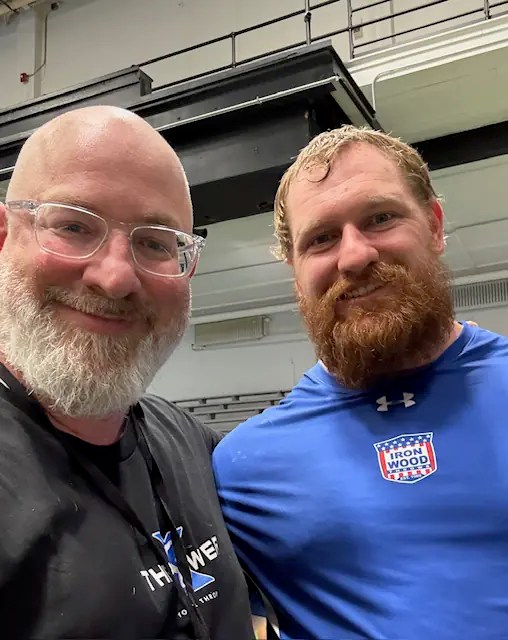
Joe Frontier and Jordan Geist at the 2025 World Shot Put Series event at Drake. Pic courtesy of Joe.

After a disappointing 2025 campaign during which he failed to make the US team for Indoor or Outdoor Worlds (and as a result is not currently funded by USATF), Jordan Geist has come out smokin’ in 2026.

How hot is he? Twenty-two meters in each of his first two meets (which is half a meter farther than he managed in all of 2025) hot.

In search of insight into Jordan’s resurgence, I reached out to my good friend Joe Frontier of Throw Big Throw Far Podcast fame, the man who officiated when Jordan married former Arizona teammate and NCAA champion Sam Noennig.

According to Frontier, Jordan has been working on technical matters with two-time Indoor World shot champ Ryan Whiting,

Frontier says, “they decided Jordan needed to land flat-footed inside the toeboard, which meant adjusting what his left foot was doing before it left the ground.”

The change has given Geist the confidence to go hard early and often in competition rather than holding back to avoid fouling. So far, that has made a world of difference.

Jordan’s life is currently a bit fragmented, with Sam finishing her Physician’s Assistant program in Phoenix, Whiting coaching in northern California, and Jordan himself coaching at Slippery Rock University in western Pennsylvania.

He has simplified in other ways, though. There will, for example, be no more hammer throwing for the foreseeable future. And Whiting is now in charge of Jordan’s lifting program, which will free him up from a longtime habit of overthinking his training.

“The goal,” says Frontier, “is to stop him from overanalyzing and second-guessing and turn him into a robot.”

So far, so good.

(If you’d like to get help from Ryan Whiting as you pursue your own throwing adventure, check out Thrower X.)


Good Question!

In my experience, there is no such thing as a boring interview with Ryan Crouser, who is as thoughtful as he is imposing. Knowing this, I asked Marlene Sack , daughter of my friend René, if she had any questions she’d like me to ask the GOAT as I prepared to speak with Ryan for a piece in Track and Field News. Here’s what Marlene came up with:

Marlene: Does it feel different to win a gold medal or break a World Record the second time you do it?

Crouser: It definitely does, and the Olympic Games is different than the World Record. For my first Olympics in 2016, I was straight out of college, the new kid on the block with not many expectations on my shoulders. For my next Olympics in Tokyo, I had been a full time thrower for five years so I felt a lot of pressure and then a big sense of relief when I won. In Rio, I was happy to have made the team and just hoping to maybe make the final and compete for a medal, but Tokyo was mine to lose. I was throwing really well that season and had just broken the World Record for the first time, so winning was less enjoyable and more a sense of release.

With the World Record, it has been almost the opposite. I had six competitions before I first broke the World Record where I thought I was going to do it. Everything in training indicated I was going to do it then, but in the meet I’d get a little tight. It was extremely frustrating. I would have made a huge wager that I was going to break the World Record in each of those 6 comps and it never happened. When I let the shot go on the World Record throw in ‘21, I thought, “Finally!”  I had expected it on 30-plus competition attempts leading up to that moment, and I felt like I had 30 whiffs and finally made contact. Then in LA  in ‘23, I was coming off a big training block with sets of five. I had been throwing well, considering I was doing 5×5 and felt beat up and tired. I did a recovery week before the meet in LA, but there were no indicators in training that I was ready to break the World Record again. But the recovery week had me feeling rested, and the ball felt light during warmups. My first static warmup went 22.00m, and I thought it would be 21.00m, so the whole day was a surprise. It was a much diff feeling than when I broke the record in ‘21. In ‘23, it was more enjoyable. It was like, “Where did this come from?”

When expectations are high and the results are low you’re living in the unhappy zone. Then, when you aren’t expecting much and the ball goes far, you’re on the happy side of the equation. When you are trudging through the unhappy side of the equation and then it connects, it means more. It’s like a sigh of relief, like ok, I’m not crazy.


Reap the whirlwind!

It’s baaaack.

More details soon!

Strength Matters with Jamie Myers: March 2026 edition.

Joe Kovacs and Jamie Myers back in the day at Chula Vista. Pic courtesy of Jamie.

During many years as a Senior Strength and Conditioning Coach for the USOPC, Jamie Myers has worked with Olympic and World medalists from a variety of events, but in his meathead heart the throws are number one. This is the first in what will be a monthly series of chats with Jamie on matters of strength.

McThrows: Is there an issue that you’ve dealt with more often than others when it comes to training throwers?

JM: The idea of the weight room becoming no longer a means to an end, but an end in itself. That might sound weird, because if you want to throw 22 meters in the shot, you are going to be hard pressed to do it if you can’t bench 500lbs and squat 700lbs.

If you are short on time, for example, and can’t do both throwing and lifting on a particular day I’d say nine times out of ten you ought to go throw.

McThrows: That’s a hard sell for a lot of throwers, especially high school boys!

JM: Definitely. Looking back on how I used to be at that age, I spent a lot more time in the weight room than was necessary. I got everything I needed in there to help me throw far, but then I still had to do flys and curls and everything else I saw guys in Flex Magazine doing. This was before Instagram.

And some guys can throw far in high school just by getting cock strong, but if a kid wants to throw in college and beyond, they should take a longer view and work more on technique.

If you can throw far in high school without benching 400lbs, that’s great because you can always put strength on later.

McThrows: Do elite throwers struggle with the throwing v. lifting balance as well?

JM: Yes, but maybe in a different way. Athletes in Chula Vista sometimes convinced themselves that they had to hit specific lifting numbers so they could throw a certain distance. That in order to throw 65 meters in the discus, for example, they first had to be able to clean 180 kilos. But I question whether or not it’s a one-to-one ratio. Maybe if they are in shape to throw 65 meters, then they are also in shape to clean 180k.

If you can cruise through triples at 450lbs on bench press, the odds are that you can bench 500lbs, so do we need to actually put 500lbs on the bar and bench it? I would argue no.

Sometimes training is such that you might not get to the point of doing singles in a given year for whatever reason. Does that mean the season is a bust? I don’t think so, and if that’s how you judge your season, you’ve got problems.

McThrows: What would you say to folks like me who love to watch Instagram vids of Joe Kovacs squatting huge weights?

JM: I’d say that Joe is one of one, and there are things he can do because he is Joe. People should not see that and think they need to do what Joe does because that ain’t happening.

It makes me happy to see him squat huge weight, but people should not see Joe squatting 700 for ten in his basement and think ‘Oh, I need to do that same number.’ If you take something from it, just look at the idea of what he is doing. Try to understand what the percentage is rather than what the number is. How does this squat workout fit into his overall plan?

Because everything you do in training has a cost, and we can’t just continue to add things even if they look really cool on Instagram. If you add one thing, you must subtract another. And that’s true of any athlete in any event.

Gerd Kanter’s Gold Medal Discus Technique: Part 2

With eleven career medals in international championships, Gerd Kanter had lots of reasons to celebrate.

One of history’s great discus throwers, Gerd Kanter was also a hell of a coach, guiding Kristjan Čeh to World Championship gold in ’22 and silver in ’23. Once a month, he will analyze a different phase of his technique for readers of McThrows.

As I explained earlier, it was very important for me to stay balanced and level during my windup, with no shifting of my weight and no leaning forward or backward. Now, in this photo, I am trying to maintain that balance and posture as I begin the throw.

That way, I could keep both of my hips loaded as I began turning to the left to set up for the sprint across the ring. Early in my career, I had a tendency to shift my weight too much to the left during this moment, which caused my left hip to “break” or collapse as I began my right leg sweep. The breaking of the left hip made it impossible to achieve a balanced entry, so we worked hard to correct it. Keeping both hips strong and loaded as long as possible allowed the right side of my body to travel out and around my left side on balance, as you will see in the upcoming frames.

Another important cue for me at this point in the throw was to keep my left arm calm and passive. As you can see, my left foot and leg are ahead of my left arm as I begin to open my left side. When I started out, I often used my left arm aggressively to try to create momentum at this phase of the throw, which aggravated my tendency to “break” my left hip. 

We spent a lot of time working on this part of the throw, because if you give up your balance here, it is game over. You cannot regain it and the throw will be wasted.

Next month, Gerd will examine the next step to setting up a successful entry. In the meantime, check out his book, Gerd Kanter: Five Championship Moments to learn more about his fantastic career.

Maggie Ewen Technique Breakdown Part 2:

This is part two of a monthly series in which Maggie Ewen, one of America’s top putters, will break down her technique step by step.

Hello! This is six-time World Shotput Finalist, Maggie Ewen.

Let’s dive into position two! In my opinion, this is one of the most important phases of the throw. This position sets up how I will drive into the middle. Do I over-rotate into the middle? Am I on balance in the stand throw? Do I move down the middle or find myself in “the bucket”? So many vital technical questions can be answered by how I set up this position. 

Continuing from position one. My upper body is still locked into the position I started in. I want to avoid initiating the rotation with my left arm as that will almost certainly lead to opening up or over rotating out of the back. Therefore, I initiate the turn with the left leg and the belly button. I realize how silly “the belly button” seems. It’s a reminder that I want my torso moving with my left leg. At this point in the throw I am not looking to create separation between the hips and the shoulders. If my hips are turning, I want my upper body to turn in unison with them. As the upper body turns, the left hand should arc towards the back of the ring and then out and around the left leg. I don’t want to shift laterally over the top of the left foot. I want the system to turn around the left. 

As I rotate the left leg I am trying to achieve two things. First is to keep my weight about 50/50 between my right and left foot. Second is to turn the left leg/ knee/ heel/ toes as far as possible without lifting the right foot. By turning the left without lifting the right, I am creating a stretch reflex across my hips. It’s the same concept as the stretch reflex across the chest on the strike. With the stretch reflex I build across my hips in this position, once I lift my right leg it will want to snap around to catch up to the rest of the system naturally. 

It is preparing to lock the left leg into the pillar that the right leg will sweep around in the next phase.

My rhythm is still slow and steady. I compare the entry to doing a power clean. Through the deadlift portion of the clean, as you’re bringing the bar off the ground to the thighs, it doesn’t really matter how fast you move the bar. You’re more concerned with setting up the right position to properly hit the bar and be athletic in the second half of the clean. It’s the same on the entry. Yes, I’m building a little momentum when I start turning, but primarily I’m focused on smoothly setting up a position that I can later explode out of. 

Tune in next month to learn about the right leg sweep!

Life on the circuit with Maggie Ewen: February, 2026 edition.

World class putter Maggie Ewen will be filing monthly reports as she travels the world plying her trade. In this piece, Maggie gives McThrows readers insight into life on the road as a professional putter.

If you’re a fan of the professional circuit, I’m betting you’ve noticed throwers always seem to be traveling. Sometimes even multiple countries and competitions within the span of a week. It’s true the life of a professional athlete is filled with travel. That’s because there’s simply more opportunity outside of the United States. Meets are contested more frequently in Europe and there is greater general appreciation for track and field overseas.  Even a relatively small throws only meet will have a packed stadium. The pay is better in Europe as well. So, yeah, we want to be over there as much as possible!

But I’m accustomed to the system now. I’d like to give you a snapshot of  that system in the hopes you’ll get a better picture of our lives on the road as professional throwers. Most athletes will have a system that looks very similar but as with all things, there are outliers. With that being said, lets get into it!

The first thing you need to know is that most meets will not host a full program. They’ll cherry pick the events they want and the genders they want competing in those events. At that point it’s my job to look through all the meets that will be contested through the year to find the ones that will have women’s shot put. I make a list of the meets I would like to compete in and hand that to my agent. Our agents have many important jobs but I’d argue reaching out to meet directors is the most important. Our agents are our advocates. They approach meet directors and discuss why their athlete should receive an invite to the meet. Most of the time it’s a quick and easy process. Other times, the meet director may wait until just a couple days before the meet to extend the invite. Needless to say, we athletes have learned to stay ready for anything.

Once my agent informs me I have been successfully invited to a meet, I will book travel. Typically, I try to set up a meet schedule that allows me to hit a couple meets while I’m overseas with minimal down time between meets. So, it’s a lot of multi-city flights and (once I’m in Europe) checking if it’s cheaper to book a flight, a train or a rental car to get to my next destination. I’m like my own travel agent. Most athletes have their agents handle this part but I’ve found I prefer to do it myself.  When the trip is fully booked, I send the itinerary to my agent who will forward it to the meet organizers. 

They send the travel itinerary for three reasons. First, so the meet knows how much to reimburse me for the travel. If I went over the travel stipend they offered, I don’t get reimbursed for the remaining portion. So it’s good to stay on budget. Second, so they know when and at which airport I will be arriving. That allows them to send a driver to pick me up from the airport. Third, so the meet organizers know how many nights I will need to stay at the meet hotel. This is the hotel where they will house and feed all of the athletes for the duration of their stay. It’s fairly standard that they will offer one or two nights before the meet and one or two nights after the meet. If I want or need to stay longer than that, I book my own accommodations out of pocket. 

Since all athletes are held to this same standard. We tend to unintentionally show up at the airport at the same time. When I leave baggage claim I scan the airport for someone holding a sign with the name of the meet or a desk set up that has the name of the meet plastered all around it. That is where the arriving athletes, coaches and medical staff congregate. Once everyone is accounted for, they throw us into a car, a sprinter van or a bus depending on how big the group is and shuttle us to the meet hotel. 

Once at the hotel, we find the meet desk located in the lobby. This is like the central hub for the rest of my stay. If I ever have a question, need something, have to get my bibs, etcetera…this is where I will go. At this desk will also be a huge board with all the information we need. Shuttle times to and from the track, when and where meals will be held, medical sign up sheets, start lists, really just everything pertinent to our stay. So once I arrive at this desk I will check in and receive my room key for the hotel. It’s important at this stage to ask who my roommate is. Unless athletes request someone specific ahead of time, roommates are assigned at random. They keep the genders separate but they’ll mix up events and nationalities. All in all, this system works fine but it can get tricky if your roommate doesn’t speak the same language. Personally, I like to coordinate with a fellow athlete and request my roommate ahead of time. I’ve found it’s just more comforting to stay with friends rather than strangers while I’m getting ready to compete.

Once settled in my room, I make myself at home for a couple days. Eat complimentary meals at the hotel, use the provided shuttles to get to and from the track, shake out, do workout at the stadium if that’s available and generally just chill until the competition. It’s a lot of down time but that’s important to keep the body ready for the big day. Competition day isn’t much different. Breakfast, small shakeout in the hotel gym, shuttle to the track, call room, compete and shuttle back.

Since, shot put is usually the first event contested, the throwers get back to the hotel hours before dinner is ready to be served. So, we’ve gotten into the habit of treating ourselves to a little meal instead of waiting. One of my favorite post meet dinners is from last year. After the Diamond League meeting in Monaco, Chase Jackson, Sarah Mitton, Jaida Ross (my roommate for this meet) and myself went to dinner. At this point in the season we were all a little homesick and craving something familiar. So, naturally, we got a round of cheese burgers and they were perfect! We ate, laughed, reflected on the meet and just had an overall great time.

Chase Jackson, Jaida Ross, Sarah Mitton, and Maggie chopping it up in Monaco. Pic courtesy of Maggie.

It’s moments like this that make us close not only as competitors but as friends. Being on the road constantly can be lonely. But no one knows the grind better than your competitor who’s going through the same thing. At a certain point, it’s hard not to befriend each other and we find ourselves helping each other through the tough times, the boredom of hotel life and homesickness we all eventually go through.

So now it’s the evening of the competition. It’s not unusual for people to leave for the airport or train station at this time. I usually book my travel for the morning after in case the meet runs long. So bright eyed and bushy tailed at usually around 4am the following morning, I will load back into a shuttle bound for the airport. Am I going home? Am I going straight to my next meet? Am I going to a training camp because there’s too much time before my next meet and they won’t pay for my housing that long? It all depends on the schedule I set up at the top of the season. But the process always stays the same.

We travel to compete. It’s a bunch of work trips. It’s not the glamorous travel-and-explore-a-country that you may think it is. We see very little aside from airports, hotels and stadiums. However, it’s an opportunity unlike any other, and I wouldn’t trade it for anything.