The Mental Game with Benn Harradine: Building Trust

Benn Harradine is the five-time Australian discus champion and co-founder of Harradine Performance, through which he helps athletes and folks from all walks of life realize their potential by strengthening their mental and physical game. Benn holds degrees in exercise physiology, physical education, and health and personal development, and currently serves as CEO of Killmonday Games. He has agreed to do regular interviews with McThrows focusing on the mental side of coaching and competing.

McThrows: Benn, I know you’re a big proponent of the coach/athlete relationship being a partnership rather than a dictatorship.

BH: Absolutely. If there is no trust between an athlete and their coach, there will also be no results.

McThrows: So how does a coach go about building that trust?

BH: It takes work, especially if an athlete has had a bad experience which has left them unable to trust easily. Someone like that is going to need to see evidence before they trust you, and even those who trust easily will always be evaluating the things you say and do as a coach.

McThrows: What type of evidence do athletes look for?

BH: People tend to trust with their heads and hearts, and there are tangible behaviors in both those areas that signal to an athlete that a coach is worthy of their trust. 

If you say you are going to turn up to a session at 9 a.m. but then you show up at ten past, and you do that consistently, it creates doubt in the athlete’s mind. If they can’t rely on you to come to training on time, how will they be able to rely on you in a high stress comp when they need you the most? 

So, when you make promises to your athletes, keep them.

McThrows: And how can you encourage someone to trust you with their heart?

BH: That requires actively listening to your athletes, and showing an interest in them outside the sport.

It signals to them that you are paying attention and you care how they feel. Those simple conversations about gardening or whatever also build a feeling of psychological safety, so an athlete can feel comfortable broaching more sensitive topics when the need arises. Sharing about your own troubles helps as well. Those interactions let the athletes know they can trust you to respect them and respect their confidentiality.

McThrows: Vésteinn Hafsteinsson has been involved with thrower development in Sweden for many years, and he says that whenever he’s working with a group of athletes he makes it a point to go around the room and ask each individual “How are you?” And by that, he means “How are you doing as a person?” not as an athlete. 

BH: That’s a great way to build trust. When you have the reputation he has of producing gold medals, why should you ask a developing athlete how their life is going? Why should you care? But the fact that he does care and he goes out of his way to show that he cares makes it even more human.

That’s part of the “how” of coaching, which to me is the most interesting and important part. People tend to focus on what is the best training program or the best technique, but it’s irrelevant if you can’t communicate it, and you need to communicate it to athletes who trust you. 

Subscribe to the McThrows newsletter to receive emailed notification about upcoming articles featuring Benn and other McThrows contributors.

Strength Matters with Jamie Myers: June 2026 edition.

During many years as a Senior Strength and Conditioning Coach for the USOPC, Jamie Myers has worked with Olympic and World medalists from a variety of events, but in his meathead heart the throws are number one. This is the latest in our series of chats with Jamie on matters of strength. 

McThrows: So, this winter Mykolas Alekna damaged his left pec and shoulder apparently during a bench press max. (Note: Mykolas missed the entire NCAA season but returned to action on June 16th with a 70.60m toss in Estonia.) Have any athletes you coached experienced that sort of injury?

JM: First of all, I just want to say that since I wasn’t present when Mykolas got injured, I can’t pretend to know what happened. I can only talk about the things I’ve seen with my athletes over the years, and we’ve had lots of small pec injuries, which are pretty common among throwers because they bench a lot. I’d say it’s usually the combo of all the throwing and lifting, the cumulative load, that is the cause rather than an athlete going too heavy that one time.

McThrows: Any advice as to how to avoid those kinds of injuries? Are there ever signs that something is about to give? 

JM: In my experience, when you talk to the athlete after an injury like that they’ll often say “I felt something, but I kept going anyway,” so the obvious answer is, if you feel something then stop. But how many times do you feel something and keep going and you get away with it? And to quote Jarred Rome, “If I only trained when I didn’t hurt, I’d never train at all.”  

McThrows: So it’s a tricky matter.

JM: It is. I suppose in a perfect world, a throwing coach would also be the one who trains the athlete in the weight room like Vésteinn Hafsteinsson or Art Venegas did. That way, they are more aware of everything that is going on with an athlete and can make adjustments in their lifting program that will hopefully prevent those kinds of injuries. 

At Chula Vista, I liked to stop by throwing and jumping practices as much as I could, so I could understand the effect those sessions were having on the athletes. And the event coaches were always welcome in the weight room. It was a lot easier to stay on the same page that way.

McThrows: What role does lifting technique play in injury prevention?

JM: It’s definitely a factor. There’s an argument right now on Instagram where some people say lifting technique doesn’t matter and the body will adapt, but my contention is that it does matter because if you want to move limit-type loads, it comes down to mechanical efficiency. There are certain parts of the body designed to do certain things, and if we are asking them to move high loads outside of what that part of the body is designed to do, we are asking for trouble.

When you start lifting limit loads, you want things to be lined up, partly to avoid increasing the risk of injury, but also because moving a load in a more efficient way lessens the cost. I wouldn’t expect Joe Kovacs or Ryan Crouser or Payton Otterdahl to perform an Olympic lift as proficiently as a competitive weightlifter, but it’s worth taking the time to work on hitting correct positions, especially when training with sub-max loads, so that the athlete will be able to move  near-max loads more safely and at a lesser cost from an energy standpoint.

I never wanted the weight room to negatively impact throwing practice. Obviously, during heavy volume phases it will. They won’t be perfect in the ring during that time. But my goal is that I want to be on the same page as the throws coach so what I’m doing in the weight room supports what they are doing in practice.

McThrows: Do you have any advice about bench press technique?

JM: I’ve talked to power lifters who say that some benches are too narrow, which makes it harder for the lifter to keep stable. I don’t think a bench should be less than 12 inches wide, and I like the Thompson bench pad, which is 14 inches. It provides a little more support, which can help with the pecs.

When Andreas Thorkildsen trained at Chula Vista, he bought a power rack from the Danish company ER Equipment and had it installed in our weight room because he liked the feel of it when he benched. A lot of Joe’s infamous Chula Vista squat videos were also done on that rack.

McThrows: When I interviewed Thorkildsen in 2010, he said he could bench 195k.

JM: He for sure benched a lot of weight and with a technique I would not have recommended. He used a really wide grip and he’d lower the weight slowly until it was a couple inches from his chest, then it became a reactive situation. 

He’d say to me, “I know this isn’t what makes me throw far,” but he liked doing it, and it wasn’t a problem for him. He had the reactivity and connective tissue strength to avoid pec problems. He also cleaned 155k.

McThrows: Final thoughts?

JM: Even though injuries like the one Mykolas had are hard to predict, my suggestion to people would be to live to fight another day.

Appreciate how much stronger you got, and keep in mind that you can now train off this new max, so every set going forward will be higher. There is certainly risk involved in trying to be the best in the world, but do your best not to be greedy. 

Maggie Ewen Technique Breakdown: Part 3

This is the third part of a regular series in which Maggie Ewen, one of America’s top putters, will break down her technique step by step.

Time to talk sweep!

I’ve included 3 pictures because the sweep is a long movement. In my entry, though it may not look like it, I feel two distinctly different moments during my sweep:

  • In the initial phase I am working to get the right leg high and out over the back of the ring.

It should also be noted that through the sweep phase of the throw the left foot and torso basically do nothing. I’ve already set up the torso and left leg in previous positions. Therefore, the sweep phase is all about being patient and letting my right leg go from being stretched out behind me to leading me into the middle. With that disclaimer in place, let’s get into it!

Screenshot

As I explained in my last post, in the position you see above, I have turned the left foot/ hip as far as it will go without picking up the right. As I continue to turn the left foot (dragging the torso with it), the right leg will get to a point that it cannot stay grounded any longer. I do not think of flicking or pushing off the ground to initiate the right leg. It happens naturally because of the stretch reflex I have created across the hips. This begins the first phase of the sweep.

Screenshot

If I do it right, you’ll see above that I find a position resembling a South African drill with an elevated right leg. At this point my left toes will be pointed in the direction of the sector and that is where I want that foot to stay planted for the rest of the sweep. Since the left foot is what encourages the torso to rotate, the torso should also stop rotating. 

Screenshot

This is where we begin the second phase of the sweep. Now that I have a high right leg, planted left foot and a torso that is no longer rotating, I squeeze the right adductor. This causes the right leg to go from straight out to the side to moving in front of me. This is the drive. It’s letting the right leg go from dragging to leading. As the inside of the leg drives into the direction of the sector, I want to keep it high so it can naturally arc down to its low point aka the middle of the ring. 

Some techniques say the athlete should be tall as they come around the corner and drive into the ring. My technique does not. I want to stay bent at the waist through the entry so my center of mass is pitched forward slightly. 

Tune in next time to find out why that’s important!

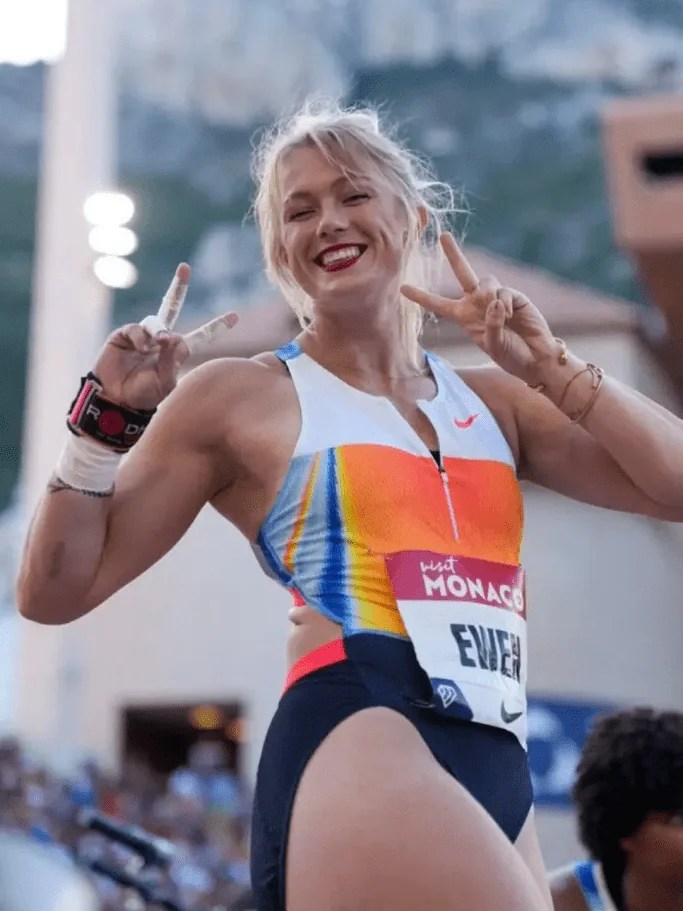
Life on the circuit with Maggie Ewen: June, 2026 edition

World class putter Maggie Ewen has been filing regular reports as she travels the world plying her trade. In this piece, Maggie gives McThrows readers insight into the many ways getting injured complicates life for a pro putter.

We have all been there at some point. Sprained ankle, slipped disc, jammed finger, pulled muscles. Professional athlete or weekend warrior, most people have experienced some sort of injury. When you go through the intense training required to excel in a sport, they become inevitable. We’re constantly striving get stronger, faster and more explosive, and over time, all the wear and tear takes its toll. So we find ourselves performing a balancing act between pushing our bodies to the limit and taking the time to rest, recover and do preventative care. No matter how diligent we are about staying healthy, though, at some point in our career, we all suffer setbacks. When that happens, we can only take solace in the hope that all the preventative rehab and prehab, the scheduled rest, the smart dieting and consistent sleep schedules, will prevent it from being a serious injury. 

At the end of last year, I strained the base of my triceps doing a simple stand throw, which is arguably the least threatening and most practiced part of the throw. I worked closely with the doctors, but it was the type of injury that only rest would heal. Once the season ended, it took about four months to finally heal up and I was able to start throwing again. But the second I tossed my first shot, I noticed a pain on the other side of my elbow (the area most people refer to as “tennis elbow”) which had never been there before. It literally appeared after four months of rest and rehab. So, again I  worked with the doctors, but so far the answer to my problem has evaded us. I’ve been prescribed additional rest, rehab, strengthening, anti-inflammatories, heat, cold, chiropractic and acupuncture. Still no dice.

So far, imaging shows no damage and mobility tests reveal no clues. Our last Hail Mary play is to go see a group of specialists in LA at the end of June. Specialists being what they are, it was hard to carve out a slot in their schedule for me. So if you’re wondering why I haven’t taken this step sooner, that’s your answer.

After all, I did just get done telling you how injured I am. So let me explain. 

Firstly, I would not label my injury as debilitating. I’d describe it more like “limiting.” I can still throw, but I really have to throttle back the intensity. My elbow only hurts when I dynamically hit full extension (aka strike the shotput) but only if I go full speed. If I lower the intensity so I am not moving through the strike with as much speed and snap, there is no pain. Obviously, that means there is also less force being put into the ball and, therefore, I am not seeing seeing the distances I typically would. But I can get through a whole practice no problem. While I don’t love constantly training at around 75% intensity, I can feel all of this low- intensity, highly-technical execution practice is really benefitting my throw. It’s forcing me to be hyper-precise, and I am definitely making improvements to my form that will translate into much larger throws once I am able to up the intensity. So I’m going to keep logging these clean reps until I get more answers from the specialists. 

Secondly, I don’t want to lose motivation. It would be easy to sit at home and watch this season unfold from the comfort of my house. I could just continue to log training reps, keep an eye on meet results and wait to get back into peak form. But… that’s not really my style. I enjoy competition. I like being challenged, and since my elbow doesn’t hurt with lower intensity throws, I don’t believe I am doing additional damage to the joint. What is important to me is not losing sight of the level I want to get back to. Hunkering down and training has its benefits, but nothing kicks my motivation into gear like getting out there and giving it a go. Does that mean I’ll likely get my butt kicked a lot this year? Probably, but that’s a great motivator to get back into form.

Thirdly, athletes have to compete in five meets in a calendar year in order to acquire a World Rank. Our World Rank influences things like the meets we can get into, teams we can make and how much funding we can expect for the following season. After eight years as a professional thrower, I have seen many athletes deal with injury. I’ve watched them decided to compete or not compete. From what I have witnessed, the injured athletes who take the season off and lose their world rank entirely have a harder time coming back the following season. Athletes who continued to compete, even if they are underperforming, only have to deal with their World Rank dropping but not disappearing. It’s definitely a gamble either way, but continuing to compete gives me more peace of mind for next year. So, I’ll stand by my decision and continue competing. By the time I see the specialists, I will have thrown in six meets. That allows me the wiggle room to shut it down after I see the specialists (depending on their findings) and I still preserve a World Rank for 2027.

Finally, it’s important to note there is no playbook for handling this type of situation. It’s all about weighing the pros and cons of your specific situation. What is the severity of the injury, what’s your standing in the sport, what meets have you been invited to or what teams have you already qualified for?

None of us would be completely right, and none of us would be totally wrong. For example, my elbow issue is reminiscent of Ryan Crouser’s. He opted to take off nearly the entire 2025 season to rest his elbow, but that was because he already had the automatic invite to the World Championships in Tokyo. On top of that, he is the most talented athlete in our sport’s history. I’m not working with a comparable level of accolades and reputation. Therefore, I need to constantly prove that I’m the kind of thrower meet directors want in their meets. I don’t have the luxury to take the season off and come back when I’m feeling ready. I don’t say that as some sort of insult to Crouser, it’s just a simple fact in the world of professional track and field. We’re all doing our best to optimize our own unique situations even when we’re dealing with similar issues. We all have to navigate our own unique path towards the same goal. 

Hopefully, in a month’s time, I can come back with good news from the doctors. Until then, I will continue to do my best to make the most of the hand I am dealt.

I may not be a big threat in 2026, but I’ve got plenty of time to rebound for the true goal. LA 2028.