Category Archives: Discus

Day four at the toyota usa Outdoor Track and field championships: Women’s Discus

Last year a storm blew in on the final day of the USATF Championships, and the winds that preceded it helped produce some fantastic results in the men’s discus.

Yesterday, throws fans seated on the hill overlooking the discus cage at Drake Stadium were hoping for a repeat performance, this time by the women.

Foul weather loomed on the horizon as flight one of the women’s discus warmed up, and the flags dangling from the safety ropes strung along the right foul line indicated a right-to-left cross wind was developing. Though for sure not a world record wind or a Hawaii wind or even a 2018 men’s discus wind, we spectators hoped that it might prove useful to Val Allman, Kelsey Card, Gia Lewis Smallwood, Laulauga Tausaga, Whitney Ashley and others fighting to make the team for Doha if they could fly the disc just right, or that it mind change direction a bit and morph into more of a headwind.

It was interesting to watch the flight-one competitors wrangle with the wind during warmups. A couple of throws released prematurely and seemingly headed out of bounds to the right were blown back into the sector. Several of the athletes had trouble keeping the disc flat, which can be challenging in a cross wind.

All in all, it seemed to be of no help to the gals in the first flight, as once the competition began only one of them notched a season’s best. That was Jere Summers, whose round-two toss of 59.66m was also a PB.

It might be that most of the flight-one competitors simply lacked the horse power to take advantage of this wind, as some of the flight-two throwers (most notably Allman, Card and Tausaga) hit long throws when their turn came to warm up.

As with the previous throwing events, each flight was given thirty minutes to prepare, which for a group of nine discus throwers is quite a lot of time.

I wrote previously about how some of the men’s shot putters, especially Joe Kovacs, used the long warmup period to take a lot of throws, and it was interesting to see the different approach taken by Val.

She went right to full throws, no stands, wheels, or fixed feet fulls, and she only took a handful of them.

When I asked her about this after the competition, she said it was a habit she developed while competing overseas. “You’re only ever guaranteed two warmup throws,” she explained, “so you have to learn to make do with that.”

She looked sharp on the warmups she did take yesterday, and seemed to be in great shape to defend her national title.

Once the competition began, things quickly got interesting.

Card, third up in the flight, took an early lead with a throw of 62.37m.

Kelsey is really fun to watch. She lacks the long levers possessed by a lot of world class discus throwers, but her entry and sprint through the ring are smooth and efficient and her fixed-feet finish allows her to thoroughly work the ground. Two years ago her coach, Dave Astrauskas, was nice enough to break down Kelsey’s technique for me, and you can read his analysis here.

Val was next up, and she snapped off a 64.34m just to let everyone know there would be no let down on her part.

Tausaga and Ashley both fouled their openers, and the round ended with Gia Lewis Smallwood moving into medal contention with a toss of 61.49m.

What can be said about Gia, aside from the fact that she is amazing? Like Kara Winger, she has spent a remarkably long time at or near the top of the US rankings in her event. Gia is the only thrower I’ve ever researched whose “Progression” page on her IAAF bio does not fit on one screen. You have to scroll down to find out that she threw 55.52m in 2000, and has thrown over sixty meters in nine of the last ten years, the exception being 2016 when she injured her back so badly that just bending down to pick up a discus off the ground was difficult.

Also like Kara, Gia is one of the nicest people you’ll ever meet.

So it was cool to see her banging away at what was, in the words of Kara who was serving as PA announcer for the long throws, “at least her fifteenth US Championships.” According to Kara, the records “only go back to 2002,” so I guess we will have to wait for archeologists to fill in the gaps some day.

Tausaga knocked Gia out of third with a round two throw of 61.51m, while both Card and Val fouled. Ashley got on the board with 54.70m, but that left her in thirteenth place.

She punctuated her round three effort with a long and barbaric yell, which resulted in a mark of 61.52m. Thus was Tausaga knocked into fourth.

I have, by the way, a soft spot in my heart for Whitney. Not only is she an excellent thrower and super articulate person (check out this post-competition interview), but I have a great memory of watching her blast her first-ever sixty-meter throw right here in Des Moines in round six of the NCAA final her senior year at San Diego State. That throw lifted her from middle of the pack into the lead and showed for the first time that she had world class potential.

As Whitney mentions in that interview, a funny thing happened during the short break between prelims and finals yesterday: the wind stopped.

So, those on the outside looking in (Val, Kelsey and Whitney occupied the top spots going into round four) would get no help from Mother Nature.

It turns out that Tausaga didn’t need any, as she smashed a 62.08m toss that jumped her back into third.

That put Whitney into a bad spot (fourth place when the top three go to Doha) and she bombed away at the 60-meter line on each of her final three attempts, determined to claw her way onto the podium.

Each time she came up short (60.29m, 60.57m, 60.19m) as did Gia, whose sixth-round 61.51m left her in fifth place.

Afterwards, I spoke with Tausaga and Card about navigating the difficulties inherent to collegiate (Laulauga) and post-collegiate (Card) chucking. That interview is here.

I also spoke with Val, who is making the transition from collegiate to post-collegiate athlete look pretty easy. That interview is here.

Full results may be found here.

The 2019 Toyota USATF Championships begin: A report on the Men’s Discus and women’s Javelin

The discus is a fickle event. Timing is everything, and a strong headwind doesn’t hurt either.

Last year’s USATF men’s discus competition has attained legendary status (three competitors over sixty-six meters, including a monstrous 68.61m for Reggie Jagers) at least in part because of beneficent winds that presaged the arrival of a violent thunderstorm.

No storm swept into Drake Stadium last night, just an annoying bit of rain that made footing treacherous during the final round of the men’s disc, a competition that will be remembered as more odd than epic.

That may be fitting, as 2019 is an undeniably odd year for track and field athletes with the World Championships taking place in Doha in late September and early October—a full six weeks later than normal.

These US Championships were pushed back a month as well, leaving athletes with the challenge of staying sharp during a portion of the summer when there are few meets available here in the States.

That can mess with a person’s training plan and with their head, and may help to explain why neither of the two favorites in the men’s discus made the podium yesterday.

Reggie Jagers, after a fairly consistent summer that included two excellent Diamond League performances (64.89m for fourth in Doha and 64.59m for sixth in Rabat) did not even make it out of the prelims.

Mason Finley, the 2017 World Championship bronze medalist who finished second to Reggie here last year with a toss of 67.06m, earned the full six throws but ended up finishing seventh with a best of 61.05m.

As best I can tell, though, Mason will still represent the US at the Worlds as the man who finished third yesterday, Kord Ferguson, does not have the qualifying standard of 65.00m and Mason is the highest finisher other than the top two (Sam Mattis who took first with a season’s best 66.69m, and Brian Williams who came next with a PB of 65.76m) to have met that standard.

Back in the day, Kord would have had a few weeks to “chase the standard” and make the team for Doha, but this time around the USATF has designated these championships as the final chance for any athlete to achieve the needed mark.

If that seems confusing to you, don’t feel bad. As you can tell from this interview with Mason neither of us had a clear understanding of the current qualification system when we spoke after the competition.

Could that have anything to do with the fact that the IAAF is constantly tinkering with the process? That they made substantial changes to it last year then changed their minds and kind of changed it but not really? I’m going to let Mason and myself off the hook and say yes.

One thing that is clear is that Sam and Brian showed up ready to rumble. Each had his best throw in round one, and when Reggie failed to make the final it was clear that they were Doha-bound.

Kord’s route to the podium was, shall we say, a bit more circuitous. Competing in flight one, he sandwiched a pedestrian 60.13m between two fouls, then had to sit fingers and toes crossed while the flight two contestants did their best to send him packing.

He entered the final sitting eighth and last, but opened the proceedings with a PB of 63.25m and hung on for the bronze.

Just how in the hell did that happen?

I’m not sure that Kord himself knows, but you can hear his thoughts on the matter in this interview with him, Sam and Brian.

While on the subject of dramatic and perhaps inexplicable turnarounds, let us turn our attention to the women’s javelin.

A nice feature of the throws setup at Drake is that the discus or hammer can be run concurrently with the jav, so fans can enjoy two competitions simultaneously.

That’s a lot of enjoyment, especially when it means getting a chance to watch Kara Winger ply her craft.

Are you a fan of consistency? Of sustained excellence?

Kara won her first USATF title in 2008. Last year, right here in Des Moines, she won her eighth.

That’s a Tom Brady-like run, with the significant difference that Kara does not come across as a weird, kale-eating robot. Rather, she seems to take joy in every aspect of competing. She’s happy when she throws well. She’s happy for her competitors when they throw well. She is unfailingly polite to fans who want to say hello or take a selfie. She is remarkably gracious when folks like me shove a camera in her face and ask her to analyze her performance when she’s got fifteen relatives waiting to take her to dinner.

She is, as I refer to her in this interview, a national treasure. If you don’t like her, you probably don’t like ice cream.

Kara has competed a lot this year, and she has had some nice results, including 63.11m on June 6th in Rome, and 62.89m on July 9th in Lucerne.

So far, though, she has been unable to produce a big, sixty-five-metersish throw, and that was the case again yesterday.

Her 59.73m toss in round three gave her a four-meter cushion over Avione Allgood entering the final, but her inability to improve on that throw left the door open for the aforementioned dramatic turnaround, this time courtesy of Ariana Ince.

Ariana announced herself as a contender by nailing a two-meter PB of 63.54m in June, which made her performance in yesterday’s preliminary rounds difficult to characterize. Baffling? Maddening? Bizarre?

She opened with 46.80m and followed that up with 49.05m, so you tell me.

A round-three 52.95m bought Ariana three more attempts, but left her seven meters off the lead.

She remedied that situation in round five, drilling 61.06m and vaulting ahead of Kara. That throw would hold up for the win.

In a conversation afterwards, she made a valiant attempt to explain this rather astonishing turn of events.

Speaking of astonishing, third place went to Stanford’s Jenna Gray who hit a PB of 57.29m and who apparently competes in both track and volleyball for the Cardinal. Unless she has a twin sister who goes by the exact same name.

I will investigate this and other matters as the 2019 Toyota USATF Outdoor Track and Field Championships continue today!

Full results, by the way, are available here.

Sandra Perkovic is not here for funny


A few nights ago, I visited a beer garden in Berlin with some friends, one of whom absentmindedly walked past the bouncer whose job it was to examine people’s bags. The bouncer was German, but he could tell we were not so he switched to English to chastise us.

”Listen,” he scolded. “I ‘m not here for funny!”

There’s poetry in that declaration, and  it captures perfectly the attitude that Sandra Perkovic, two-time Olympic champion, two-time World champion, and winner of forty-two Diamond League meetings, brings to each and every competition.

I was present for the first of those Diamond League wins, at the Adidas Grand Prix in New York in 2010, and it was apparent right away  that the nineteen-year-old Perkovic was something special. On that humid morning when the dead air seemed to suck the life out of the rest of the field, Sandra competed with a passion that demanded attention.

A couple of years later, I saw her throw at the Adidas meeting again, this time in a driving rain with temperatures in the forties. On that day, I stood near Sandra’s coach, Edis Elkasević, both of us freezing the buns off, and watched as he and Sandra conferred between throws. At one point during the competition, an official decided (in spite of the fact that the running events did not even begin for another hour) to block Sandra as she crossed the track to speak with Edis. She did not even break stride.  “You, shut up, you!” she commanded. And he did.

Her adrenaline pumping, Sandra launched her next attempt sixty-eight meters.

So, she is not one to mess around, this Sandra Perkovic.  No less an expert than René Sack, coach of the highly decorated Nadine Müller, told me that Sandra’s ferocity might be the quality that separates her from the other top-notch women’s disc throwers. “She is a nice person,” he said, “but during the competition, she wants to kill you.”

And, at the risk of some throws fans wanting to kill me, can I just get this out of the way right now and state that Sandra is very close to establishing herself as the greatest discus thrower of all time?

I know, I know. No one will ever match Al Oerter’s four Olympic golds, or his remarkable comeback when, as a forty-three-year-old geezer, he finished fourth in the 1980 Olympic Trials. I mean this as no dis to Al. He is deservedly a legend.

So is Virgilius Alekna, with his two Olympic golds and two World titles.

So is Robert Harting, who a few days prior to the women’s disc final, made his last appearance as a member of the German national team. Robert will retire at the end of this season with one Olympic and three World Championship golds.

The one thrower whose list of achievements may still outshine Sandra’s is Lars Reidel, winner of one Olympics and an incredible five World Championships.

Keep in mind that though the Olympics are special and attract a tremendous amount of interest, the World Championships are, for track and field athletes, the same thing minus the synchronized swimming and rhythmic gymnastics. Winning a World Championship gold means surviving a qualification day then defeating the very best in your event inside a huge, often raucous stadium. It is just as difficult as winning an Olympics.

If we can agree that World and Olympic golds are equal in value, then we can say that Al won four major titles, as did Alekna and Harting. That leaves Lars on the top of the heap with six.

As mentioned above, Sandra has two Olympic and two World titles to her credit, so she’s short of Lars in that department. But, consider her forty-two Diamond League wins. Since 2010, she has competed against and defeated her main rivals five times a year at Diamond League venues all over the world. That’s a level of consistency that no other thrower in  history can match.

If Sandra can maintain that level for the next two years, pick up another World title in Qatar, another Olympic title in Tokyo, push her total number of DL wins into the fifties…to me that would make her the best there ever was.

I imagine that Sandra came to Berlin last week quite conscious of the opportunity these Championships offered to further burnish her legacy. A win in Berlin would be her fifth consecutive Euro title, a feat that no athlete in any event had accomplished.

And with a season’s best throw of 71.38m, seven meters farther than anyone else in the field, her odds of winning that fifth title seemed more than deece.

Thursday morning’s qualification round exposed no chinks in Sandra’s armor. She settled matters quickly with a first attempt of 64.54m to lead all qualifiers.

It seemed likely that the battle for silver and bronze would come down to the three German entries,  Shanice Craft…

…who reached 61.13m in qualification…

…Claudine Vita…

….who hit 59.18m, and Nadine Müller…

…who produced the second best throw of the prelims, 60.64m.

Another intriguing qualifier was Italy’s Daisy Osakue, the US Division II collegiate champion for Angelo State University in Texas.

Coming nearly three months after the end of a long collegiate season, Daisy’s qualifying throw of 58.73m was impressive. Making her achievement all the more remarkable was the fact that two weeks earlier, while training in Turin, Italy, she had suffered a scratched cornea when struck in the eye by an egg thrown from a speeding car. The incident put Daisy squarely in the middle of a recent controversy over the anti-immigrant stance of the newly elected Italian government led by Prime Minister Guiseppe Conte. It has been suggested, much to Conte’s chagrin, that the assault on Daisy was inspired by his government’s inflammatory and often racist rhetoric.

Either way, it was a traumatic and extremely ill-timed experience for Daisy and made it seem unlikely that she’d make an appearance in Berlin, let alone advance to Saturday night’s final.

But advance she did.

A storm that rolled through just after the men’s javelin final on Thursday left pleasant weather in its wake and helped to create absolutely lovely conditions on Saturday.  Here are Coach Sack and Nadine Müller enjoying the cool evening air at the warmup ring outside the stadium…

…as Edis Elkasević and Sandra Perkovic plotted their assault on that fifth straight Euro title.

Eventually, the athletes were loaded aboard carts and transported inside…

…where they were greeted by 60,000 spectators ready to support a solid lineup of German athletes including medal contenders in the men’s high jump, women’s long jump, and of course the disc.

And for a while, Germans held the lead in all three of those events.

I know nothing about the high jump or long jump, so I can’t say whether or not things played out as expected there, but you can count me as very surprised when Nadine Müller entered the fifth round with a three-meter edge over Sandra in the disc.

Here’s how it came about.

Nadine entered the meet with a season’s best of 62.73m (a bit subpar for her as she has surpassed the 65.00m mark every year since 2009) and in round two, she bumped that season’s best to 63.00m.

It’s hard to imagine Sandra being rattled by Nadine’s throw, but for the first four rounds, she clearly was not her normal butt-kicking self.

This was odd, as Sandra seemed in excellent shape at the warm-up track. Here she is smashing a pre-meet power position throw:

https://m.youtube.com/watch?v=1Tyh3SX6nec

She caged her first attempt of the competition, though, then went 59.09m in the second round on a throw that looked like it might have gotten a piece of the cage as well. She followed that up with a round-three 59.97m.

I’m not gonna lie, it was weird. The crowd was understandably pro-Deutschland, and they were going nuts the whole time over the high and long jumps and over their discus trio, but those folks appreciate great throwing and they clearly wanted to see Sandra go 70.00m. They  gave her plenty of love each time she entered the ring, and she was the only non-German thrower afforded the honor of having a quick burst of rock music blasted through the PA system before each of her throws to signal folks to stop watching the jumps for a second and pay attention to the discus.

Sandra usually thrives on that stuff, but on this night, she looked lost.

Meanwhile, Claudine Vita put herself in second place going into the reordering with a third-round toss of 61.23m, while Daisy (58.09m) and Shanice (59.73m) each earned the full six throws with their second-round efforts.

As the fourth round began, the place was going absolutely bonkers. The German high jumper, Mateusz Przybylko, was locked in a duel for the gold medal and his every attempt inspired huge cheers from the fans. At the same time,  German long jumper Malaika Mihambo, was contending for gold as well, so there were lots of reasons for folks to make noise.

I kept wondering how the throwers dealt with all the distractions they faced in a competition like this. For sure, noise and excitement must be preferable to throwing in front of the docile and comparitively sparse crowd that showed up for the morning qualification rounds, But on this night it was not unusual for a discus thrower to be midway through their windup only to have 60,000 people erupt over a high jump clearance. And the masterful way that the Germans managed the proceedings on this night, using the large video screens and the PA system to cue the fans when a big moment was unfolding, caused frequent delays at the discus cage. Whenever a race was about to start, or even when the runners were being introduced, all throwing stopped.

So I can see why some athletes, especially those who had not experienced this type of atmoshphere before, might struggle to maintain  focus.

But Perkovic? There is nothing she hasn’t seen and contended with throughout her long career.  Bad weather. Bad officiating. Huge crowds. No crowds. At the Rio Olympics, she opened with two fouls in the qualification round and in the finals and still came away with the gold medal. And clearly, someone with forty-two Diamond League wins knows how to squeeze out an excellent throw even when feeling “off” on a given day.

So I knew for sure that Sandra would regain her composure during the reordering  and set everything straight on her fourth throw.

Which she proceeded to whang into the cage.

I’m sure Nadine would have loved to take advantage of Sandra’s mysterious loss of rhythm and put a little more distance between them, but in round four she managed only 61.99m. Daisy, seemingly oblivious to any and all distractions, nailed a near-PB of 59.32m in round five to move into fifth place, while Claudine and Shanice each fouled their fourth and fifth attempts.

The swallows returning to Capistrano. My mother-in-law ringing the doorbell while I am taking a nap. Some things in life are inevitable.

And so it was with Perkovic. She finally found her rhythm on her fifth throw, a toss of 67.62m, which secured the gold medal and restored natural order to the throwing universe.

Both Sandra and Nadine fouled in round six, but Shanice Craft drilled a 62.46m which jumped her past Vita into third place.

Here are the happy medalists:

Daisy ended up fifth, and the experience left her utterly stoked.
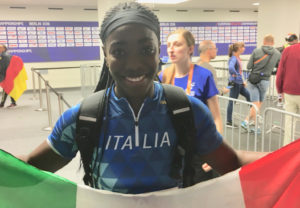
”This year has been so wonderful!” she exclaimed after the competition. “I did my PR (59.72m) at the Angelo State Relays in April, then I won the DII nationals, then I came to Italy, went to the Diamond League meeting in Rome, won the U23 Mediterranean Championships, came her and got fifth. So, like…wow!”

“My first goal was to make it to the finals, so I got to the finals and I was like ‘Wow, what did I just do?’ Then I tried my best to get in the first eight so I could get three more throws, and I don’t know, I just ended up fifth! I ‘m super overwhelmed, so I think I ‘m talking too fast. It is something crazy! I would never have expected it, fifth place in Euro from nowhere?”

And what was it like throwing in front of 60,000 fans?

“I loved it! The cheering! It’s a big stadium, so I was scared that I wouldn’t react to it the right way, but I think I got the right thing!”

I was curious how she managed to stay sharp over the course of a very long season, and Daisy gave equal credit to Nathan Janusey, her throws coach at San Angelo State, and Maria Marello, her coach in Italy.

“They talked a lot and coordinated everything.  And our head coach Thomas Delbert helped me a lot. He knows that I am a transfer student from Italy. He says ‘Don’t worry. Just do this, this, this for San Angelo, then you can do this, this, this for Italy.’ So it worked out great.”

I was also curious how a thrower from Italy ended up attending a university located in San Angelo, Texas.

“They chose me! I got a message from Coach Janusey on Facebook ‘Would you like to come to San Angelo?’ I was like, ‘Uh, I don’t know.’ Then I talked  to my parents and my coach, and they said ‘It will be a great experience, so you have to try it.’”

“It was hard adjusting at first, but we have athletes from all over the world. After a month, I got friends. This is thanks to my biggest problem—my parents say that I can talk to walls, that I can talk to any living thing or not living thing!”

Like Daisy, Shanice Craft was positively giddy over her performance.

She moved to Berlin a year ago to join the training group of Robert and Julia Harting under the direction of Coach Marko Badura, and she was very happy with her new situation.

“I love it! Before, I was in Mannheim and I didn’t have a training group. Now I have two very good teammates. We have a lot of fun, and we push each other. It gives me so much motivation to see them work!”

I asked her if it was difficult to maintain focus that night with all the delays interrupting the flow of the competition.

“I should be able to block that out, but today I had big problems. There were so many breaks from the competition that it was very hard for me to stay focused, and I just felt like I couldn’t do anything in the ring.”

“Lots of my friends and my family were here, and after the fifth attempt I thought, ‘No, I can’t do that to them.’  The last attempt, I wanted something big. I came here to get a medal, and I thought ‘No, it’s not possible that I will get fourth place.’  For my last attempt I thought of Robert Harting’s last throw at the World Championships in 2009. I was here at the stadium that night! Before my final throw, I was watching that competition in my head. I had it in front of my eyes.  I wanted to do the same thing that Robert did that night!”

I reminded Shanice that after winning the gold in 2009, Robert had picked up Berlino—the large, cuddly bear mascot—and romped around with him on his back.

“I have to go to the gym more so I can do that next time!”

I spoke with Nadine Müller next, and it turns out that her less than stellar season up to that point had been due to a back injury she sustained in April which cost her several weeks of training.

“In April, before we were to fly to a training camp, during the final training I injured my back so I could not fly. I missed a lot of throws, I could not throw for three weeks.”

“I have lost so many throws this season,” she lamented. “I hope the rest of this season I can be fine and the next competition throw past 63.00m.”

As with the other throwers, Nadine loved the level of excitement in the stadium, but did not appreciate all the delays.

“I think it’s okay when they start a race to have us break, but there were so many other breaks where they made us wait two or three minutes,  But it is the same always in major competitions.”

Nadine would know, having competed in two Olympics and five World Championships. She won silver in Daegu in 2011 and bronze in Beijing in 2015. I asked if over the years she had been able to develop a method for handling the interruptions.

“Yes,” she laughed. “I‘m the old lady who has so many finals! I think by now it is easier for me. I ‘m a cool down girl, so I can stay focused better than the young ones,”

Just then, the  queen of focus happened by, carrying a large stuffed animal and reveling in another moment of triumph.

She attributed her struggles on this night to an uncharacteristic bout of overconfidence, “Because I was in really good shape, and in the first or second round I was thinking ‘If my discus just go out of the net, I will be European champion.” Maybe I was thinking is going to be easy job for me.”

“Then in the third round  I messed up again, and I said to myself, ‘Oh my god, what is going on? You cannot be yourself?’ Then I also had a nice try in the fourth round, which also went into the net. Then, before the fifth round I started saying ‘Oh my god, your training! Your goals! You have four European gold, and this is your chance for a fifth one like nobody did. You want to miss it?'”

“I told myself before my fifth throw, ‘You want to wait for the sixth attempt in front of a German crowd?’ And then I saw it fly, and I know it is 65.00m plus, minimum. Then I saw 67.62m,

‘All the girls know they need to wait for me and in one round I will get it. I’m used to throws like last year in London, where it was like 69.00m then 70.00m then 70.00m again then 69.00m again. It was an easy peasy competition for me, but this time was strange.”

I asked if she noticed that the crowd was on her side.

“Yes,” she said. “I was fighting against the Germans but they support me! But I didn’t have good, positive vibes around me. It wasn’t the other girls or the crowd.  I was confused, and I never felt that before.”

“The last few days, I had some problems. A bee stung me in training! And one day I was was working and I flipped my ankle. Maybe these things distracted me.”

Having seen how much she relies on Edis during competitions, I wondered if Sondra worried that the stress he must feel on nights like this was might be shortening his life span.

“No, he is a very strong person! After the third round, he really woke me up. He was like, ‘You want the crowd to enjoy this moment or not? Will you waste all your training or will you win a fifth gold like nobody has before?'”

“He knows that if you start talking shit to me, I’ll be like, ‘Are you serious? Now you’re gonna see!”

I ran into Edis a few minutes later. He was slowly making his way through the stands with a friend at his side. He looked drained.

“Come on,” I teased him. “You knew she’d come through.”

His friend spoke up.

“That’s right! We did. It was her fifth European title, so she waited for the fifth throw to win. It all makes sense!”

With that they strode off in search of Sandra.

This was my final night in Berlin, so  I made one last leisurely lap around the stadium then headed for the subway.

Thanks, Berlin, for the most amazing track and field experience  of my life.

Thanks to all the coaches, shop owners, concession stand workers, ushers and and everyone else I ran across on my trip, including my favorite bouncer. Without fail, they did their best to make up for my ignorance of their language by communicating with me in English.  I will never forget their kindness.

And thanks to all the athletes who took the time to chat. I was at the bottom of the media food chain at the Euros, so by the time they got to me in the sweltering mixed zone some had been answering questions non-stop for an hour. I’m sure all they wanted to do was to get the heck of there to celebrate or commiserate with their friends and family, and they were under no obligation to talk to me.  But they were so friendly and so polite, it makes a guy think that maybe he fell in love with just the right sport.


A sweaty and glorious night in Berlin

Have you ever watched the video of the men’s shot competition at the 1988 Olympics? The one where Randy Barnes throws 22.39m on round six to take the lead,  then Ulf Timmerman answers with 22.47m to grab the gold. That throw of Ulf’s is famous (at least among throws nerds) because he raises his fist in triumph even before he sees where the throw lands.

There is one other memorable aspect of that video. The stands are almost completely deserted. The average Saturday morning freshman football game in the US  attracts more spectators than showed up at the stadium in Seoul that day to witness maybe the greatest shot competition ever.

Last night, at the Olympic Stadium in Berlin, the situation was a bit different.

One reason was that the gentleman pictured above, the incomparable Robert Harting, was making his final appearance as a member of the German national team. He has a couple more competitions on his schedule before he hangs up his throwing shoes, but this was his last night representing the Fatherland, and it meant a lot to him and it meant a lot to the fans packed into that end of the stadium.

Here’s a video I took when Robert was introduced last night. The quality is not so good, but the sound is what matters. Take a listen.

http://www.youtube.com/watch?v=3ftI7Q-g9Kg

Compare that to the sound of crickets that probably greeted Ulf’s winning throw in Seoul, and you’ll understand why every single thrower I ‘ve spoken with at these European Championships loves competing in Germany.

And if Robert’s fairwell appearance wasn’t enough to get folks fired up, just a few meters away in that same end of the stadium, the 2015 women’s shot World Champion Christina Schwanitz was competing as well.

As much as the Germans love Robert, I doubt many considered him a candidate to win the men’s discus title last night. After four years spent battling knee injuries, a bronze medal finish was probably the best that Dee Harting could hope for.

Not so with Schwanitz. After taking off the 2017 season while giving birth to twins (Dear God, please let her move to the US so that I can coach those children some day), Christina has returned to twenty-meter form, and in the absence of Hungarian rival Anita Marton, appeared to be a lock to win the gold.

And if that still wasn’t enough to get everyone excited, there were Germans in contention in the men’s long jump and decathlon, which took place concurrently with the throws.

Hence the noise. Hence the madness.

Surprisingly, Schwanitz was unable to feed off the  energy of the crowd to produce a big throw. She tossed right around 19.00m in warmups, opened with 19.19m and never improved.

But, for most of the competition, none of her competitors appeared capable of surpassing her. Poland’s Paulina Guba opened with 18.77m but did not add to that over the first five rounds.

Aliyona Dubitskaya of  Belarus pounded away at the high 18.00m range the entire competition, eventually settling for a best of 18.81m in round five.

The oppressive heat that has settled over much of Europe this summer seemed to take the life out of most of the putters. They had, after all, been through qualification in that same heat the day before. And on this night, they had taken their early warmups under a blazing sun at the throwing area outside the stadium.

Maybe they were all exhausted, and Christina would walk away unhappy with a subpar performance but happy to have won in front of an adoring crowd.

Then, things got a little nutty.

The Polish mojo that has been wreaking havoc in the men’s throws (so far, Poles have taken first and second in the men’s shot and hammer) appeared and lifted Klaudia Kardasz to an U23 national record of 18.48m.

Guba must have gotten a whiff of it as well. She stepped in as the final competitor with a chance to unseat Schwanitz and promptly…well…unseated her with a throw of 19.33m.

Here is a vid of Christina’s final throw. Again, the quality is pretty awful but it will give you an idea of the noise level in that stadium.

https://m.youtube.com/watch?v=Qa8P6RIlFEs

Schwanitz could manage only 18.98m on her final attempt, and as Guba celebrated another triumph for the Polish throws crew…

…a disappointed crowd turned its full attention to the men’s disc.

Humid air. No wind. Enclosed stadium.

These are not the conditions which generally produce big discus throws. And for the first couple of rounds, it looked like anyone who could somehow reach 66.00m would have a good chance at winning.

Apostolos Parellus of Cyprus must love him some dead air, as he opened with a PB of 63.62m. No one else was close to their best.

Daniel Stahl, second at the 2017 Worlds opened with a foul. Andrius Gudzius, the defending World Champion started with, for him, a pedestrian 65.75m.

Gerd Kanter, who had hit the automatic qualifying mark of 64.00m on his first throw the day before, could manage only 59.30m in round one.

Robert, meanwhile, hit 61.09m, a distance that was not likely to buy him the full six throws.

In round two, Gudzius fell to 62.89m but maintained his lead when Stahl fouled a big one—at least 67.00m.

Robert pleased the crowd if not himself with a 63.45m toss, which at least prevented him making an early exit from the competition.

Stahl, facing an early exit himself, went 64.20m in round three. Gudzius answered with 67.19m, an impressive display of horsepower in these conditions.

For a moment in round four, it looked like Robert might be able through sheer toughness and force of will to seize a medal. His 64.33m put him into second place.

The moment did not last.

Stahl, exhibiting his own reserves of grit, blasted one 68.23m to take the lead and knock Robert into third. Gudzius replied to Stahl with another big toss, this one 67.66m.

Then, in round five, Lucas Weisshaidinger of Austria, who had struggled mightily in the qualifying, came through with a toss of 65.14m to oust Robert once and for all from medal contention.

A final round 64.55m from Sweden’s Simon Pettersson and a 64.34m by Kanter pushed Robert further back in the standings.

Here is Robert’s final throw as a member of the German national team.

https://m.youtube.com/watch?v=Hj2VksB-yJs

Meanwhile, Stahl and Gudzius still had to settle the matter of who would go home with the gold.

Daniel fouled his final attempt, so Gudzuis entered the ring needing to surpass 68.23m.

Gudzius is a large man, and he is remarkably fast for his size. Sometimes, he seems a bit out of control, and this may be why he struggled in qualifying. He did not hit the auto mark until his third toss on Tuesday.

But when he hits one right, he generates an astonishing level of power. It took that kind of power to launch a 68.46m final throw for the win.

Afterwards, the competitors were exhausted, drenched in sweat, and very grateful to have experienced a competition in this environment.

Alin Alexandru Firfirica, a twenty-three-year-old Romanian who finished seventh was totally spent.

This European Championships was his first major international meeting at the senior level (he was European U23 champion in 2015) and the experience was a bit overwhelming.

”The stadium is great,” he said.  “And I am in good shape, but today I was tired. It is hot! I start with fifty-eight meters! Every time they stop us when a race starts. It was disturbing. I try to ignore because I don’t have anything else to do. My next meet will be throws only meet here in Germany. It will be fantastic! I hope there to throw sixty-six meters again. Here was hard because we don’t have wind; with wind is possible to throw sixty-seven meters.”

Alin recently wrapped up his studies, and is excited about his future as a thrower.

What did he study?

”Sports, of course!”

Simon Pettersson, who entered the meet with a PB of 65.84m and finished fourth with is sixth round 64.55m effort, said that he loved the energy in the stadium.

“It was very fun. The atmosphere was unbelievable, kind of like Worlds last year. I even like when they run the 200 and everybody is like ‘whoa!’It gives me energy. Sometimes I get too hyped!”

That was apparent tonight, as Simon fouled four of six throws, once literally falling down out of the front of the ring. But, his ability to regain his composure and drill a near PB in the final round bodes well for his future in meets of this caliber.

Daniel Stahl, the Swedish giant, was exhausted, proud, and defiant after the competition.

I asked him how he was able to keep his cool sitting on two fouls going into round three.

“It was mental strength.  I’m really happy. It was great conditions, and I’m very happy. I was focused all six throws. My goal was to win, but I’m really proud of 68.23m. This was great atmoshpere. Germany is really good to track and field. It was a great audience, great people. I really Like Germany. Now, I prepare to win in Doha.”

Unknown to me, these European Championships will also be the final international competition for Gerd Kanter, one of the true gentlemen of the sport.

Though the attention of the crowd was understandably focused on Robert, Gerd was happy to have made his farewell in this stadium.

”As expected, the environment was very good, I remember from 2009, and today everybody focused on the discus. When I was planning my retirement I wanted to have it here. Next year at Doha, I don’t think will be very exciting. This was where I wanted to have my last Championships.”

I told Gerd that the first time I ‘d seen him throw was in Zurich in 2005, and asked him if he remembered being overtaken by Virgilius Aleena in the final round there.

“Yes, but he fouled it! The winner got a nice watch, and he got it. He still owes me that watch.”

“We had just came from Helsinki, the World Championships. I was leading until last round there, too, and he threw a championship record to beat me!”

As long as we were on the subject of the ones that got away, I asked him about the 2012 Olympic Games where he came within one discus length of taking a second consecutive gold medal.

“It was reallyemotional,” he recalled. “But it wasn’t like losing a gold medal, it was like winning a bronze medal. Compared  to Beijing, I was not the favorite. And it was first time I set my season best at a major championships, so I am very proud of that bronze medal.”

The last sweaty giant I spoke with was Lukas Weisshaidinger, who was about as happy as a man on the verge of heat exhaustion can be.


“It was my first time at European Championships, so to come home with a medal, I’m extremely happy,” he told me. “My whole family is here, so this is an awesome moment.”

Lukas had struggled in the qualifying rounds, going Foul, 59.48m, and then finally 62.26m which got him in the final. I asked him how he had been able to get his act together after almost failing to qualify.

“This was a new day. And also, I know that Alekna once placed eleventh in qualification and ended up with gold medal, so I knew I could make a medal today.”

Lukas also credited the atmosphere in the stadium for elevating his performance.

“It was awesome! They clap for everyone, not just the Germans. And there  were a lot of Austrian fans. That gave me power!”

I couldn’t resist asking Lucas how he had developed his rather unique setup at the start of his throw. If you’ve never seen it, he has his left foot back like Tom Walsh in the shot, and he winds the disc very high before beginning his entry.

“I’m not the biggest guy,” he explained. “Or the tallest guy, so I have to make something different, so we try this.”

Is his setup an attempt to increase the path of acceleration? Does it have something to do with creating a certain orbit of the disc?

“That I cannot tell you. It is top secret.”

Not wanting to offend a man that beefy, especially at the happiest moment of his life, I changed the subject and inquired about the future. Was he thinking ahead to Doha?

“It is really hard with the World Championships in October, then followed by the Olympic Games. It is really hard to make a perfect plan for those two competitions.”

I have asked a few coaches recently how they plan to handle their training schedule next year with the Worlds coming so late. But talking to Lucas, I realized that it wasn’t just next year, but the following year as well (when everyone will want to peak for the Olympics) that will be thrown off by the odd schedule.

Torsten Lönnfors, coach of Chris Harting, told me that Chris will be in an exceptionally difficult situation as he is required to put in four weeks of police training at the end of each season. So, if he competes in the 2019 Worlds in October then takes a break then has to do his four weeks with the police, that makes for a very late start for his Olympic preparation.

But those are matters for people much smarter than me to figure out.

This was a night to celebrate giant, sweaty men who devote their lives to throwing things far.

Speaking of which, after all was quiet I stood with a group of journalists waiting for a final word with Robert Harting. But the hour was late, and I had a long train ride ahead of me, so after a while I gave up and began the long walk up the stadium steps towards the exit.

And there he was. Signing autographs, Surrounded by fans. Happy and sad and probably wishing that this long, humid Berlin night would never end.

Torsten Schmidt Lönnfors Discus Webinar Coming Tomorrow!

On December 9th at noon Central Standard Time, Torsten Schmidt Lönnfors, Coach of Rio Olympic Champion Chris Harting, will present a webinar on the German method of training young discus throwers.

Here is an outline of the topics he will cover:

  1. German Support Systems for Young Athletes

sports school

sports clubs

Olympic support center

the role of the German federation

2. Long Term Education Concepts

3. Possibilities for Training During Youth/School Years

4. Planning a Season for Youth Athletes

main training resources

build-up, progression, shaping

condition training

5. My Philosophy on Youth Training

general training

weight lifting/special strength training

training technique/motor learning

6. My Personal Coaching Principles

The cost for this webinar is $30. To register, first follow this link to pay on Paypal.

Next, follow this link to register on Zoom.

You will then receive an email invite allowing you to access the webinar.

Anyone who registers and pays will also be given access to a video of the webinar on Coachtube.


Just rehearsed with Torsten Schmidt Lönnfors for next Saturday’s discus webinar

After the 2004 Olympics I somehow got my hands on a CD with clips from the men’s discus competition, and I often watched it with my throwers. That was the year that the great Virgilius Alekna opened with a titanic 69.89m toss (still the Olympic record) and walked out of the ring looking pissed because he knew that his arch nemesis Robert Fazekas was capable of beating that mark.

Fazekas did, in fact, surpass Virgilius’s record toss (what did he throw, just under 71 meters, wasn’t it?) but then ran into a bit of trouble with the anti-doping folks when they insisted on watching very carefully as he…ummm…prepared to provide a urine sample. The testers had been tipped off that Fazekas had been pulling the old switcheroo and submitting someone else’s clean urine in place of his own.  Much vexed that the testers would not get out of his grill, Fazekas stormed out of the testing room and into infamy.

Also on that CD were clips of Franz Kruger showing off his long-levered fixed-feet style, the super smooth Aleksander Tammert, and a very tall young German named Torsten Schmidt.

Fast forward ten years, and I just happened to be walking through the lobby of a hotel near the Zurich airport when I spotted that tall, still remarkably fit German ambling towards the elevator.

He was in  Zurich coaching 2012 Olympic champion Robert Harting and Julia Fischer (now Julia Harting) at the 2014 European Championships. Another thrower in his stable, Chris Harting, was not competing in Zurich that week, but would go on to win discus gold in Rio.

I accosted him and unleashed a barrage of questions about discus  technique, which he patiently answered then and continues to patiently answer to this day.

Now married to a wonderful woman named Sanna Lönnfors (Torsten has since taken on Sanna’s last name) Torsten has agreed to share his insights on the German method of developing young discus throwers via a webinar to be offered Saturday, December 9th at noon Central Standard Time.

Roger Einbecker (my partner in crime with this website and with our webinars) and I rehearsed Torsten’s webinar yesterday, and I can tell you, it is going to be fascinating to anyone who trains teenage discus throwers.

One clip that Torsten shared with us was of a young thrower he is currently training performing discus steps in a gym while holding a small weight plate. It is the kind of drill that many of us have our athletes do, but Torsten has an approach to it that coaches will find really, really interesting.

Roger and I agreed afterwards that we could have spent the better part of an hour just asking Torsten questions about that clip.

And that is just one segment of what promises to be a super informative presentation.

The cost to attend this webniar is $30. I invite you to join us by following this link to Paypal, and then following this link to register for the webinar.

Attendees will be able to submit questions throughout the webinar. It will last somewhere between 90 minutes and 2 hours.

Afterwards, a video of the presentation will be posted to Coach Tube, where those who have paid the $30 registration fee will be given access to it at no additional charge.

The webinar will be limited to 100 attendees.

I hope you can join us!


Develop young discus throwers the German way: Upcoming webinar with Torsten Schmidt

Since 1992, the first Olympics after German reunification, Germany has produced a remarkable number of discus medalists at the Olympics and World Championships.

I don’t mean to insult the USA, and things are looking up for us after Mason Finley’s bronze-medal performance in London last summer, but take a look at these numbers:

Olympic  and World Championship Discus medals since 1992

German Men: 20  (10 gold)

US Men: 2  (1 gold)

German Women: 7  (4 gold)

US Women: 1 (1 gold)

These numbers illustrate what a great job the Germans have done in developing discus talent, and on Saturday, December 9th, at noon Central Standard Time, German Federation coach (and former Olympian) Torsten Schmidt will offer insights into how Germany has consistently produced excellent discus throwers.

This webinar will cost $30 and last from 90-120 minutes. Attendees will be able to submit questions throughout the presentation.

To register, follow these two steps.

  1. Follow this link to pay $30 on Paypal.
  2. Follow this link to register for the webinar.

Once both steps are completed, you will receive an email invite to the webinar.

This webinar will be limited to the first 100 registrants.

Unlike our previous webinars, a recording of this one will not be posted to Youtube.


Torsten Schmidt Webinar “German Discus Training for Young Throwers” to be presented December 9th

Torsten Schmidt, the coach of Rio Olympic gold medalist Chris Harting, will present a webinar on  “German Discus Training for Young Throwers” on Saturday, December 9th at noon Central Standard Time.

This is an unprecedented opportunity to get an inside look into the system which has produced many World Championship and Olympic medalists.

Torsten’s presentation will focus on the training of discus throwers under the age of twenty.

Here is an outline of the topics he will cover:

  1. German Support Systems for Young Athletes

     sports school

     sports clubs

     Olympic support center

     the role of the German federation

2. Long Term Education Concepts

3. Possibilities for Training During Youth/School Years

4. Planning a Season for Youth Athletes

     main training resources

     build-up, progression, shaping

     condition training

5. My Philosophy on Youth Training

     general training

     weight lifting/special strength training

     training technique/motor learning

6. My Personal Coaching Principles

7. Questions/Discussion

After making the discus final at the 2004 Olympics, Torsten transitioned to coaching and gained valuable experience mentoring young throwers at the Federation Training Center in Neubrandenburg. While there, he helped develop  outstanding young athletes  such as Anna Ruh, Patrick Muller, and Henning and Clemens Prufer,

For the past several years he has been based in the Federal Training Center in Berlin. In 2016, he coached Robert Harting, Julia Fischer Harting, and Chris Harting to the Rio Olympics where Chris won the gold medal.

The cost for this webinar is $30.  Attendees will be able to submit questions throughout Torsten’s presentation. This webinar (the presentation and the Q&A segment) will last somewhere around 90-120 minutes.

Unlike our previous webinars, a video of Torsten’s presentation will not be posted to Youtube.

Registration for this webinar requires two parts. First, fill out this registration form.

Next, use this link to pay the registration fee on Paypal.

You will then receive an email invitation to attend the webinar. This invitation will be sent by December 1st.

If you have any questions regarding this webinar, please contact Dan McQuaid at daniel.mcquaid@cusd200.org


London Predictions: Women’s disc

Could anyone blame Sandra Perkovic for being distracted or just plain tired?  Traveling all over the  world doling out ass-beatings for years on end has got to take something out of you.

And I’m not being facetious.

I interviewed Valerie Adams a few years ago when she was near the end of a fifty-meet undefeated streak, and though clearly determined to maintain her domination, she also seemed worn down by the effort it took to stay on top for that long.

Same for Robert Harting when I spoke with him in the summer of 2014, while everything was still going his way. He was three-time World Champion. Defending Olympic Champion. The next day, at the New York stop on the Diamond League circuit, he smashed a 68-meter throw on a humid morning with the smell of garbage in the air. (Apparently, Icahn Stadium was built over a landfill.)

Robert was at the height of his uber mensch phase, capable of willing the disc 68 meters whenever he wanted, and yet…talking to him you could tell that like Val, he was weary of the  grind and looking ahead to retirement.

So when I started seeing photos like this…

…posted by Sandra on Instagram early this year, I began to wonder if maybe she was a little bored with the incessant training and travel, with maintaining the laser focus necessary to win two Olympic and one World Championships gold.

She had always been in great shape, but in the pictures she posted this summer she seemed to be noticeably thinner than in the past.

Could it be that looking glamorous had become more important to her than winning medals?

Uh….no.

Two weeks ago, she hammered a PR of 71.41m, thus serving notice on any knuckleheads out there who might have doubted her that they were mistaken.

Yes, Sandra, that sound you hear is me munching on crow.

A quick digression. I fear that my remarks on Sandra may come across as  sexist. What, can’t a woman look good in an evening gown and still throw 70 meters?

But another fine thrower, the American shot putter Jordan Clarke…

…also had me wondering this winter when he frequently posted images of himself powering through high volume, cardiac-heavy workouts–not the kind of training one would  indulge in if one’s main goal in life was to make a sixteen-pound ball go far.

The  slimmer Clarke became from those workouts, the more I wondered about his intentions for the upcoming season. And, as it turns out, he did retire from the sport.

Anyway, I just want everyone to know that I’m an equal opportunity doubter.

And Jordan, I know that it has always been your dream to appear in an article about female discus throwers. so…you’re welcome.

That said, if Sandra Perkovic is indeed in top form, does anyone have a chance of beating her in London?

How about Cuba’s Jaime Perez?

Built like a long jumper, she is an ardent practitioner of the “haul ass and knock the crap out of it” approach to discus throwing.  And she has had a sensational year, hitting a PR of 69.19m and beating Sandra head-to-head on more than one occasion.

How about Australia’s Dani Stevens (formerly Dani Samuels)?

After winning the 2009  Worlds in Berlin as a nine-year-old (that’s what it seemed like, anyway) her best finish in an Olympics or Worlds since is fourth in Rio.

But she threw 66.78m as recently as March, and she has tons of big meet experience.

How about Melina Robert-Michon of France?

Her tenth-place finish at the Beijing Worlds in 2015 prompted me to leave her out of my Olympic preview last year. She responded to that slight by belting a PR 66.73m in Rio to nab silver.

Her best throw so far this year is 63.63m, good for 14th on the world list. At the age of 38, she might be over the hill but she also might be lying low in an effort to make me look ridiculous again.

How about Gia Lewis-Smallwood of the United States?

She is the same age as Melina, but a very nasty back issue prevented her from even competing in Rio. It is something of a miracle that she is once again in fighting trim and currently ranked fourth in the world with a toss of 65.81m.

A throw like that wouldn’t win in London, but would likely get her on the podium.

The best of the German women this year is the veteran Nadine Muller.

A two-time World Championships medalist, her season best of 65.76m has her tied for fifth on the world list. As far as I can tell, she did not compete at the German championships this month, which made me wonder if she was injured, but she is on the team for London, and if healthy surely a threat to medal.

The best of the Chinese is Xinyue Su, currently ranked eleventh in the world with a season’s best of 64.08m.

She finished fifth in Rio.

Time for predictions.

Trofimuk

Gold: Perkovic

Reason: I quote: “She is the best there ever was and ever will be.”

Silver: Perez.

Bronze: Stevens.

McQ

Gold: Perkovic.

Reason: When Cuba’s Denia Caballero defeated Sandra in Beijing, she did so by dropping a 69-meter hammer on  her in round one.  At the time, Sandra was dinged up and 69 meters was beyond her range, so the competition was essentially over after one round. Perez would like nothing better than to follow her teammate’s example and kill one early, but Perk’s recent 71.41m suggests that she’s got the stuff to match anything Jaime can muster.

And, if it comes down to a battle of will, nothing against Perez, but…good luck.

Last year in Rio, Sandra showed her mettle when she walked into the ring for her third throw during the rain-soaked prelims sitting on two fouls. She threw 64.81m to advance.

The next morning, she opened the finals with…two fouls. A lesser person might have pooped the pants at such a moment. Sandra coolly drilled a 69.21m bullet that snagged her the gold.

A few years ago, I had the privilege of watching Sandra compete up close and personal at the New York Diamond League meeting. For some reason, the TV people wanted the discus out of the  way before the rest of the meet started, so I want to say warm-ups began at 9:30am.  Something like that. And it was fah-reeeezing out! Forty degrees with rain and a nasty wind. In late May. I like to have died.

Anyway, due to the early start and the conditions, I think Sandra’s coach Edis Elkasevic, my friend Peter Trofimuk (brother of Pat who helps me with these predictions) and I were about the only spectators in the stadium when the discus started, We stood where we could get the best view of the discus cage, and between every warm-up and competition throw Sandra came over to confer with Edis. I couldn’t understand what they were saying because they were not speaking English, but I could tell that in spite of the conditions, Sandra was jacked about competing that day.

She struggled on her first two or three attempts, and after one of them an official tried to block her from crossing the track to check in with Edis. Mind you, this was a couple of hours before the running events began, and the track was deserted, so I’m not sure what this guy was thinking, but no matter.  Sandra strode right past him, and when he protested she turned and said “You shut up, you!”

He did shut up, and a couple of throws later, Sandra got into that slick ring with a cold mist blowing sideways and knocked out a 68-meter throw to take over the world lead.

I wish I could say that the crowd roared in appreciation, but Edis, Peter, and I were too frozen to move our mouths.

Anyway, you get the idea.

Whatever happens in London, whatever Jaime or Mother Nature throw at her, Sandra will respond.

Silver: Perez.

Reason: She’s got more pop than anyone in the field aside from Perkovic. That will be enough to keep her ahead of a tightly packed group in which less than two meters separates those ranked numbers five thru thirteen in the world.

Bronze: Gia.

 Reason: Oh, why the hell not? If millions of Game of Thrones fans can convince themselves that there were dragons and people with perfect teeth running around during medieval times, why can’t I believe that a thirty-eight-year-old recovering from a serious back injury can conjure up  the performance of her life to win her first World Championship medal? I have one thing to say to those who doubt her. “You shut up, you!”


London Predictions: Men’s Discus

As with the men’s shot put, the men’s discus competition in London will feature a giant dude who has spent the summer dropping bombs.

That would be the big Swede, Daniel Stahl, who has four competitions over 68 meters this season including a 71.29m blast on June 29th at the Folksam Grand Prix meeting.

In London, Stahl will seek to exorcise memories of an awful performance in Rio where a best effort of 62.26m did not get him to the final (this, after finishing fifth at the  2015 Worlds in Beijing with a toss of 64.26m).

Oddly, Stahl’s main competition in London will come from three other athletes whose experiences in Rio were also at least semi-disastrous.

Frederick Dacres produced a groan-inducing best of 50.69m in Rio, but has looked fast, powerful, and confident on the Diamond League circuit this summer, hitting 68.36m in Stockholm, 67.10m in Oslo, and 66.66m in London.  Also, like Stahl, he performed well at the 2015 Worlds, finishing 7th with a toss of 64.22m and thus proving that he has the ability to make the final at a big meet in a big stadium.

Philip Milanov staked his claim as next great thrower on the horizon by taking silver at Beijing in 2015, then bit the weenie in Rio where he finished ninth. He has looked sharp this season with his best effort of 67.05m coming in Stockholm.

Robert Harting, arguably the best big meet thrower since Al Oerter, looked ready to  pull off a major comeback in Rio after blowing out his knee in the fall of 2014 and missing the entire 2015 campaign. He won the German championships in 2016 with a 68-meter effort, but suffered a back spasm the night before the Rio prelims while bending over to turn out a light. His best mark this year is 66.30m, but if the young bucks tighten up a bit and those Rio memories start to nag, can he be counted out?

Three of the top four finishers in Rio will not be competing in London. Neither gold medalist Chris Harting, who suffered an early spring back injury that threw him completely out of kilter, nor bronze medalist Daniel Jasinski made the German squad. Fourth place finisher Martin Kupper managed a season’s best of 62.86m.

Last year’s silver medalist, however, will compete and in spite of a lackluster 2017 campaign must be considered a threat to make the podium.

That would be Beijing champion and perennial victim of various Hartings, Piotr Malachowski. His best of 65.90m puts him tenth on this season’s performance list, and for the first time in about a hundred years he did not win the Polish championships, but his experience and toughness make him a contender.

Speaking of contenders, there are twenty-two throwers who have gone beyond 65 meters this year, among them Gerd Kanter (65.87m) who even Malachowski probably refers to as “Gramps,” Robert Urbanek (66.73m) who  defeated Malachowski at the Polish nationals, and the Lithuanian Andrius Gudzius (68.61m).

That said, let’s make some picks.

Trofimuk

Gold: Milanov

 Reason: As Trofimuk humbly puts it, “He is the only sensible pick. His performance at Beijing gives him the edge over the guys throwing the best this season.”

Silver: Malachowski

Reason: “He always performs well at the World Championships.”

Bronze: Stahl

Reason: “He’s having a great year. He’s young and  hungry for a medal at a major championship. Plus, he’s bigger than a refrigerator.”

McQ

Gold: Harting

 Reason: When the young bucks Milanov, Stahl, and Dacres start warming up in London, everything had better go right for them or Rio-inspired self questioning might be tough to suppress. Those guys are only human, right? Harting might be too, but he’s that odd, Michael Jordan kind of human who performs best in situations where others would be mired in doubt. In 2009, Malachowski throws a national record 69.15m in round five at the Berlin World Championships putting Harting in the position of having to conjure up a PR in  round six. We all remember how that turned out. At the London Olympics, he felt like crap. At the Moscow Worlds, he had a back injury. He still found a  way to win. If nerves or what have you keep the best throwers in the 67-meter range next week,  he’s my pick to squeeze out a winner.

Silver: Stahl

Reason: Like Trofimuk, I respect a man who could punch out a dinosaur. Even if he has a kind-of-crappy day, he’s going  66 meters.

Bronze: Malachowski

Reason: Sentiment. Watch this ESPN vid and tell me you won’t be rooting for him:

http://www.espn.com/videohub/video/clip?id=19906682&categoryid=null