Category Archives: Shot Put

It’s not so simple, this qualification business


Tuesday morning at the European Athletics Championships featured an embarrassment of riches for throws fans. Two rings full of women shot putters vying for the automatic qualification mark of 17.20m that would advance them to Wednesday’s final. And, running concurrently with the women’s shot, two rounds of men’s discus featuring some of the best throwers in the world, among them 2016 Olympic Champion Chris Harting and 2017 World Champion Andrius Gudzius. The qualification line for the men’s disc was 64.00m, which many of these athletes had thrown in previous competitions. But, as it soon became apparent, 64.00m can seem awfully far if something knocks you off your rhythm. The early hour. The unusually hot conditions (Germany, like much of the rest of Europe, is in the middle of an historic heat wave). An unusually fast or slow throwing surface.

Some made qualification look easy.

Christina Schwanitz, much to the delight of the crowd (as she is German and the favorite to snag the gold here) went 18.83m on her first attempt. Thank you, and good day.

Daniel Stahl, the silver medalist at last year’s World Championships in London,  also launched his first throw well past the qualification line (it turned out to be 67.07m) raised his arms in triumph and headed off to rest for Wednesday’s final.

On his way out, I asked Daniel if he generally takes something off a first round throw in order to avoid fouling.

“No,” he replied. “Always 100 percent.”

This approach seems to suit the big man’s personality. Stahl is the kind of guy who, if you were a kid, would be your favorite uncle. Large. Easy going. Always smiling.  Not the kind of person whose confidence would be ruined by a first round foul.

For some, though, it was not so simple.

Poland’s 2015 World Champion Piotr Malachowski would appear to be cut from the same mold as Stahl.  He comes across as very even-keeled, and has been through many, many qualification rounds at major competitions.

Somehow, though, after warming up at 65.00m, Piotr simply could not find his timing when the throws counted. He walked out on his first attempt (it looked to be about 57.00m), caged his second, and misfired badly on his third, ending up without a mark and without an invitation to the finals.

Afterwards, he seemed perplexed.

“My shape today was very good,” he said. “My practice throws were good, then…I don’t know. I don’t know what happened.”

Piotr seemed ready to shake off this experience though. When I asked if he planned to continue throwing through the Tokyo Games, he replied, “Of course. It is my dream. A gold medal!”

While Piotr was suffering his inexplicable meltdown on one end of the stadium, two young shot putters came away from their first ever qualifcation rounds at a senior international competition smiling and utterly delighted to have made the final.

One, British Champion Amelia Strickler, threw a PB of 17.31 on her second attempt.

”I ‘m so excited!” she said afterward. “It was amazing being out there because this is such a big venue, and that’s what you want. You want the big stage. Even though the stadium wasn’t quite full, you could still feel the atmosphere. I can’t wait for the final!”

Like Amelia, twenty-year-old Alina Kenzel surpassed the qualifying line on her second attempt.

Her throw of 17.46m was the seventh best among qualifiers.

She told me afterwards that she was “very excited because it was my first big international event. I was very nervous at the first attempt, but the second it was like ‘okay just do your thing just like training’ and it was the standard for the finals!”

“After my first throw, everybody was saying ‘Alina go on!’ I was like okay,okay, keep going, keep going. Then, it was like boom! I ‘m done, so now I can go to the hotel and have some rest and tomorrow the final.”

Another competitor who seemed just as excited by his success in qualification was the great veteran Gerd Kanter. He threw 64.18m on his first attempt and was positively giddy after.

”I’m old,” he joked. “So, in this heat I have to do it on the first throw. Out there, we were like chickens in ovens.”

After all the success he’s had, including winning the gold at the Beijing Olympics, Gerd still prepares conscientiously for qualification days.

“I would say the qualification procedure is most difficult at these competitions. If you are in the final, it is already like regular competition, but in qualification, you only get two warm-up throws, it is the early morning, it’s not comfortable. So, in training, we practice making a safety throw.”

“We call it a safety throw because you don’t need to go full out. You don’t need 67.00m or 68.00m. The line is 64.00m, so that’s what you need. So, in a safety throw you take less risks. You are not going to go as far back in your backswing, you just make it very simple to avoid errors. One part of training for a championships is we always make two or three throws where the coach says ‘Okay, you need to do a safety throw.’ So not a maximum effort, but you must throw maybe 63.00m.”

The most surprising moment of this qualification day came when defending Olympic champion Chris Harting failed to advance.

Chris showed that he was in good shape two weeks ago by winning the German Championships with a toss of 66.98m, and most observers would have considered him a candidate to challenge Stahl and Gudzius for the title here, in the city where he lives and trains.

But, one chink in Chris’s armor is that his natural release point often sends the discus down the right side of the sector, and depending on the type of the cage, he sometimes has trouble getting off an unimpeded throw.

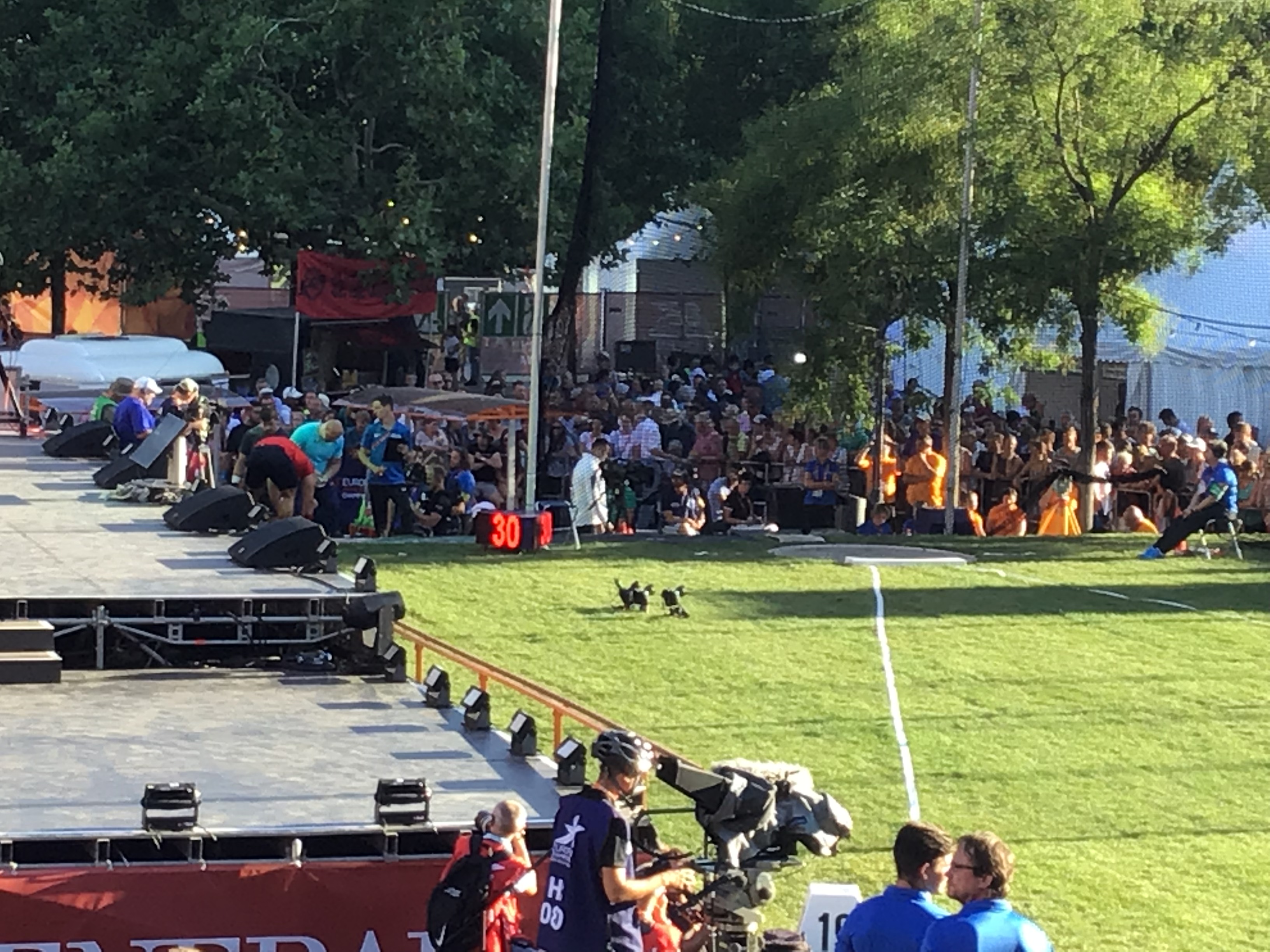
His coach, Torsten Lönnfors, told me later that the type of cage used for this year’s  European Championships makes it difficult for Chris to throw in his natural slot because it is shorter than cages normally used in international competitions, with the front support standard jutting out in just the spot where Chris’s throws often travel. Notice the difference between the cage in the photo above at a different competition, and the one below in a photo from yesterday’s qualification round.

I highlighted the front standard to make it easier to see. Torsten told me that they had tried (and apparently succeeded) in practice to get Chris comfortable throwing with this type of cage, and in warmups he was able to throw a nice, clean 65.00m toss. But, Olympic champions are humans, too, and maybe once that first competition throw ricocheted off the cage…maybe all of a sudden throwing in your home town with all eyes on you and the music turned loud each time you entered the ring…maybe it just got to be too much.

After three throws off the cage resulted in three fouls and a humiliating exit from the competition, Chris had to face a very disappointed German media.

Afterwards, he graciously spoke with me for a few moments. Heartbroken, he struggled for words to describe how this had come to pass.

”It took less than 63 meters to qualify,” he said, shaking his head in amazement. “I can throw that from a stand.”

Just one of those days?

“Yes,” he replied. “That’s a good way to put it. Just one of those days.”


Deutschland über alles

Call it “heaven” or “nirvana” or “Iowa.”

Call it what you want, but if you are a fan of the shot put, what took place in the shadow of the Kaiser Wilhelm Memorial Church in the heart of Berlin today was pretty close to perfect.

Especially when you consider that this spot, known as Breitscheidplatz, was the site of a terrorist attack in the winter of 2016. Typical of such incidents, the attack was meant to destroy Breitscheidplatz as a thriving public place (the attacker struck during a popular Christmas market).

Part of the German response to that effort was to wedge a world class shot put competition into the narrow confines of the Platz.


They built a wooden platform approximately four feet high, covered it with turf, erected some temporary bleachers, and invited people to come and watch for free.

And come they did.  The atmosphere (and I mean this as a compliment) reminded me of a high school football game on a warm September evening in a small town in the United States. People cheered and chanted and dressed in semi-ridiculous outfits. An entire section wore matching red hats and lime green t-shirts.

There was an endearingly lame pep band. There was recorded music (everything from Michael Jacksons’s “Don’t Stop Till You Get Enough” which elicited a 19.54m toss from Luxembourg’s Bob Bertemes, to Billy Squier’s “Slowly Stroke Me” which greeted Bosnia and Herzegovina’s Kemal Mesic as he walked into the ring for his third throw sitting on two fouls. He went 18.70m and missed the final).

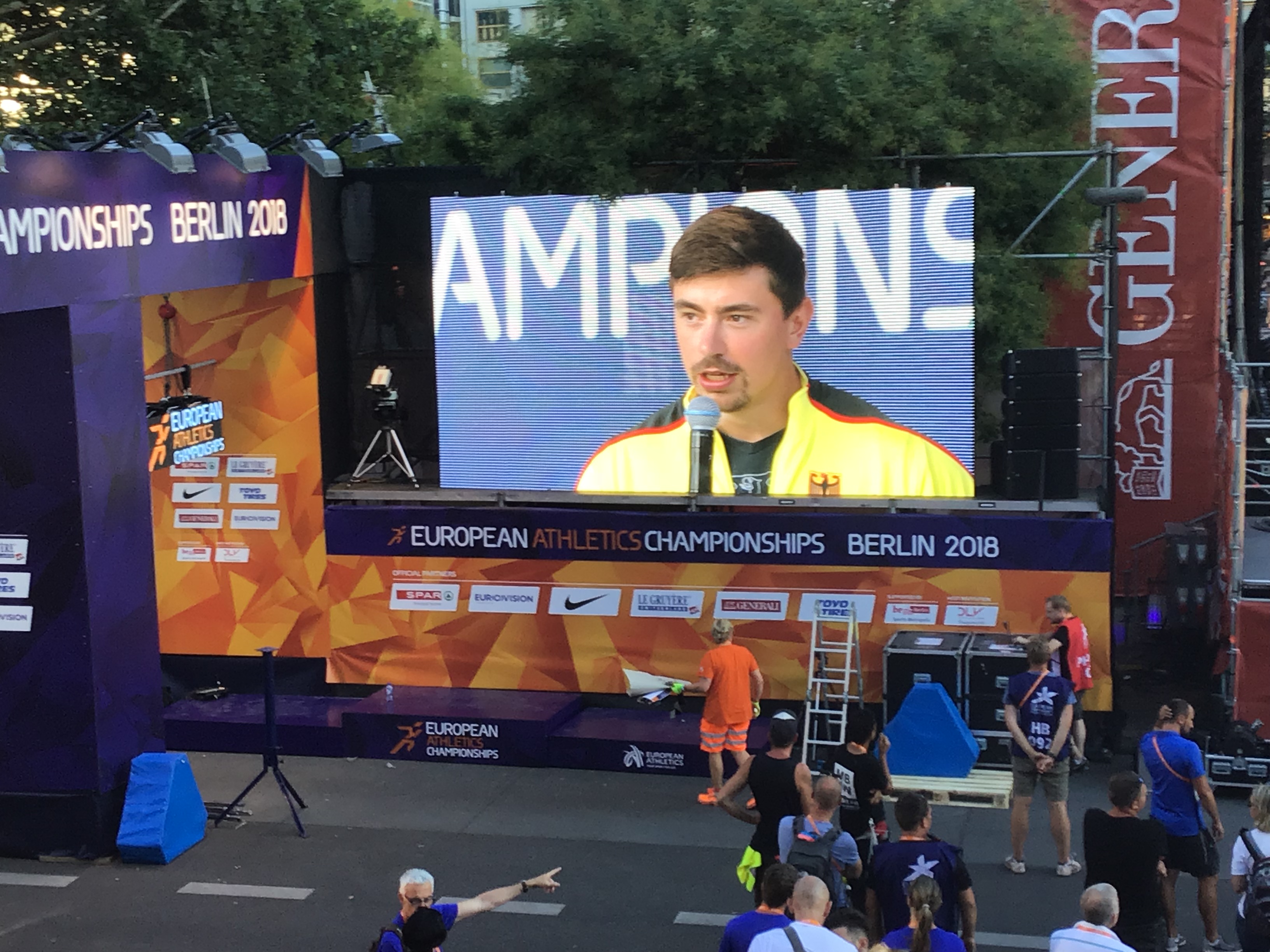
There were large video screens. The one that I was facing showed a slo-mo replay of every…single…throw.

There was drama. In round three, Bosnia and Herzegovina’s Mesud Pezer dropped one right at the automatic qualifying line of 20.40m only to have his effort nullified as a foul. He protested, and as the officials discussed the matter, the crowd was treated to several slo-motion replays of the throw, which caused them to boo lustily when it appeared that Pezer had commited no obvious infraction. It seems that he was called for the phantom right heel on the toeboard on his reverse, similar to what happened to Joe Kovacs in last year’s World Championships. This time, however, reason prevailed and the call was overturned. Pezer’s throw turned out to be 20.16m, enough to secure him a spot in the final.

There was big time homerism. Homegrown favorite David Storl received an ovation for warming up (two fixed-feet glides, one around 19.00m and another around 20.60m), for being introduced, and for hitting an automatic qualifier of 20.63m on his first attempt (he reversed on that one).

As round two ended for Storl’s group, the competition was briefly halted while the MC for the night interviewed David.

I ‘m not sure that was totally fair to those in the field who were still hoping to hit a qualifying mark, but the crowd loved it.

And that’s the thing. The crowd was active and happy and alive throughout the entire competition. How often can you say that about any track and field preliminary?

One thrower who thrived on the atmosphere was Nick Scarvelis, representing Greece.

”Qualifying situations are almost always in an empty stadium at nine in the morning on the opposite side of the track from some empty stands,” he told me after making it through to Wednesday’s final with a season best of 20.20m. “So I ‘d like to see more of this type of thing.”

I was curious as to where the throwers took most of their warmup attempts, as they seemed to be allowed only two on site. Had they warmed up at the Olympic Stadium practice facility before traveling to the Platz?

“No,” Nick explained. “We warmed up at another practice track. They actually put a ring in the middle of a park inside of a university. There was like a three-hundred-year-old column next to the shot put ring. But it was still a twenty-minute drive away, so it wasn’t exactly ideal.  A lot of guys were complaining, but I didn’t mind. The music. The atmosphere. Throwing in the shadow of the church. I loved It.”

Two others who prospered were Craoatia’s Stipe Zürich, the bronze medalist in last year’s World Championships, and Poland’s Michael Haratyk, the silver medalist from the 2016 European Championships in Amersterdam. Each surpassed the automatic qualifying mark on his first attempt, and they are the two most likely to give Storl some trouble as he strives to notch his fourth European Championships title.

The final will take place inside the Olympic Stadium on Tuesday night, and though there might well be 50,000 fans going nuts for Storl, I don’t know if the atmosphere there or anywhere else can match what the Germans created tonight.

At one point during the competition, the bells of the Kaiser Wilhelm Church rang out.

https://m.youtube.com/watch?v=Xl4Zpe74t6c

I won’t say they were heralding a German shot put renaissance, a return of David Storl to his top form. There was something more to that sound. A little defiance maybe, and a lot of joy over thousands of people coming together on a warm Berlin night to…well…to have fun.


Coach Nathan Fanger webinar now on Youtube

Coach Nathan Fanger of Kent State University spent an hour with us this past Thursday breaking down the rotational shot put technique of Danniel Thomas-Dodd, the 2017 NCAA champion and 2018 Indoor World silver-medalist.

It was a fantastic presentation.

I have spent twenty-seven years obsessively tinkering with how best to coach the rotational shot, and I learned a bunch from Coach Fanger’s analysis of Danniel’s form.

His approach with Danniel is very different from anything I’ve tried over the years, and I can’t wait to work on some of his concepts with my athletes.

Those attending the webinar live were able to get their questions answered directly by Coach Fanger. You won’t be able to do that, but if you are at all interested in the rotational shot, I think you’ll love the video of his talk. Here it is:

https://www.youtube.com/watch?v=POhbm1pgVec&t=6s


Free Rotational Shot Put Webinar with Coach Nathan Fanger

McThrows.com is extremely jacked to present a free webinar on rotational shot put technique with Nathan Fanger, the long time throws coach at Kent State University.

This webinar will take place on Thursday, July 26 at 7:00pm Central Standard time.  You can register here.

During his time at Kent State, Coach Fanger’s throwers have won fifty Mid American Conference titles.  Thirty-three of Nathan’s throwers have qualified for the NCAA Championships, with fourteen finishing as All-Americans including Reggie Jagers (who last month won the USATF title in the discus) and Danniel Thomas-Dodd, 2017 NCAA shot put champion, 2018 Indoor World Championships silver medalist, and 2018 Commonwealth Games champion.

In this webinar, Coach Fanger will break down Thomas-Dodd’s rotational shot put technique, which is quite a bit different than the standard American approach to rotational throwing.

A year ago, I interviewed Nathan on this topic, and his explanation of Danniel’s technique was really interesting. You can find that interview here.

This webinar will be a unique opportunity to get an inside look at the technique of a world class thrower. Participants may submit questions to Nathan throughout the presentation. Whether you coach beginning or advanced throwers, I think you’ll find this to be fascinating discussion.


Jessica Ramsey intends to contend

Remember that moment in Rocky when out of nowhere he decks Apollo Creed in the first round?  Nobody in the place thinks he’ll so much as lay a glove on Creed,, and then…Bam!…he lands a haymaker. In the end,  Rocky did not win the that fight, but that punch and his ability to hang tough for fifteen rounds against overwhelming odds gave him credibility as an athlete and changed the course of his career and his life.

Okay, I know Rocky is a movie. Don’t mistake me for those Game of Thrones fans who can’t wait for time travel to be invented so they can go back and get a look at a dragon.

But I witnessed a very Rocky-like moment in real life recently. It occurred, ironically enough, during the first round of the women’s shot at the USATF Championships in Des Moines.

As I sat down on that perfect Sunday afternoon to watch flight two warm-up, I anticipated a hard-fought battle between the current NCAA shot put champion Maggie Ewen and the defending USATF champion Raven Saunders.

I’d also hoped that Rio Olympic champ Michelle Carter would push the youngsters and make it a three-way contest, but it became clear during warm-ups that she was not in shape to do that. (Afterwards, Michelle revealed that that she was still recovering from off-season knee surgery.)

No other thrower seemed likely to break 18 meters, and since Ewen and Saunders were reliable 19-meter throwers, this was clearly going to be a two-person race.

It turned out, however, that I’d missed something during warm-ups, a clear sign that a third contestant might just upset the form chart.

Twenty-six-year-old Jessica Ramsey, who had finished fifth in the hammer competition a day earlier and who came to Des Moines with a lifetime best in the shot of 18.42m, had warmed up with several non-reverse throws, each of which had traveled around 17 meters.

As signs go, this was admittedly a subtle one.

According to the Bible, signs foreshadowing an earth shaking event may include “distress of nations in perplexity…the roaring of the sea and the waves, people fainting with fear and with foreboding.”

Nothing in there about fixed-feet fulls.

But to two people present in Drake Stadium that day, Ramsey and her coach John Smith, those warm-up throws portended a cosmic shift in the women’s shot.

 Ramsey recalled later that those warm-up tosses “told me I was going to get it.”

Smith recalls seeing them and thinking, “Okay, here it comes.”

And come, it did.

Ramsey strode into the ring on her first throw and absolutely killed one.

“After warm-ups,” she recalled later, “I  prayed and did my little meditation. Then, on that first throw when I hit the middle and  I stayed in, I felt like it was a good one.”

It was. The throw measured 19.23m.

It was a three-foot PR and the seventh best throw in the world this year. In the space of a couple of seconds, Ramsey had gone from an anonymous member of a large group of better-than-average American female shot putters to one of the best in the world at her event.

Actually, it took a little longer than a couple of seconds.

Ramsey graduated from Western Kentucky University in 2014 having put together a fine college career (seven-time conference champion, all-American in the shot) under a fine college coach (Ashley Muffet, now at Ohio State). Her PRs though (53.84m in the disc, 61.44m in the hammer, and 17.49m in the shot) were not necessarily those of a future world-class thrower.  Ewen, by comparison, just graduated from Arizona State having thrown 62.47m in the disc, 74.56m in the hammer, and 19.46m in the shot.

In spite of this, Ramsey was determined to pursue a career in the professional ranks, so she packed her belongings and relocated to Carbondale, Illinois, to train with Smith, at that time the throws coach at Southern Illinois University.

Two months after her arrival, Ramsey’s determination received its first test when Coach Smith and his wife Connie Price Smith accepted an offer to take over the track program at Ole Miss. Ramsey describes that moment as “very hard for me. I had just moved to Carbondale! I’d packed up everything and spent all my money to move there, and a couple of months later I had to pack up again.”

After settling in Oxford, Mississippi, Ramsey had to figure out how to support herself while also leaving time to train.

“When I first came to Mississippi, I worked at a senior care facility, a daycare facility, and a company called Insomnia Cookies. That kind of hindered my practicing.”

“Later, I got a raise at Insomnia, so I dropped the senior care job. After that, I  got hired at Dicks Sporting Goods, so I dropped the daycare job. That’s where I’m at now. Most of the time, I work seven days a week just to pay the bills.”

In spite of this, under Smith’s tutelage Ramsey kept improving in the hammer and the shot.

As a glide shot putter, Ramsey could not have found a better, more experienced coach than Smith. Many years ago, Smith developed a reputation as the best glide shot coach in the United States. He honed his skills at teaching the glide while guiding Connie to a long and remarkably successful career that began in the 1980’s when winning international medals meant beating the Commies, and lasted until the early 2000’s by which time the fall of the Eastern Bloc and the advent of stricter drug testing protocols had significantly altered the nature of the sport.

Throughout most of Connie’s career, all evidence indicated that the glide technique was the most reliable path for a female shot putter to win a medal at a major championship.  

It was not until Jill Camarena-Williams nabbed bronze at the 2011 Worlds that a rotational shot putter broke through. Prior to that, every World and Olympic medal awarded in the women’s shot had been won by a glider.

But the increasing success of the rotational technique among the men (including a sweep of  shot medals at the 2000 Olympics) caused Smith to believe that women could benefit from adopting the rotational technique as well.

In March of 2014, shortly before Ramsey joined his training group, Smith posted an article in which he made a compelling case that it was time for female putters to abandon the glide. 

So Ramsey was in for a bit of a surprise when she arrived in Oxford. Smith wanted to convert her to the spin.

She did not give in easily.

“The first year,” Smith told me a couple of days after the USATF meet, “she fought me on it. If the spin wasn’t working for her in practice, she’d go back to the glide.”

Ramsey has similar memories of that period. “I didn’t want to change because I was consistently throwing  58-59 feet with the glide, and when we tried the spin it was so hard! Some days I’d be like, ‘I got this!’ Then other days, I’d be slipping in the middle, fouling, dropping my elbow, and I’d think, ‘I’m going back to the glide!’ The thing about the spin is, if you miss one thing then the whole throw is messed up! That’s what’s frustrating about it. Even at meets, I’d sometimes start with the spin and then switch to the glide.”

Complicating matters was the fact that over her first two seasons with Smith, Ramsey pushed her glide PR into the 18-meter range. But Smith still felt that she was wasting her potential.

“She’s 5’6”, which is too small to be more than a sixty-foot glider. She’s explosive as hell, but her top end in the glide will never be what it is in the spin.”

Matters came to a head at the 2016 Olympic Trials.

“She didn’t throw worth a crap at the Trials,“ Smith recalled, “and a couple of days later at practice right there in Eugene, I said, ‘You need to change to the spin. I know for a fact from training people over the years that the spin is nine to nine-and-a-half percent better than the glide. If you add that on to your glide, you’re a sixty-six-footer!’”

Finally, a year ago, Ramsey committed fully to the rotational technique. Job one was to master the art of using the ground or, as Smith calls it, “working the Earth.”

Over many years of careful observation, Smith came to believe that gliders and non-reverse discus throwers shared a quality that was often missing from the technique of rotational putters: a strong connection with the ground. As he saw it, discus throwers and rotational putters who focused too much on getting air time–whether during the non-support phase or as they launched the implement from the power position–were sacrificing distance and reliability.

He discussed his theory in this article first posted in 2003. (Note: Check out Smith’s vision of the kind of rotational putter who might eventually threaten the men’s world record. It calls to mind a certain Sasquatch-sized Olympic record holder who was eleven years old at the time Smith wrote the article.)

Long story short, Smith made Ramsey take a whole lotta fixed-feet throws over the past year.

It all finally came together in Des Moines. After her huge throw, Ramsey felt the emotions welling but tried to hold them back. “I had to compose myself because I didn’t want it to look like I didn’t know I had a throw like that in me.”

She didn’t come close to 19 meters again (her series went 19.23m, 17.65m, 17.61m, F, 18.24m, F), and she didn’t win (Ewen passed her in round five with a toss of 19.29m) but that one throw was enough to get her an invitation to her first Diamond League meeting (in Rabat on July 13th) and perhaps usher in further life changes that will make staying in the upper echelon of putters a bit easier than getting there in the first place.

A strong showing in Rabat could get her invited to the Diamond League meeting in Monaco on July 19th. She is also scheduled to compete at the NACAC Championships in Toronto in early August.

If she finishes the year with a top-ten world ranking, Ramsey will likely qualify for the USATF tier system, which will allow her to  have health insurance for the first time since leaving college.

Additionally, Ramsey hopes to soon be sponsored by the New York Athletic Club. Should that happen, she would be able to cut down to working only one job and have more time to recover from her daily training sessions.

Owing to the brutal financial calculus of the sport of track and field, Ramsey’s performance in this next handful of meets may determine whether or not her days of averaging five hours of sleep, of trying to get by on $300-$400 dollars worth of food per month, or praying that she doesn’t sustain an injury for which she cannot afford treatment, are over.

Either way, Ramsey is committed to continuing her journey.

“Confidence is the biggest thing in this track industry, and I’ve got it. I believe I am going to throw great in Rabat and that will open more doors for me.”

Not a bad attitude for a young athlete who wants nothing more out of life than a little extra free time that she can devote to mastering the fine art of  “working the Earth.”

(You can find additional coverage of the USATF women’s shot competition including videotaped interviews with Jessica, Michelle, and Maggie here.)


Torsten Schmidt Webinar “German Discus Training for Young Throwers” to be presented December 9th

Torsten Schmidt, the coach of Rio Olympic gold medalist Chris Harting, will present a webinar on  “German Discus Training for Young Throwers” on Saturday, December 9th at noon Central Standard Time.

This is an unprecedented opportunity to get an inside look into the system which has produced many World Championship and Olympic medalists.

Torsten’s presentation will focus on the training of discus throwers under the age of twenty.

Here is an outline of the topics he will cover:

  1. German Support Systems for Young Athletes

     sports school

     sports clubs

     Olympic support center

     the role of the German federation

2. Long Term Education Concepts

3. Possibilities for Training During Youth/School Years

4. Planning a Season for Youth Athletes

     main training resources

     build-up, progression, shaping

     condition training

5. My Philosophy on Youth Training

     general training

     weight lifting/special strength training

     training technique/motor learning

6. My Personal Coaching Principles

7. Questions/Discussion

After making the discus final at the 2004 Olympics, Torsten transitioned to coaching and gained valuable experience mentoring young throwers at the Federation Training Center in Neubrandenburg. While there, he helped develop  outstanding young athletes  such as Anna Ruh, Patrick Muller, and Henning and Clemens Prufer,

For the past several years he has been based in the Federal Training Center in Berlin. In 2016, he coached Robert Harting, Julia Fischer Harting, and Chris Harting to the Rio Olympics where Chris won the gold medal.

The cost for this webinar is $30.  Attendees will be able to submit questions throughout Torsten’s presentation. This webinar (the presentation and the Q&A segment) will last somewhere around 90-120 minutes.

Unlike our previous webinars, a video of Torsten’s presentation will not be posted to Youtube.

Registration for this webinar requires two parts. First, fill out this registration form.

Next, use this link to pay the registration fee on Paypal.

You will then receive an email invitation to attend the webinar. This invitation will be sent by December 1st.

If you have any questions regarding this webinar, please contact Dan McQuaid at daniel.mcquaid@cusd200.org


London Predictions: Women’s Shot

There has been a recent development.

Just last week, China’s Lijiao Gong

…cracked the 20-meter barrier for the first time this season. Her 20.11m put in Bohmenkirch, Germany vaulted her into the world lead by a substantial margin over Raven Saunders, whose 19.76m blast at the USA Championships in June announced her as  a serious  gold medal candidate.

After finishing a disappointing fourth in Rio with a 19.39m toss (she had thrown 20.22m to take silver at the London Games) Gong appears to be in excellent trim as she seeks a fourth outdoor World Championships medal.

Standing in her way is a formidable female foursome.

The aforementioned Saunders has been something of a riddle during this long collegiate indoor into collegiate outdoor into World Championships season.

She won the NCAA Indoor meet with a massive 19.56m effort, then sank to 4th at the NCAA Outdoor Championships.

Buried in fifth place as she stepped in for her final  throw at the USA Championships, she detonated that 19.76m bomb. (You  can read more about that incendiary moment here: https://mcthrows.com/?p=1820)

The question is, which Raven will show up in  London? The confident butt-whipper who PR’d in Rio and came up big in Sacramento, or the foul prone, sulking Raven who could not find her bearings in Eugene?

And how about Dani Bunch?

She is exhibit A for those who argue the superiority of the rotational technique. Certainly, her switch to the spin (detailed here: https://mcthrows.com/?p=1829 ) has paid off.  She went from a really good Big 10 shot putter as a glider to one of the top throwers in the world as a spinner.

The question is, will her technique hold up under the pressure of her first really, really, I mean really big meet?

And what of the most decorated female rotational thrower of the past few years, the Hungarian Anita Marton?

She was fourth in  the Beijing Worlds.  Second at last year’s Indoor Worlds in Portland. Third in Rio with a 19.87m PR.

With that track record in major competitions,  there is no question about Anita keeping her stuff together in London.

Her best throw this year is 19.63m, but it came on April 30th. Has she slipped a bit since last year, or has she simply been biding her time all summer, waiting to shine on the big stage as she did in Rio?

And let’s not forget the defending Olympic and Indoor World champion Michelle Carter. 

Her best this year is the 19.34m that got her third in Sacramento. That’s more than a meter less than her gold-medal-winning toss in Rio, but considering that she won her World Indoor and Olympic titles with titanic sixth round chucks, there will be no such thing as a safe lead in London until she’s  had her say.

Aside from these five, I  see no one who has  a reasonable chance at getting on the podium. So, it is time for some predictions.

Trofimuk

Gold: Carter.

Reason: Even after Gong’s recent twenty-meter toss, Trofimuk has not lost faith in Carter’s ability to rise to any occasion. She is, according to him, “Much in the clutch.”

Silver: Marton

Reason: Trofimuk’s gut tells him that Marton is ready to go big, and he suspects that Raven’s loooong season will make it tough for her to rise to the occasion.

Bronze: Saunders

McQ

Gold: Gong

Reason: If the women’s shot consisted only of Gong versus Saunders, it would still be enough to set this man’s heart aflutter. The world’s best glider against the world’s best spinner. China against the United States. Monolithic communism against Coach John Smith.

Forget NBC Gold, this match-up should be available only on pay-per-view.

And if I were NBC, I’d arrange a bunch of Mayweather v. McGregor style press conferences with lots of posturing and Mandarin cuss words.

Anyway, as  much as I love the pure, sometimes malevolent energy that Raven has brought to the sport, I’m giving the nod to Gong based on her extensive international experience.

Either way, don’t miss it.

Silver: Saunders

Reason: From a fan’s point of view, the great thing about Raven is that every time she enters the ring, it is possible that something amazing might happen. She might foul a huge throw then go headbutt Coach Smith, then get back in the ring and throw 20 meters. It’s like watching Nascar. You don’t want to see somebody get into a huge wreck, but the fact that it might happen really keeps your attention.

I’m guessing that Raven will avoid a ten-car pileup in London, but if Gong is as fit as she appears, it will be hard to match her consistency.

Bronze: Marton

Reason: God knows I love and respect Michelle Carter. She has personally made the United States a dominant force in women’s shot putting. But it might take 19.70m to medal in London, and based on the year she’s had, I just don’t see her getting there.

Same for Dani. She has had an amazing year, and on a given day she can outgun Marton (as she did at the Shanghai DL meeting) but when it comes to the Olympics and World Championships, experience can make a big difference.

London Predictions: Men’s Shot

It is time for my former thrower, Pat Trofimuk, and I to make our annual Big Meet predictions. I’m a bit worried that this will be Trofimuk’s last time helping me as he is but a few days from getting married and I know from experience that what a fiance puts up with a wife may not. If the little woman makes him choose between spending time keeping track of throws stats and spending time watching professional wrestling…. I’ll need a new partner.

That said, here we go.

Men’s Shot

When I played little league baseball, there were always one or two kids in the league who were legitimately eleven years old but through some quirk of nature looked to be in their mid-20’s.

I exaggerate, but you know what I mean. There were always a couple of guys who were way more physically mature than all the  other kids, and when they pitched against your team you knew you had no shot.

And I don’t mean you had no chance of winning the game. You had no shot at making contact with the ball.

You’d slouch your way to the batter’s box knowing you were about to strike out and just hoping that you could get through it without taking a fastball to the head.

Three or four pitches later you’d be on your way to the safety of the dugout, glad to have survived.

Competing against Ryan Crouser must be kind of like that right now.

In a world filled with outstanding shot putters (14 have gone over 70 feet this year) he appears to be unbeatable.

Twenty-two meters in an Olympics or World Championships is a great performance.  Throw that in London, and you’ll for sure be in the hunt…for second place.

Consider Joe Kovacs.

The 2015 World Champion, Joe is a super explosive, technically excellent putter. Just entering his prime, he can already make a case as being one of the best of all time.

Accordingly, he came up huge this past June at the USATF Championships with a sixth round bomb of 22.35m (73’4″for you provincial types).

That’s a monster put, and because of it, Joe only lost by a foot when Crouser responded with 22.65m.

Former indoor World Champion Ryan Whiting, another all-time great, also showed up big in Sacramento. After enduring a couple of sub par years due to injuries, his  21.54m demonstrated that he is once again ready to fight for a spot on the podium at big meets. It also left him nearly four feet behind Crouser.

How about New Zealander Tom Walsh, the Rio bronze-medalist who nailed a 22.04m toss just the other day at the MF Athletics Shot Put Invitational?  (By the way, how in the heck does a guy from New Zealand, where the season begins in January, still make great throws seven months later? Tom, you need to give a seminar on that some time soon. Until then, we will all start eating vegemite.)

But again, even if Tom goes twenty-two meters in London (and he may well do that) he’s not walking away with the gold.

How about my guy David Storl? I love the glide technique, and this two-time World Champ may be the best glider ever. Like Whiting, he has been limited by injuries the past couple of years, but his recent 21.87m put suggests that he’s in great shape.

If he matches that distance in London, he’ll have an outside shot…at a bronze medal.

Anyway, you get the idea.

So, without further ado, here are our predictions.

Trofimuk:

Gold: Crouser

     Reason: Duh!

Silver: Walsh

     Reason: To quote Trofimuk, “He has been tearing it up on the Diamond League. At his last Diamond League meeting, his worst throw was 21.46m. Plus, he’s no wussy. Plus, I love New Zealand.”

Bronze: Kovacs

      Reason: Trofimuk says that three spinners will medal, (is it just me, or does that sound a tad biased?) and that Joe is the only contestant aside from Walsh and Crouser who can throw 22.00m.


McQ:

Gold: Crouser

     Reason: At the 2013 NCAA Championships in Eugene, a young, skinny Crouser was sitting on two fouls as he entered the  ring for his third throw. According to Dan Block, probably the greatest thrower in Illinois prep history who was competing for Wisconsin at that time, Crouser took a slow motion safety throw. The result? Twenty meters thirty-one for the win. Crouser beating a stacked NCAA field, which included two-time defending champ Jordan Clarke, with a half-speed throw suggested the possibility of  future dominance. Now, four years and forty pounds later, the future has arrived.

Silver: Kovacs

     Reason: Joe is the only putter in the field aside from Crouser who can  go 22.20m on a “good” rather than “insanely great” day. Insanely great performances are rare at the World Championships.

Bronze: Storl

     Reason: At the risk of sounding like that friend who just can’t accept when a relationship is over…”If only she’d give me another chance!”…”Dude, she’s been married for five years”…”I know, but if only she’d give me another chance!”…I am not ready to give up on my favorite glider. Have I told you about the time I sneaked into a press conference for the German team at the 2014 European Championships to ask Storl why he had switched to throwing non-reverse? Some might call that stalking. I prefer “loyalty.”


A look back at Coach Smith’s busy day in Rio

Qualifying two throwers in different events for the Olympics is a dream come true for any coach, including John Smith of the University of Mississippi who accompanied shot putter Raven Saunders and hammer thrower Gwen Berry to the Rio Games. Unfortunately, the women’s shot prelims and finals took place on the same day as the hammer prelims, making August 12 probably the busiest, most pressure-packed day of Coach Smith’s life. 

I talked with John a couple of days later, and asked about his impressions of the Rio Games in general, and more specifically how he survived his big day.

Coach, what were the accommodations like in Rio?

I stayed with the other coaches at the  hotel  for personal coaches of high performance athletes. It had air conditioning and toilet paper, so it was pretty good.

The US has a naval base that belongs to the Brazilian navy and there’s a track there and a weight room there.  Basically my time was spent going to the track, practicing and lifting. 

Did you lift at the naval base?

Yes. They had a US-only training place. It is right on the ocean. You could see the sailing competitions from it. If you saw the sailing competitions on TV that’s where our track was.

What was it like getting around?

They had shuttles for us to and from the practice track every day. Everything was there at the naval base. The weight room was like the Chula Vista weight room. They even had a safety squat bar that I requested. We were able to do everything training wise that we needed to do just like we would at home. Because of that, our athletes were prepared and ready to go. Compared to other Olympics, it was unbelievably accommodating for the coaches. USATF and the USOC gave us a chance to do what we needed to do.

This was my fifth Olympics and you could tell  the organizers weren’t ready. The day we finally got to go to the stadium. they had just put in toeboards at the practice track the day before. And they were building the cage inside the stadium the day before. But, at least  they had an Olympic lane on the streets so we could avoid the traffic. Even with that, for the athletes it took an hour to get to the naval base and an hour to go from the village to the stadium. It pretty much took an hour to go anywhere important.

Did the streets feel safe?

You had to be careful. Where we were at there were bars on the windows, metal doors.  There were even bars on the windows on the second story.

You had to be happy with Raven getting a PR of 19.35m and finishing fifth.

We were in great shape. In practice prior to the Games,  she did some fantastic things, but you never know if they are going to come out or  not.  We had a practice in the last six or seven days where she threw a sixteen-pound shot 45 feet, and a 3.75k 66 feet. She usually matches her 3.75k distance in a meet, so she was pretty excited. After she qualified for the final,  I said “Raven, go for it. On your first throw get into the top eight then just go after it. I don’t care if you foul.”

She was pissed afterwards that she didn’t throw 65. She only has one speed–all out. She is fearless and that is what makes her great. I expect her to throw 66 feet next year. The only think I may add to her repertoire is I may have her lose a little weight and I may add push jerks.

Are you planning on adjusting her  diet?

Yes. There is a lot of room for improvement in her diet. I’d like her weigh about 245.

How would the push jerks specifically help her?

As fast as she gets across the ring, she needs to get up quickly. I have her throw into a net every other throw in practice–one to the net, one to the field. And we emphasize getting up at the end of the throw.  But after seven days in Rio without the net, she lost her ability to lift at the end. Her speed has to go from horizontal to vertical. When she fouls it is because she doesn’t get up soon enough or hard enough, 

How did Gwen look leading up to the Games?

Gwen was ready to go. She threw the 3k 280 feet in training, but this was Gwen’s first time, and the failure rate the first time at an Olympics or Worlds is 85-90 percent.

Deanna (Price. who John coached at Southern Illinois University) was the same way last year. I asked her what was the difference between this year and last year, and she said, “Last year I was scared. This year I wasn’t.” (Note: Deanna made the World’s team last year, but did not make the final in Beijing. In Rio, she did.)

World qualifying is a bitch. Until they go through it…

Can you take us through your day on August 12 when both girls  competed?

I got up at 5:30 to catch the 6:30 bus, but it got lost on the way to the track, so it took an hour and fifteen minutes to get there when it should have taken 35 minutes. I had to go get my credentials to get in the practice track, and once I got in, I had Raven take a non-reverse half-turn and a non-reverse full, another non-reverse half-turn and non-reverse full.  I had her take a full throw to see that everything was balanced okay, then I took her to the waiting room and went inside the stadium.

She fouled her first throw then hit the automatic qualifier (18.40m) on her second throw (18.83m), which for someone in their first Olympics is fantastic.

I thought it would take 18-meters to qualify, so for several weeks we practiced twice a day where I would  give her four warm-up throws then she would get three throws to throw 18 meters with the 3.75k, then she would go home. We did that for ten weeks.

We got to the point where I was comfortable that she could  make it.

Then the day before the competition we were going to rest, but it started to rain, and there was a chance it would rain the next day in the competition, so I took her  to the track and had her take some throws to get used to those conditions. She threw about 63 feet with the 3.75k.

After the shot qualifying, they had a car for me, Michael Carter (father and coach of Michelle), and Larry Judge (coach of Felisha Johnson) to go back to the hotel. I felt bad for Michael because the airline lost his bags and he ended up wearing the same clothes for six days. We got back just after noon, and I went to have something to eat at a smorgasbord where you put your food on the plate and pay by the pound.

I left on the 5:30 bus to go to the track again, and this time I had Gwen getting ready for the prelims, but the warm-up area for the long throws was at a different practice track, so I had to go back to the stadium and then take a shuttle to the long throws track, which looked like a vacant lot with a hammer cage on it.

From there they took the girls to the call room, and they had another bus to take the coaches back to the stadium.

While you were at the warm-up track with Gwen, where was Raven?

She was at the warm-up track at the stadium and Connie was there. (Note: John is married to former Olympian Connie Price Smith who was the head coach for the women’s track team in Rio).

So you were positioned to manage that potentially difficult situation.

Yes. And if Gwen ended up in  the second flight, which competed when  Raven was throwing, JC would have coached Gwen. (Note: “JC” is JC Lambert who Smith coached at SIU and who took over as throws coach there when the Smiths moved to Ole Miss) He’s worked a lot with Gwen, so it would not have been a problem.

Anyway, it worked out well that Gwen was in the first flight, because the second flight competed during the women’s shot final, so when Gwen was done I just walked around to the other side of the stadium, and Raven was already warming up.

 I never did get to see Raven after the competition. Connie did, but I had to catch the 11:30 bus back to the hotel.

That was quite a day!

Yes. I had one fantastic performance and a girl that came up a little short and still had a lot of emotional baggage. Gwen felt like she had something to prove instead of just getting in there to throw. After the whole thing with the asthma medication, she felt like she had to prove that she wasn’t on drugs.

Will Gwen keep throwing?

I hope so. Whenever an athlete has a disappointing Olympics they sort of re-think their career. But I think she will. She has tons of potential. 


Olympic Predictions: Women’s Shot

The contenders:

carter

Like Tom Walsh on the men’s side, Michelle Carter of the United States rolled the dice on a double peak in this Olympic year and the early returns were outstanding: a monumental 20.21m toss on her final throw in Portland for the win. Unfortunately, she injured her back on  that attempt and has yet to regain top form. Her best toss so far outdoors was her 19.59m winner at the Trials. Her ability to medal will depend entirely on her health. When fit, she has the experience, toughness, and horsepower to compete with anyone.


marton

Like Carter, Anita Marton of Hungary went all-in for Portland, blasting a sixth-round 19.33m to take the silver. Unlike Carter, she has been able to surpass that sterling  performance outdoors, hitting 19.49m earlier this month.  Twenty-seven years old and possessing  fine rotational technique, she is in her prime and throwing great. Unfortunately, at this Olympics it may well take 20 meters to medal, and that is out of her range.  She’ll make the final, but  not the podium.

raven

Another rotational thrower likely to make the  final in Rio is Raven Saunders of the United States, the twenty-year-old enfant terrible of the women’s shot. She set the NCAA meet record of 19.33m in June, followed that up with 19.24m to take second at the Trials and, under the direction of veteran Coach John Smith, will likely surpass 19 meters again at the Olympics. A top five finish would be a huge accomplishment, and if we had to  pick an early favorite for Tokyo, it would be her.


felicia

My money is on Felisha Johnson to make the final as well. She hit a PR of 19.26m in a low-pressure meet at North Central College in beautiful Naperville, Illinois, this summer (full disclosure: I live there) and backed that up with a 19.23m toss at the highest high-pressure meet of her life: the Trials. A similar distance won’t get her anywhere near the podium in Rio, but hopefully she will find a way to stay in the sport and put her Olympic experience to use in Tokyo.


gong

China’s Gong Lijiao has thrown at least 20 meters  in seven of the past eight years including a PR of 20.43m two months ago, so I’m going to go out on a limb and say that she will very likely throw 20 meters in Rio and contend for the gold.  Her most recent effort was a 19.73m toss on July 29.

val

Since finishing 7th at the 2004 Olympics, New Zealand’s  Valerie Adams has won two Olympic golds, four outdoor World Championship golds, and three Indoor World golds. She could finish 57th in Rio and still be considered by folks in the know (well, by me anyway) the best shot putter in history.

Not that it’s been easy for her lately. Multiple surgeries kept her from throwing 20 meters last year for the first time since 2005. This winter, she took third in Portland with a 19.25m toss and began the long, slow climb back to the top.

Unfortunately for the rest of the world, she appears to have made it. Twice this month, she surpassed 20 meters with a best of 20.19m on July 18th.

It turns out that Val’s beloved coach Jean-Pierre Egger will not be able to make the trip to Rio due to a bum knee, but my guess is that his absence will only make Val more determined to bring home the win. And a determined, healthy Valerie Adams will be hard to beat.


schwanitz

Germany’s Christina Schwanitz won gold at the Worlds last year in Val’s absence, but got a late start this spring due to knee surgery.  Like Val, though, she seems to be rounding into form just at the right time winning the European title with a 20.17m chuck. I’ve heard that a German biomechanics study determined that the  base in her power position is inefficiently wide, but her fixed-feet glide technique reliably produces 20-meter throws with no fear of fouling. That makes her a formidable opponent in any big meet.


Our picks:

Bronze: Carter. Having grown up in Texas with a former NFL defensive lineman (and Olympic medalist) for a father, she is not going to let a little thing like back pain slow her down.

Silver: Schwanitz.  The fixed feet glide can be deadly in a high-pressure meet.

Gold: Adams. She’s been a dominant competitor and tireless ambassador for the sport for a dozen years. Plus, her brother (NBA star Steven Adams) can beat up your  brother.